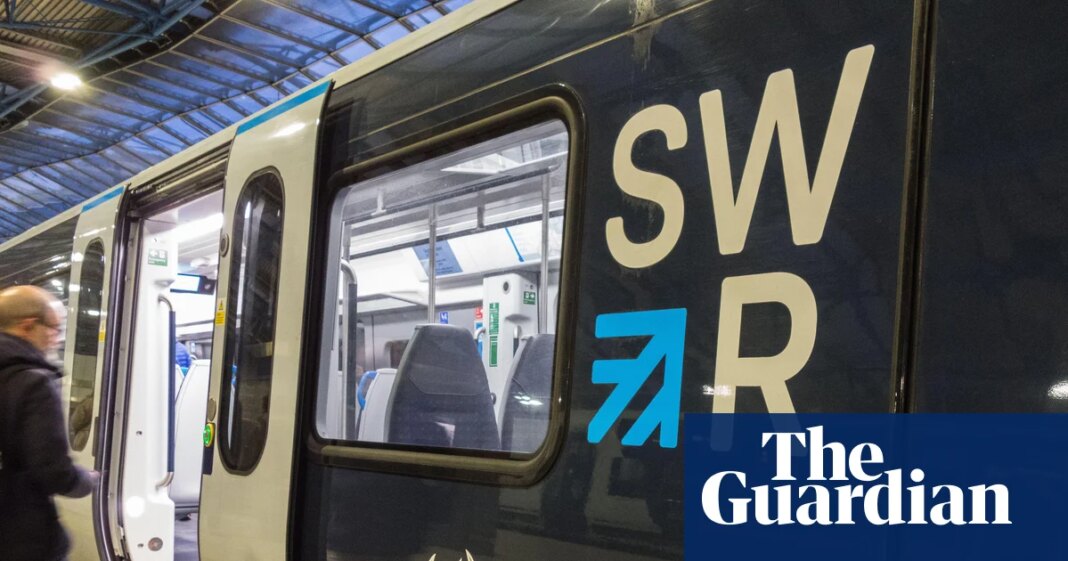
South Western Railway’s newest train, wrapped in union jack-inspired Great British Railways livery, may divide opinion on aesthetics, but the interior is certainly an upgrade: air-conditioned carriages, more space and greater passenger capacity.
For ministers, the fact that it is the 45th Arterio model brought into service since the SWR network was nationalised is vindication of the GBR approach.
As the first operator to be renationalised under Labour’s planned reforms, SWR has attracted some scrutiny. Ministers said its GBR badge was a right to be earned, only for punctuality to plunge amid a cascade of failures of tracks, trains and staffing.
However, exactly 12 months on, SWR has reached the threshold where half – and soon a majority – of the new £1bn fleet of 90 commuter trains is running after years of delay since the order was placed under the old privatised and fragmented system.
Speaking at the launch at London Waterloo, Peter Hendy, the rail minister, said the accelerated rollout since May 2025 showed the difference reforms were already making. A single managing director is responsible for both track and train and is “incentivised on running a decent service” rather than operating to the letter of a contract.
Nationalisation was “cutting red tape that held the railway back for decades”, Lord Hendy said. A variety of technical problems had delayed the introduction of the SWR trains. They were ordered in the last decade, with the first models built six years ago, but were largely languishing in the sidings as the last private operator, First Group, grappled with union objections and its contractual demands.
Only six were running when the state took direct control. “A year on, we’ve got half these new trains in service,” he said. “They’ve got more capacity – they’re 10 coaches, not eight – and they’re more reliable. The old ones have gone to a knacker’s yard.”
The managing director of SWR and Network Rail Wessex, Lawrence Bowman, has, Hendy said, “had to work really hard; he’s had to recruit more staff because the previous owners left it with insufficient drivers, and he’s on the road to recovery. It’s not there yet – but we’re going in the right direction.”
He admitted there remains “all sorts of things wrong, because the incentive on the previous owners was not the incentive to do things for passengers”.
He said that, at one point, 80% of the trains at Waterloo would run all day with the same driver and guard and now it is 8%. “To save a few drivers and a few hundred thousand quid, they crosslinked all of the staff rosters – so when it all goes wrong, quite often the train’s in the platform, the driver’s at Epsom and the guard’s at Staines. And the result is, when anything goes wrong, this place is wiped out.”
Hendy said work to restore SWR to full reliability would include getting more drivers in and revising rosters and timetables. “And that’s what public ownership’s going to do … attention is going to be paid to making the railway run better. Not what the contract gives you five bob for, but actually running it so that people can rely on it.”
He said that nationalised companies would still “have to run it as a business: it’s got income from taxpayers and it’s going to come from passengers and they want to see their money well spent. But if [Bowman] improves the reliability of the service, the revenue goes up.”
Bowman himself said that still involves major infrastructure upgrades, recruiting more staff and keeping customers better informed, and a new timetable. “We have a lot more to do, but we are making steady progress towards building a more reliable and resilient railway for the future,” he said.
Hendy said he also cares that the train still has South Western written on the side, “because that’s this part of GBR, and I want people to recognise that [Bowman] is the man in charge”.
Does that mean other brands will persist, when companies such as Avanti come under the GBR banner? “Avanti, we’re going to sell it for charities and see whether anybody wants it,” he jokes. “The Gerald Ratner of railways.”
The GBR train livery, drawn up on the cheap by ministers and advisers in the Department for Transport, has attracted attention – some incredulous. It was described by one insider as “more GB News than GBR”, while the architecture and design critic Cath Slessor said the “effortfully deconstructed livery looks like an explosion in a union jack factory – and not in a good way”.
Hendy remains unrepentant: “It is good design; it’s got the right lettering, Rail Alphabet 3, it’s got the double arrow. It’s in the right typeface. That’ll do me.
“The unity of the UK is quite an important concept. It was always going to be red, white and blue and I think it’s fine.”