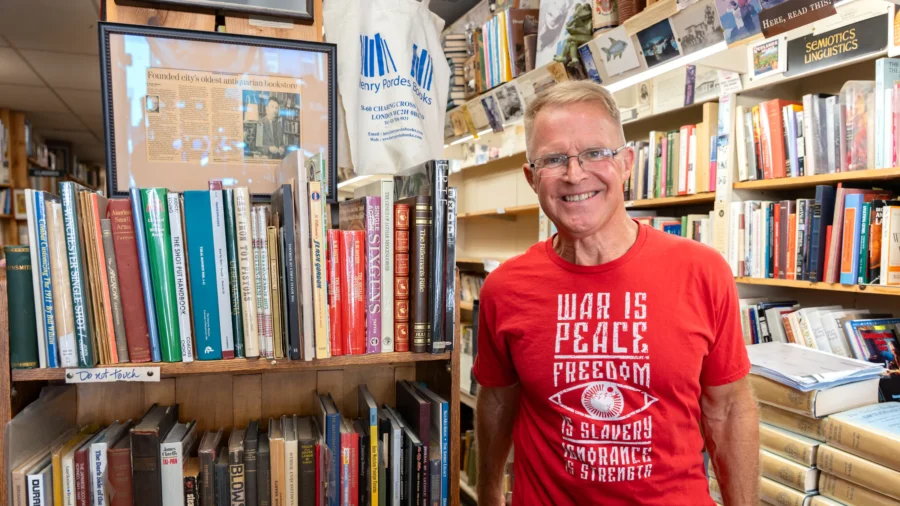
A Southern California used bookstore owner has turned away more than $5,000 in book orders in recent months after becoming concerned that the books could be purchased by intermediaries for artificial intelligence companies, scanned for AI training, and then destroyed.
“We started noticing larger orders from companies that typically gave us very little business,” Maxwell said. “And then finally, from companies we had never heard of before.”
He said that it was “extraordinary,” even “fishy,” for a small bookshop like his to take 50 to 60 orders a day from these companies. A larger used bookstore in Washington, with an inventory of nearly 1 million books, had received an order for 50,000 books, said Maxwell.
At first, Maxwell filled the orders, though he remained puzzled about why buyers would want so many books through resale markets rather than new copies.
He said the explanation came when he saw news coverage describing an internal memo in which Anthropic, the AI company behind the Claude chatbot, detailed a process of cutting the bindings off books to make them easier to scan, then discarding the books once digitized.
As book lovers, both Maxwell and his partner and assistant Christine decided that they would cut off sales to book brokers who order books for these AI companies immediately once they found out anything bad was happening to the books.
“So we threw on the brakes immediately and stopped selling to these companies,” Maxwell said.
The decision came with a financial cost, running up to over $5,000 in orders so far, and potentially more. He also said canceling orders could hurt his standing with online book marketplaces, which may require sellers to maintain a certain order-completion rate.
That said, Maxwell and his partner did it for “an essential reason.” He called it “one of the easiest decisions” he has ever made.
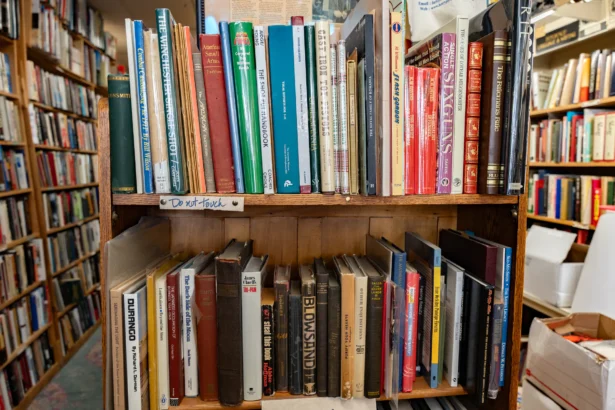
Maxwell’s House of Books, a bookstore in La Mesa, in southeastern San Diego County, Calif., on Aug. 27, 2026. Jane Yang/The Epoch Times
A Genuine Book Lover with ‘Biblio Gene’
He explained that no one comes into the used book business for money.
“You either go into the business because you’re crazy or because you love books and/or maybe a little of both.”
He said that he went into the business because he really loves books. “I couldn’t imagine being happy doing anything else. And I’ve been happy every day I’ve been here,” he said.
He said that he wanted to sell books to “avid collectors and readers.”
“I’m not interested in selling books to those who want to destroy them,” he said.
Maxwell said his store serves readers and collectors across a wide range of subjects, including mystery, science fiction, history, philosophy, mathematics, theology, political science, and poetry. It has a particular emphasis on scholarly and academic books and university press editions.
The store also carries first editions, signed books, fine bindings, and other collectible volumes.
His connection to the bookselling world goes back generations.
He said reading remains a family tradition. His parents and his sister are all readers. Reading is an old habit for the family, an “old-fashioned pastime,” and a “wonderful way to spend time.”
“I inherited the Biblio gene,” Maxwell said.
Maxwell was late for work on the day of the interview because he was lying on his bed reading a book.
“You lose yourself in another world when you read,” he said, “so that’s why you cannot tolerate the people [who] shred the books.”
A Broader Concern
For Maxwell, the financial loss from refusing the orders was ultimately secondary to preserving the books. He said the possibility that large numbers of physical books could be acquired, digitized, and destroyed raises concerns beyond the fate of individual copies.
“We’ve been reading about the kinds of people who do that in dystopian science fiction novels our whole lives,” he said, citing Fahrenheit 451 and the works of George Orwell, Aldous Huxley, and C.S. Lewis.
“I think many of us never imagined that we would actually wind up facing this kind of a threat at any point,” he said. “It’s a real thing now.”
Maxwell said he is particularly concerned about books that exist in limited physical numbers.
“If all of the physical copies are confiscated by them and destroyed, they will have sole control over the contents,” he said.
“If they do this to enough books and if they become the sole keeper of the contents of these things and have a paywall between interested readers and the content, you know, you can only imagine what that would mean for future generations. And they would also be able to manipulate the content in any way they want,” added Maxwell.
“It really, it really is horrific.”
Jane Yang contributed to this report.