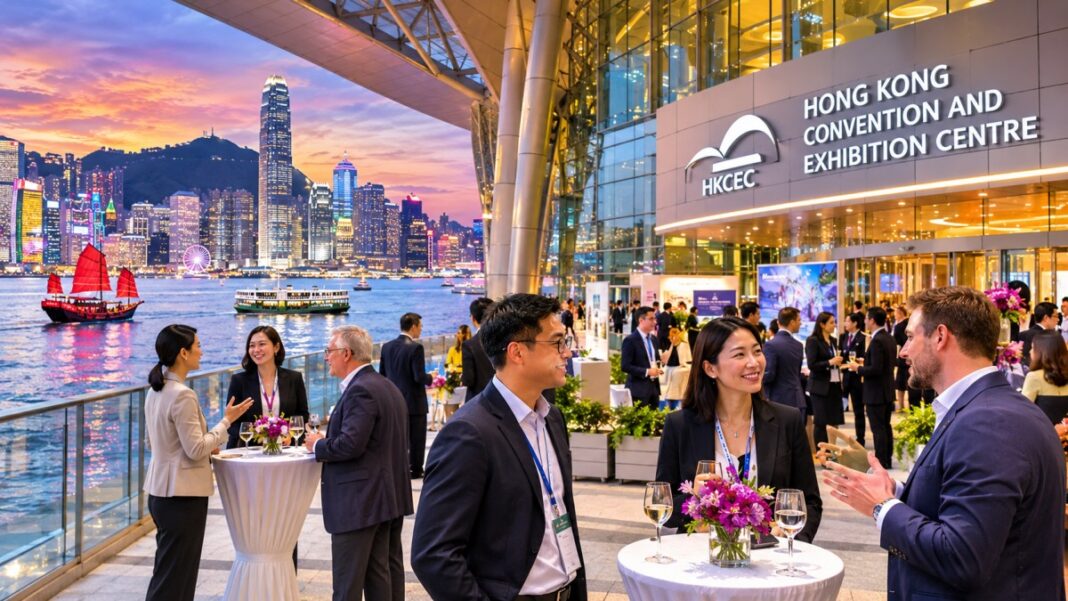

Hong Kong is strengthening its position as an international tourism, business events and entertainment destination through a new phase of high-value tourism development. On 8 November 2026, Financial Secretary Paul Chan outlined plans to attract more business travellers, major exhibitions, international conferences and leisure visitors through an expanding calendar of events and investment in world-class venues. The strategy follows reported year-on-year economic growth of 5.2 per cent in the third quarter, an 11.8 per cent rise in October visitor arrivals and improving retail and restaurant performance. Major infrastructure projects, including AsiaWorld-Expo Phase 2 and the Wan Chai North redevelopment, are intended to increase Hong Kong’s large-scale convention and exhibition capacity by more than 40 per cent, strengthening its ability to compete for international events.
Hong Kong’s High-Value Tourism Strategy Places International Events and Business Travel at the Centre of Growth
Hong Kong is pursuing a tourism development strategy that places greater emphasis on the economic value generated by visitors rather than relying exclusively on arrival numbers.
Financial Secretary Paul Chan described the approach in his official blog published on 8 November 2026.
The strategy combines major international events, convention and exhibition development, business travel, entertainment and improvements to tourism infrastructure.
Hong Kong already possesses important advantages as a business and leisure destination.
Its international airport connects the city with major markets, while its established financial services industry supports corporate travel and professional events.
Advertisement
Advertisement
The city also offers convention facilities, hotels, restaurants, retail districts and cultural attractions.
The government’s approach is to strengthen these assets while expanding the range and scale of events Hong Kong can host.
Advertisement
Advertisement
For tourism businesses, the strategy could support demand across several sectors.
International conferences generate requirements for accommodation, transport, meeting facilities and hospitality services.
Major concerts and sporting events can attract leisure visitors and create additional spending opportunities.
Exhibitions connect overseas businesses with commercial partners while bringing delegates into the city.
Advertisement
Advertisement
However, the economic benefits depend on actual visitor spending, event attendance and the proportion of activity generated by visitors rather than local residents.
The government has identified high-value tourism as a priority, but individual projects should be assessed through measurable results.
Hong Kong’s Economy Expands as Tourism, Retail and Hospitality Show Signs of Recovery
The tourism strategy is being developed against a backdrop of improving economic conditions.
In his November statement, Paul Chan highlighted several indicators showing stronger economic activity.
Hong Kong’s economy expanded by 5.2 per cent year on year during the third quarter of 2026.
Growth across the first nine months reached 5.1 per cent.
Advertisement
Advertisement
Chan described this as the fastest expansion for the corresponding nine-month period in five years.
The government also reported an 11.8 per cent year-on-year increase in visitor arrivals during October.
Retail sales rose 6.4 per cent in September, while restaurant receipts increased 3.1 per cent during the third quarter.
These indicators suggest that tourism-related consumption is improving alongside wider economic activity.
However, each statistic measures a different part of the economy.
Gross domestic product reflects overall economic output.
Advertisement
Advertisement
Visitor arrivals measure inbound travel volumes.
Retail sales measure goods sold through retail businesses.
Restaurant receipts provide information about food-service revenue.
The figures should therefore not be treated as interchangeable measures of tourism performance.
Nevertheless, their simultaneous improvement provides useful context for the government’s decision to strengthen tourism and events development.
Hong Kong’s Key Economic and Tourism Indicators in 2026
| Indicator | Reported result | Reference period |
|---|---|---|
| Real GDP growth | +5.2% year on year | Third quarter 2026 |
| Real GDP growth | +5.1% year on year | January–September 2026 |
| Visitor arrival growth | +11.8% year on year | October 2026 |
| Retail sales growth | +6.4% year on year | September 2026 |
| Restaurant receipts growth | +3.1% year on year | Third quarter 2026 |
| Planned large-scale convention capacity expansion | More than 40% | Future development programme |
| AsiaWorld-Expo Phase 2 scheduled completion | 2028 | Announced timetable |
Source: Financial Secretary Paul Chan’s statement of 8 November 2026, as reproduced in the supplied report. Historical growth figures are distinguished from announced future infrastructure plans.
Advertisement
Advertisement
The data indicates that Hong Kong’s economy has gained momentum.
The next challenge is converting that momentum into sustained visitor expenditure and international competitiveness.
Hong Kong’s Tourism Arrivals Reach 40.7 Million as Government Targets Higher-Value Overnight Visitors
Hong Kong’s tourism performance provides a strong foundation for its high-value visitor strategy.
At its meeting on 2 November 2026, the government’s Tourism Strategy Committee confirmed that Hong Kong welcomed approximately 40.7 million visitors during the first nine months of the year.
This represented growth of 12 per cent compared with the corresponding period in 2025.
August was particularly strong, with approximately 5.46 million arrivals, setting a new post-pandemic monthly record.
Advertisement
Advertisement
The government has projected 53.8 million visitor arrivals for the full year, representing approximately eight per cent growth over 2025.
It also expects total tourism expenditure associated with inbound visitors to reach HK$238.1 billion, approximately ten per cent higher than the previous year.
These are official projections, not completed annual results. Government Information Centre
The figures demonstrate why Hong Kong is increasingly concentrating on the economic contribution of tourism.
A visitor who stays overnight may require hotel accommodation, meals and additional services.
A conference delegate may also spend money on local transport, business hospitality and leisure activities.
Advertisement
Advertisement
However, visitor spending varies considerably. An overnight stay does not automatically guarantee higher expenditure than every same-day visit.
Hong Kong’s objective is to attract more visitors who contribute meaningfully to its hospitality, retail, entertainment and professional services industries.
The Tourism Strategy Committee has specifically identified the development of distinctive, high-quality tourism products and stronger multi-destination travel opportunities as priorities.
AsiaWorld-Expo Phase 2 Will Transform Hong Kong’s International Events Infrastructure by 2028
One of the most important infrastructure developments supporting Hong Kong’s tourism ambitions is the expansion of AsiaWorld-Expo.
The project forms part of the wider SKYTOPIA development associated with Hong Kong International Airport.
According to AsiaWorld-Expo’s official project information, Phase 2 is targeted for completion by the end of 2028.
Advertisement
Advertisement
The expansion will increase the venue’s total exhibition space from approximately 70,000 square metres to 100,000 square metres.
This represents an increase of approximately 42.9 per cent for AsiaWorld-Expo itself.
The project will also introduce a major multipurpose indoor arena designed to accommodate more than 20,000 spectators.
The arena is intended to support international concerts, sporting competitions, entertainment productions and other large-scale events.
Its planned facilities include flexible staging configurations, professional audiovisual systems and premium hospitality areas.
The venue is also expected to feature 30 VIP suites.
Advertisement
Advertisement
These features are relevant to high-value tourism because major international events require infrastructure capable of supporting different audience sizes and commercial arrangements. AsiaWorld-Expo
AsiaWorld-Expo Phase 2 Development Details
| Feature | Official development plan |
|---|---|
| Location | Hong Kong International Airport area |
| Development | AsiaWorld-Expo Phase 2 |
| Scheduled completion | End of 2028 |
| Existing exhibition space | Approximately 70,000 sq m |
| Planned total exhibition space | Approximately 100,000 sq m |
| New indoor arena capacity | More than 20,000 spectators |
| Premium hospitality | 30 VIP suites |
| Wider development | SKYTOPIA Airport City |
These are announced plans. The additional facilities are not yet operational.
The project’s importance extends beyond its physical size.
Its location near Hong Kong International Airport could support the organisation of international events involving overseas delegates, exhibitors and performers.
Airport-area facilities can be particularly useful for events requiring international logistics and large numbers of arriving visitors.
However, the commercial success of the expansion will depend on the events secured, attendance and the ability to generate sustainable revenue.
Advertisement
Advertisement
Wan Chai North Redevelopment Will Support Hong Kong’s Convention and Exhibition Ambitions
Hong Kong’s convention and exhibition strategy also includes redevelopment in Wan Chai North.
The area is already associated with the Hong Kong Convention and Exhibition Centre, one of the city’s major business events venues.
The planned redevelopment is intended to strengthen Hong Kong’s ability to accommodate international conventions and exhibitions.
In his November statement, Financial Secretary Paul Chan linked the Wan Chai North project with AsiaWorld-Expo’s expansion.
He indicated that the developments would increase Hong Kong’s large-scale convention and exhibition capacity by more than 40 per cent.
That figure represents an announced development objective and should not be interpreted as capacity already available to event organisers.
Advertisement
Advertisement
The two projects serve complementary purposes.
AsiaWorld-Expo is positioned within the airport-area development.
Wan Chai offers an established urban business location with access to hotels, commercial districts and visitor services.
Together, the developments could provide organisers with a wider range of venue options.
For international associations and businesses, suitable venue capacity is an important factor when selecting a host destination.
However, infrastructure alone does not guarantee additional events.
Advertisement
Advertisement
Hong Kong will also need to remain competitive in venue pricing, accommodation, transport, professional services and event organisation.
Why International Conferences and Exhibitions Matter for Hong Kong’s Tourism Economy
The meetings, incentives, conventions and exhibitions industry, commonly known as MICE, forms an important part of Hong Kong’s high-value tourism strategy.
Business events differ from ordinary leisure travel because visitors often travel for professional reasons.
International conferences bring together delegates, speakers, organisers and service providers.
Trade exhibitions connect businesses with buyers, suppliers and commercial partners.
Corporate incentive travel combines professional objectives with destination experiences.
Advertisement
Advertisement
These activities can generate demand across several parts of the local economy.
Hotels provide accommodation and meeting facilities.
Restaurants and catering companies support delegates and event functions.
Transport providers connect airports, venues and commercial districts.
Event production companies supply technical equipment, staging and logistics.
Retailers and attractions may also benefit when delegates extend their stays or explore the city outside scheduled events.
Advertisement
Advertisement
However, the economic contribution of a conference depends on the number of visiting delegates, their spending and the proportion of expenditure retained locally.
This makes reliable event-performance data important.
For Hong Kong, expanding convention infrastructure is a long-term investment intended to improve its ability to compete for international business events.
Hong Kong’s Retail Sales Growth Signals Stronger Consumer Activity
Retail performance is another important element of Hong Kong’s visitor economy.
Official figures released by the Census and Statistics Department on 3 November 2026 show that retail sales reached a provisional HK$33.4 billion in September.
This represented year-on-year growth of 6.4 per cent.
Advertisement
Advertisement
The value of retail sales increased by 8.3 per cent during the first nine months of 2026 compared with the same period in 2025.
Online retail sales also expanded.
They accounted for 13.1 per cent of September retail sales value, reaching approximately HK$4.4 billion.
The government identified stronger local consumption and increased visitor activity among the factors supporting retail performance. Government Information Centre
For tourism, retail activity is relevant because shopping remains part of many visitor itineraries.
International travellers may purchase fashion, electronics, cosmetics, gifts and other products during their stays.
Advertisement
Advertisement
However, the September increase cannot be attributed entirely to tourists.
Retail sales include purchases by local residents.
The figures therefore provide evidence of stronger consumer activity, rather than a direct measurement of tourist shopping expenditure.
Hong Kong’s Restaurant Industry Benefits from Improving Economic Conditions
Hong Kong’s restaurant sector also recorded stronger revenue during the third quarter of 2026.
Official provisional statistics show that total restaurant receipts reached approximately HK$27.5 billion.
This represented growth of 3.1 per cent compared with the third quarter of 2025.
Advertisement
Advertisement
After adjusting for price changes, the volume of restaurant receipts increased by 2.1 per cent.
Non-Chinese restaurants recorded a 7.1 per cent increase in receipts value, while Chinese restaurants recorded growth of 1.2 per cent.
These results indicate improving activity across parts of the food-service industry. Government Information Centre
The restaurant sector is particularly relevant to Hong Kong’s high-value tourism ambitions.
Dining experiences form an important part of leisure holidays, business entertainment and convention programmes.
International delegates may also use restaurants for meetings, corporate hospitality and networking.
Advertisement
Advertisement
However, restaurant revenue reflects spending by both residents and visitors.
The increase therefore supports the broader picture of improving economic conditions but does not independently establish the financial contribution of mega events.
Hong Kong WinterFest and Clockenflap Strengthen the Year-End Tourism Calendar
Hong Kong’s final months of 2026 include a programme of festive entertainment, music, sports and cultural activities.
Financial Secretary Paul Chan identified Hong Kong WinterFest and Clockenflap among the events expected to contribute to the city’s year-end tourism activity.
WinterFest is associated with the city’s Christmas celebrations and seasonal visitor experiences.
Clockenflap is an established international music and arts festival.
Advertisement
Advertisement
Both events appeal to different visitor interests.
Festive attractions can encourage leisure travel, while music festivals can attract audiences interested in entertainment and contemporary culture.
Hong Kong’s event strategy also includes concerts and sporting activities at Kai Tak Sports Park.
The venue provides infrastructure for major entertainment and sporting programmes.
For tourism businesses, these events can create opportunities to attract visitors who combine attendance with hotel stays, dining and sightseeing.
However, event-specific attendance figures and economic contributions should only be reported when confirmed by organisers or government agencies.
Advertisement
Advertisement
The existence of a major event does not automatically establish its impact on international visitor numbers.
Kai Tak Sports Park Adds Another Dimension to Hong Kong’s Mega-Event Tourism Strategy
Kai Tak Sports Park is an important part of Hong Kong’s efforts to develop its sports and entertainment economy.
The complex provides facilities for major sporting competitions, concerts and other events.
Its development has expanded Hong Kong’s ability to host large audiences.
This supports the government’s wider objective of integrating culture, sports and tourism.
Major sporting events can attract visitors with specific interests, while concerts provide opportunities to reach international entertainment audiences.
Advertisement
Advertisement
These visitors may also participate in other tourism activities during their stays.
For example, an overseas concertgoer may combine an event with shopping, dining and sightseeing.
However, such spending should be treated as a potential benefit rather than a guaranteed outcome.
Event organisers, tourism authorities and hospitality businesses need to assess actual visitor behaviour to determine the economic contribution of individual programmes.
The government’s strategy is to strengthen the connections between these sectors.
Hong Kong’s Multi-Destination Tourism Strategy Could Support Wider Regional Travel
Hong Kong is also exploring ways to strengthen multi-destination tourism involving Mainland Chinese cities.
Advertisement
Advertisement
The Tourism Strategy Committee discussed this approach during its meeting on 2 November 2026.
The objective is to encourage international visitors to consider Hong Kong as part of a broader regional itinerary.
The government has identified opportunities to develop distinctive tourism products and strengthen cooperation with neighbouring destinations.
This approach is relevant because Hong Kong’s transport connectivity provides access to several important markets.
However, travellers should not assume that entry requirements are identical across destinations.
Hong Kong and Mainland China operate different immigration arrangements.
Advertisement
Advertisement
Visitors planning multi-destination holidays must check the requirements applicable to their nationality and itinerary.
The development of multi-destination tourism could create opportunities for tour operators and hospitality businesses, but its success will depend on practical transport arrangements, travel policies and consumer demand.
Why This Matters
Hong Kong’s high-value tourism strategy matters because it represents a broader approach to tourism development.
The government is seeking to increase the economic contribution of visitors through business events, entertainment, hospitality and improved infrastructure.
The strategy is supported by strong recent arrival figures and improving economic indicators.
However, higher visitor numbers do not automatically guarantee greater spending per traveller.
Advertisement
Advertisement
For tourists, an expanding event calendar provides more reasons to consider Hong Kong for leisure and entertainment.
For business travellers, planned convention infrastructure could increase future venue options.
For hotels, restaurants and transport operators, stronger event activity may support demand.
The strategy also has long-term implications.
AsiaWorld-Expo Phase 2 is scheduled for completion in 2028, meaning some of the planned capacity benefits remain several years away.
Hong Kong’s success will depend on its ability to convert infrastructure investment and event promotion into sustained visitor spending and internationally competitive services.
Advertisement
Advertisement
What Travellers Should Know
Travellers considering Hong Kong during the final months of 2026 should distinguish between events currently scheduled and infrastructure projects planned for future completion.
The city is promoting a range of festive, cultural, entertainment and business activities.
However, individual events may have different admission arrangements, ticket prices and booking requirements.
Before Booking
- Entry requirements: Check the Hong Kong Immigration Department’s requirements for your nationality.
- Event dates: Confirm schedules through official organisers before making travel arrangements.
- Tickets: Review admission conditions, availability and refund policies.
- Accommodation: Consider the location of hotels relative to event venues.
- Transport: Check official MTR, airport and venue transport information.
- Business events: Confirm registration requirements and professional eligibility.
- Multi-destination travel: Review separate entry requirements for Hong Kong and Mainland China.
- Future venues: AsiaWorld-Expo Phase 2 is planned for 2028 and should not be treated as an operational facility in 2026.
Travellers should also allow sufficient time when moving between airport-area venues, central business districts and major entertainment facilities.
Frequently Asked Questions
What is Hong Kong’s high-value tourism strategy?
Hong Kong is seeking to attract visitors who contribute more to the local economy through overnight stays, business events, exhibitions, entertainment, shopping and hospitality services.
How many tourists visited Hong Kong in 2026?
Official figures show approximately 40.7 million visitor arrivals during the first nine months of 2026. The government projects 53.8 million arrivals for the full year, but that remains a forecast.
Advertisement
Advertisement
When will AsiaWorld-Expo Phase 2 open?
Construction is targeted for completion by the end of 2028. The project will include additional exhibition space and an indoor arena designed for more than 20,000 spectators.
Which events are supporting Hong Kong’s year-end tourism campaign?
The government’s announced programme includes Hong Kong WinterFest, Clockenflap, international sporting events and concerts at Kai Tak Sports Park. Travellers should verify individual schedules with organisers.
How will the convention expansion benefit international travellers?
The planned expansion could provide more options for international conferences, exhibitions, concerts and sporting events. However, additional facilities will only become available after the relevant projects are completed.
Hong Kong’s Tourism Outlook Points Towards a More Events-Driven Visitor Economy
Hong Kong’s tourism development strategy is entering a significant period as the government combines improving economic conditions with major investment in events infrastructure.
The latest official figures show strong visitor growth, rising retail sales and improving restaurant receipts.
The government’s full-year tourism projections also indicate expectations of continued international demand.
Advertisement
Advertisement
At the same time, planned projects such as AsiaWorld-Expo Phase 2 and the Wan Chai North redevelopment demonstrate a longer-term commitment to convention and exhibition development.
These investments are intended to strengthen Hong Kong’s position in international business events and entertainment.
However, their future economic contribution remains dependent on successful completion, event bookings and actual visitor expenditure.
For travellers, the immediate attraction is Hong Kong’s expanding programme of festivals, concerts, sporting activities and cultural experiences.
For the tourism industry, the larger opportunity lies in combining those experiences with business travel, hospitality and regional connectivity.
Hong Kong’s next phase of tourism growth will be measured not only by how many visitors arrive, but also by how effectively its events, venues and visitor experiences contribute to the wider economy.