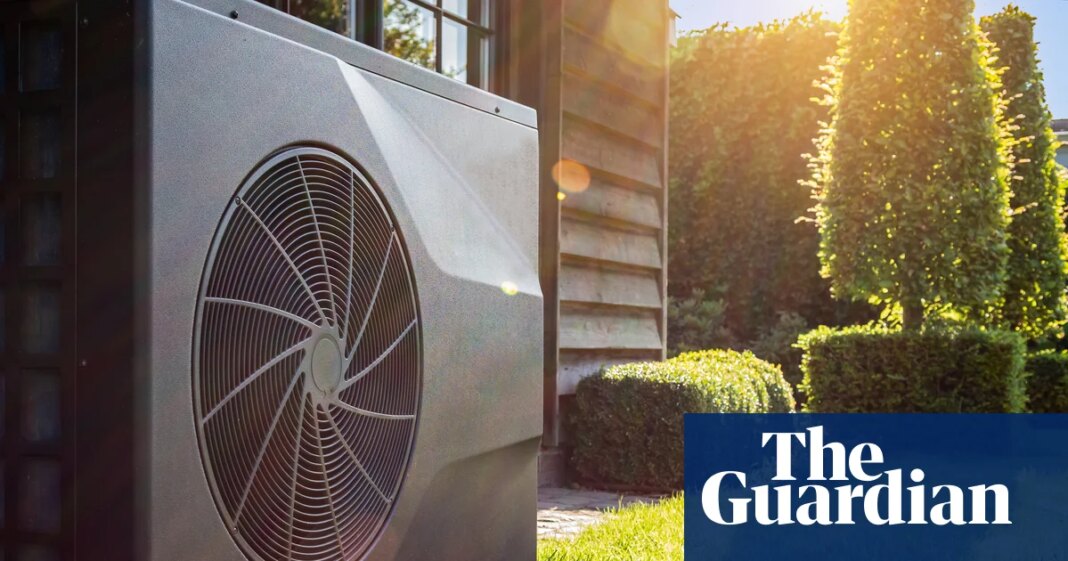
“If it is 35C outdoors, I can get the temperature down to 21C,” says Andrew Ingram of the sanctuary that his living room has provided this summer.
“On the nights I’ve slept in there, you have to put your thick pyjamas on,” jokes Ingram, who lives in Maidenhead, Berkshire, with his wife, Sue.
“When I post on Facebook about it, people say: ‘That’s air conditioning’ and I say: ‘No, it’s the heat pump.’ It’s just working the other way around.”
Rather than generating heat from burning fuel, a heat pump transfers heat energy from one place to another. However, despite the name, heat pumps can be used for cooling, too.
The energy is released through an “emitter” such as a radiator or underfloor heating. The Ingrams have an air source heat pump. It extracts heat from the air outside and uses it to warm the radiators of their three-bedroom house (this is called an air-to-water system).
In 2023, when the Ingrams ripped out their gas boiler, the firm suggested they consider whether they wanted to cool any rooms.
“We thought about it because the sitting room gets really hot, and that’s the room we spend time in,” Ingram says.
“It’s been a revelation. We bought it on the basis that there might be a heatwave, and it’s been an absolute lifeline this year.
“You know those times when you are really feeling exhausted and want to sit somewhere cool. We turn it right down and then let the temperature drift back up again.”
The couple have radiators throughout but the living room also has another “emitter” – called a fan coil unit. This is an appliance that blows air over hot or cold pipes. The whole new home energy system cost roughly £18,600, with the cooling aspect accounting for £1,700 of that.
“If you’re pumping cool water around a property, it’s a bit like putting cool beer in a glass on a warm day,” says Ingram of what is potentially one of the pitfalls of cooling this way.
“You get loads of condensation, so you either have to wrap pipes in quite sophisticated trunking or do what we did, which is have them outside.
“We used the cooling a bit in 2024, and, guess what, in 2025 even more – and in 2026 we’ve been a rather popular place for people to visit.”
The government’s boiler upgrade scheme offers grants of £7,500 to assist homeowners in England and Wales with the cost of installing an air-to-water or ground-to-water system (a heat pump that extracts heat from the ground through buried pipes).
Households not connected to the gas grid qualify for an additional £1,500 in support, increasing the grant to £9,000.
If you live in Scotland, you may be able to get an interest-free loan or a grant to make your home more energy efficient.
To qualify for funding, the heat pump must be certified through the Microgeneration Certification Scheme, which certifies installers.
Previously heat pumps that also cooled required planning permission, as the permitted development rights rules (legal permissions that allow certain home improvements without a planning application) stated they had to be solely for heating. The PDR has now been updated to allow cooling.
To date, Britons have mostly installed air-to-water systems, and of the UK’s 358,000 heat pumps, approximately 323,000 are this type, according to MCS data.
This could be about to change because the government is to offer £2,500 grants for air conditioning units that can heat and cool. The air-to-air heat pumps move heat using wall-mounted fans and cost about £4,500 to fit in a flat or small house. (Air-to-water heat pumps typically cost in the region of £12,000.)
The run of heatwaves has thrown the spotlight on “heat-trap homes”. A recent report by the Climate Change Committee said that hotter heatwaves could lead to 92% of existing homes overheating by 2050 and they may require air conditioning, as passive measures such as drawing curtains and opening windows are unlikely to be enough.
A recent study conducted in the Energy House 2.0 – a £16m climate-controlled chamber at the University of Salford – found that using a heat pump for cooling can “significantly reduce overheating” in modern homes.
Two new modern houses have been built inside the weather simulation facility so that scientists can test how “real” homes perform under extreme conditions.
The Salford scientists paired a heat pump with fan coils in one of the houses. When the lab weather was 32C, the rooms stayed comfortable – between 19C and 24.9C. With the heat pump running around the clock, the cost was £2.50-£3 a day.
Prof Lubo Jankovic, the scientist leading the research, says the results “demonstrate that reversible heat pumps can play an important role in protecting future homes against overheating”.
But Jankovic says the challenge of designing systems with both heating and cooling in mind “needs to be addressed before cooling this way becomes mainstream”.
With the October price cap predicted to exceed £1,700 a year for a typical dual fuel bill, the big question for many is: will a heat pump save me money?
A recent poll by the consumer group Which? revealed growing consumer interest in heat pumps, but also that they were a “high-stakes gamble” owing to their unfamiliarity, high upfront costs and uncertain impact on bills.
One way to get a better understanding is to look round a home with one and quiz the owner. The charity Nesta runs the “visit a heat pump” scheme, which offers tours of more than 1,200 homes, including the Ingrams’.
When it comes to bills, the Energy Saving Trust says the biggest saving comes in homes that switch to a dedicated heat pump energy tariff and add other green technologies such as solar panels.
The tariff is vital because heat pumps run on electricity, which is generally more expensive per unit than gas. On a standard tariff, this can lead to substantial energy bills, negating some of the efficiency benefits.
Heat pump users moving on to a time-of-use tariff can save about £330 a year compared with sitting on a flat-rate tariff, the trust says. This rises to about £800 with extras such as solar, although these add to the upfront costs.
The Ingrams have solar panels and a home battery to help keep their bills down. “There’s lots of juice in the batteries from the solar,” Ingram says. “The batteries charge up overnight if they’re not full, but they have been recently. So if you want to run the pump, it is running on free or very cheap electricity.”