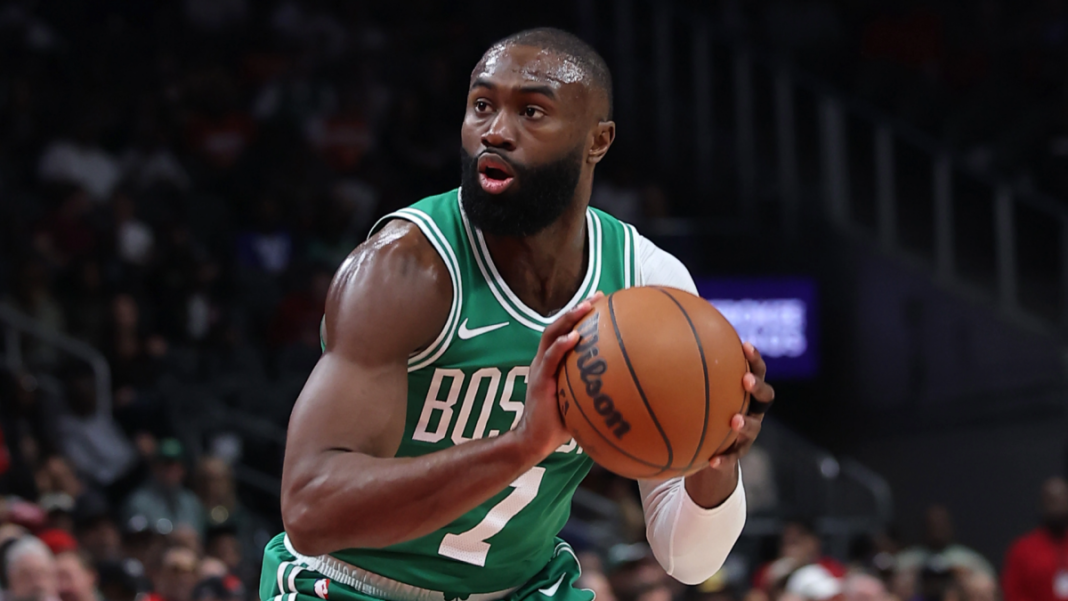
The Boston Celtics are trading Jaylen Brown to the Philadelphia 76ers in exchange for Paul George, two first-round picks (2028 and 2031) and two second-round picks (2028 and 2030), according to ESPN. The 2028 first-rounder could convert from a first to a pick swap that is more favorable to the Celtics, while the 2031 pick is unprotected.
The stunning deal marks the end of Brown’s enormously successful 10-season run in Boston. The No. 3 overall pick in the 2016 NBA Draft made five All-Star teams with the Celtics. He averaged at least 20 points for seven consecutive seasons, took the Celtics to the Eastern Conference Finals six times, the NBA Finals twice, and won Finals MVP as Boston won its 18th NBA championship in 2024. Now, he will continue his career in a rival city alongside a core of Joel Embiid, Tyrese Maxey and VJ Edgecombe.
Brown played alongside Jayson Tatum since Boston drafted the latter in 2017, but rumors about the Celtics splitting up the pair were common for much of their run together. The Celtics were linked to superstars like Anthony Davis and Kevin Durant over the years, but never pulled the trigger on a trade for Brown during his joint ascent with Tatum. The Celtics were rewarded for that faith with the 2024 title, but things slowly broke down from there.
Tatum tore his Achilles during Boston’s title defense in 2025, and he missed most of the 2025-26 season. With Tatum sidelined, Brown had the best statistical season of his career in leading the Celtics to 56 wins, but Boston blew a 3-1 lead and lost Game 7 of its first-round series against the 76ers with Tatum out. That series exposed holes in Boston’s roster that would be hard to address with both Tatum and Brown earning supermax salaries in this enormously restrictive CBA environment.
Brown responded by venting on Twitch after the Celtics were eliminated, claiming the NBA had an agenda against him. Perhaps just as notably, he called this season his “favorite year” of his basketball career rather than the 2024 title season. The Celtics, meanwhile, spent most of June negotiating a trade of Brown to the Milwaukee Bucks for Giannis Antetokounmpo. When Antetokounmpo was ultimately dealt to the Miami Heat, Boston elected to move on from Brown anyway, sending him to Philadelphia in a shocker.
For much of the past two years, Philadelphia’s destiny was tied to two aging and injury-prone players. George has played just 78 regular-season games over two seasons with the 76ers, and he is entering his age-36 season. Coupled with the frequent absences of Embiid, Philadelphia appeared to be stuck with two supermax contracts that were aging badly.
But George, following a 25-game suspension, returned to finish out the season strong. He averaged an efficient 17.4 points per game in the playoff series win over the Celtics, and now, he’s headed to Boston to serve as their Brown replacement. With Brown only 29 years old, the 76ers have improved at the forward spot with a player six years younger than the one that they sent out.
Now, if Embiid can only stay healthy, the 76ers have a real path to genuine championship contention in a crowded Eastern Conference. Let’s grade the trade.

Philadelphia 76ers: A+
Landing Brown while moving off George’s contract? An outright steal
When I ranked the worst contracts in the NBA in March, George, making supermax money ($54.1 million) for the next two seasons, ranked No. 5. At the time, that was a fairly common sentiment. He was out at that point due to a 25-game PED suspension, but even before that, he was inefficiently averaging a pretty modest 16.2 points per game and had far less defensive impact than at his peak. A good player, but a severely overpaid one whose 36th birthday was looming. The assumption was that Philadelphia would have to attach draft capital to move off of his contract.
What changed after that? He returned from that suspension and played 10 nearly star-level regular-season games. He was fantastic in the playoffs, making nearly half of his 3-pointers and turning back the defensive clock against the Celtics. Essentially, in 21 games, George went from immovable to the only player involved in a trade for Brown. For a brief, fleeting moment, another team considered George to be a positive-value asset, or at least not so overwhelmingly negative that he would impede a trade like this. Was it just shooting variance? Did the 25-game rest revive him? It just seems hard to imagine that a 36-year-old could turn the clock back like that in any sort of permanent way.
Brown is coming off a Second-Team All-NBA season. There is a credible reason to believe that the season was fool’s gold. Brown shot just under 51% on mid-range shots and just under 71% on restricted area shots from October through December. That’s around the point at which some people tried to nudge him into an MVP conversation he really never should have been a part of. After Jan. 1, he fell back down to earth, falling to around 41% on mid-range jumpers and 69% in the restricted area. He is not, in fact, a Kevin Durant-level individual scorer. But the 76ers did not pay a Durant-level price.


Any concerns about analytics, about unsustainable shooting, lackadaisical off-ball defense or years of on-off data suggesting the Celtics were just fine without Brown, fly out the window at this price. Two first-round picks. Two good first-round picks, to be fair, especially the 2028 pick that will reportedly be the better of the 76ers’ or the Los Angeles Clippers’ selections. But two picks nonetheless. That’s all it took for Philadelphia to turn an inferior, 36-year-old small forward into a superior one going into his age-30 season.
So Brown isn’t really a Second-Team All-NBA player. Who cares? He won’t need to be in Philadelphia. For all of these years, we’ve talked about the possibility of Brown getting traded so he could lead his own team. On the 76ers, there will be nights in which he’s the leading scorer and there will be nights in which he finishes fourth. To get a reliable, in-his-prime All-Star for two picks and what we’ve been treating as one of the NBA’s worst contracts is an outright steal. Brown has never missed more than 19 games in a season. George has missed more time in six of the past seven.
That youth and durability change a lot for Philadelphia. With Brown, Maxey and Edgecombe, the 76ers have so much shot creation that they can afford to be as cautious as humanly possible with Embiid. The name of the game, as we saw in the Boston series, is getting him into the playoffs healthy and then through the playoffs in one piece. He swung the series that we can now say broke up the Celtics. His workload has never been lighter than it is now.
Brown is eligible to extend with Philadelphia. Even if he tacks on the maximum two years, his deal will still expire after his age-34 season. George’s tenure in Philadelphia began in his age-34 season. That’s how substantial the age gap here is. Brown should remain a productive player for a long time, but even as he starts to slip, the younger Edgecombe is in place to grow into a bigger role. Edgecombe, who turns 21 this month, won’t be paid market value for three more years, and Embiid’s contract expires at that point. Philadelphia should be able to keep this group together at least that long, and potentially longer.
There are definite questions on the roster. The signing of Dean Wade addressed on-ball defense, and Brown will to some extent as well, but they’re still lacking on that end of the floor. The mere fact of paying Brown, Embiid and Maxey the max makes paying role players nearly impossible. The sixth-highest paid 76ers player right now is No. 22 overall pick Labaron Philon. They still have work to do.
But we can’t overthink this one. Two first-round picks should not be able to turn a bad contract into an All-NBA six years his junior. No matter what concerns you might have about Brown, he is a substantial upgrade on George. This is among the biggest trade no-brainers in recent history.

Boston Celtics: D-
A baffling move for Boston on multiple levels
Unless you’re treating George as a genuinely positive trade asset, Walker Kessler got traded for more than Brown on Wednesday. The Utah Jazz, at least, managed to extract two first-round swaps from the Los Angeles Lakers. The Celtics couldn’t even do that much with the 76ers.
It’s not even clear that they got Philadelphia’s best available draft pick. That 2028 selection headed to Boston, reportedly the more favorable of the 76ers and Clippers, is great on paper. That’s especially true in the lottery reform era, where any pick has a chance to wildly outperform expectations. But the 2028 NBA Draft is regarded as relatively weak at this point. There’s a reason so many teams trading big-name players this offseason are targeting picks deep in the 2030s. Not only are the next few drafts considered underwhelming, but the new lottery reform rules expire after 2029, so there’s value in the uncertainty that will follow. Boston got one such pick in 2031. It did not get Philadelphia’s 2033 selection, arguably the best of the bunch for an executive with the sort of job security Brad Stevens has.


The theory of trading Brown in the first place, unless there was unresolvable tension behind the scenes, seemingly related to his contract. Both he and Tatum are making supermax money. Having two players make 35% of the salary cap every year puts an almost impossible strain on your depth. When the Celtics pursued Antetokounmpo, part of the idea was that a 35% max salary was justifiable for an MVP candidate who provided the exact rim-pressuring skills their team was lacking. George is not an MVP candidate. He does not have the exact skill set the Celtics were lacking. He is also making supermax money, just on a contract that is one year shorter.
Brown’s value can’t have fallen that far, could it? And if so, were there not better offers out there? The Cleveland Cavaliers are trying to convince LeBron James to return for a minimum salary right now. Cleveland could’ve offered similar draft compensation, but with Jarrett Allen attached to solve Boston’s center problem. Reports have suggested that neither the Houston Rockets nor Charlotte Hornets, both coached by former members of Boston’s staff, were interested in Brown. They are both so asset-rich that either could have topped this price without really disturbing their long-term plans.
Is there a follow-up move that makes this make sense? The Celtics still have a $27.7 million trade exception, but after signing Mitchell Robinson, they don’t have the first-apron hard cap flexibility they’ll need to take advantage of it without moving off more salary. Two first-round picks are valuable trade chips, but the Celtics still control most of their own picks moving forward. If they’re planning to shoot for, say, Trey Murphy III, you’d figure they already had the draft capital to get him. Maybe they’re planning to spend their own picks elsewhere and just didn’t want to leave themselves completely bankrupt in terms of remaining draft capital? Maybe the situation behind closed doors was just bad enough that they had to take what they could get? We may never know.
But on paper, the easiest comparison here is the disastrous Luka Dončić trade the Dallas Mavericks made in 2025. The Celtics traded the better and younger player for an older, worse one, with minimal draft capital attached. Brown is not as valuable as Dončić, but the same six-year age gap applies. The Celtics did not get meaningfully cheaper in the deal. They didn’t even steal a Max Christie-esque role player.
Every fiber of my being wants to give this trade an “F.” It is, by all reasonable logic, an “F” trade. But the Celtics have been so undeniably competent for so many years that I have to believe there is more to this trade than we currently appreciate. We’re talking about a team that won a championship with Brown two summers ago. They’ve made six Eastern Conference Finals since drafting Brown and won 56 games with him leading the team a season ago.
Whether there were interpersonal dynamics we don’t understand, the market was truly this barren, or if there’s another move coming that makes a bit more sense of the situation, the Celtics have earned just enough benefit of the doubt to believe there’s a better explanation for this trade than we see in this moment.
But on paper, this is a catastrophe.
The Celtics got older and worse without getting meaningfully cheaper or overwhelmingly richer in draft capital. A Brown trade made sense if it was going to net Antetokounmpo or a picks-and-depth bonanza. But at this price point, it’s just hard to justify giving Brown away rather than simply keeping him.