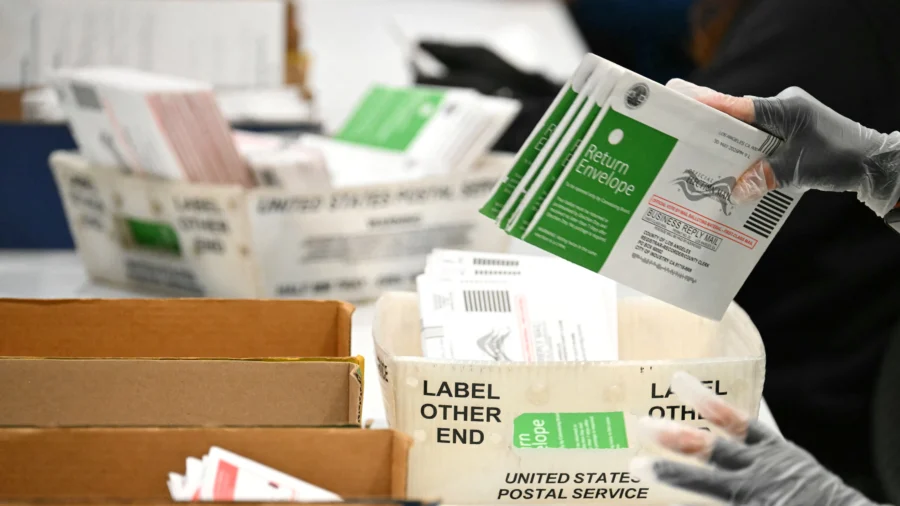
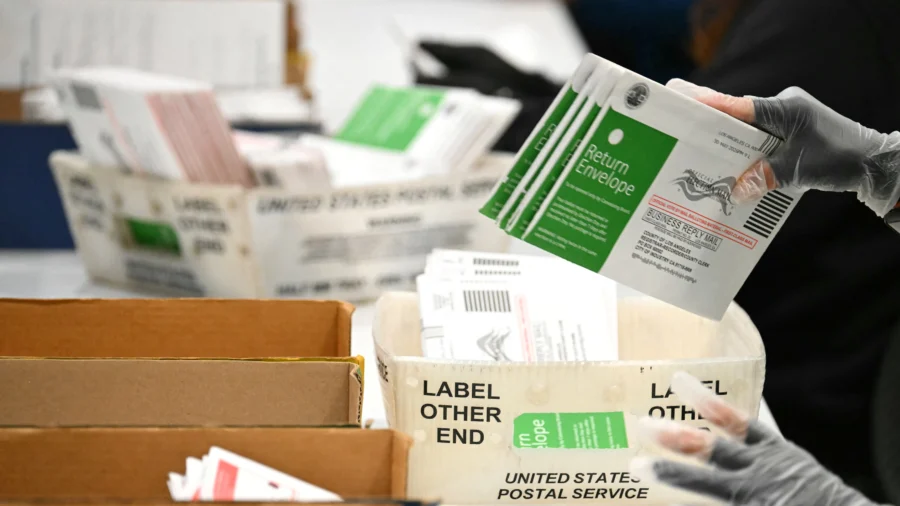
A federal judge on Sept. 4 issued a preliminary injunction preventing the U.S. Postal Service (USPS) from implementing a regulation that tightens rules around mail-in voting.
The injunction applies to the Nov. 3 midterm congressional elections and any federal elections that take place before then.
The Trump administration previously filed an appeal of the restraining order that was still pending before the U.S. Court of Appeals for the First Circuit, but the judge’s decision to upgrade the order to a preliminary injunction rendered that appeal moot, or legally irrelevant.
The injunction blocks the mandatory parts of the post office’s final rule published Aug. 26 that implements Section 3 of President Donald Trump’s Executive Order 14399. That provision would assign federal agencies a larger role in who receives a mailed ballot and how those ballots are processed by the USPS.
Advocacy groups and a coalition of Democrat-led states sued to block parts of the rule, arguing they would lead to voter disenfranchisement. Republican states intervened in support of the federal government, arguing the rule would promote election integrity.
The Trump administration previously said the executive order would help to keep federal elections honest. The Department of Justice (DOJ) argued that USPS is imposing mailpiece design and data standards under its general authority to regulate the mail, not deciding who is eligible to vote; states are still free to set voter lists and count ballots.
In her Aug. 27 order, Talwani blocked the post office from implementing the parts of the rule implementing Section 3 that required state and local election officials to submit outbound and return mail envelopes for USPS design review, place unique tracking barcodes on those envelopes, and upload voter names, addresses, and barcode data to a new federal portal. Mailings that do not match portal data or that fall short of the envelope standards would not be accepted for delivery.
Talwani held in her new ruling that the challengers were likely to succeed in their lawsuit, that the USPS lacked authority to enforce the rule, and that, as election officials have said, given existing time constraints, complying with the rule for the midterms was “likely impossible.”
Talwani said Congress never agreed to delegate its powers under the Constitution’s Elections Clause to the USPS, so the rule “clashes with Congress’s statutory scheme, and is unconstitutional where it intrudes not only on … [those] powers but also that power left to the States.”
The judge added that even a small glitch in the new system would be problematic and could mean ballots never go out, that eligible voters would almost certainly lose the chance to vote by mail, and that the disenfranchisement of plaintiff groups such as the League of Women Voters of Massachusetts was “practically inevitable.”
The Supreme Court stated that its decision “does not mean that any measure taken by the Government to implement the Order will necessarily be lawful … but the [executive order] itself does not harm the States, so … [Talwani] lacked jurisdiction to bar the Government from trying to implement it.”
In other words, the high court said any concrete injury the challenging states may experience would come from later agency actions implementing it, and states may then sue over that issue when it arises.
It is unclear when the First Circuit will act on the newly filed appeals of Talwani’s Sept. 4 order from DOJ and the Republican-led states.