Introduction: UK exports to Middle East drop 20 % since war began
Good morning, and welcome to our rolling coverage of business, the financial markets, and the world econony.
UK trade to the Middle East has shrunk since the Iran war began eight weeks ago, new data shows.
The British Chambers of Commerce has reported that the number of certificates of origin issued by Chambers of Commerce for exports to the region fell by 20% year-on-year in March, down from 15,437 in March 2025 to 12,360 in March 2026
This decline indicates goods are either being delayed, rerouted or not shipped at all.
Companies classified as Arab League countries for certificates of origin include Algeria, Bahrain, Comoros, Djibouti, Egypt, Iraq, Jordan, Kuwait, Lebanon, Libya, Mauritania, Morocco, Oman, Qatar, Saudi Arabia, Somalia, Sudan, Syrian Arab Republic, Tunisia, United Arab Emirates and Yemen.
Steven Lynch, director of international trade at the British Chambers of Commerce, says UK firms are dealing with less reliable trade routes, rising costs and geopolitical risks, adding:
“Our documentation data shows a clear and immediate shock to UK trade flows linked directly to disruption across the Middle East. The fact that exports tied to Arab markets are falling far faster than elsewhere tells us this is a targeted, region‑specific impact, not a broad‑based downturn.
“Firms are reporting increased delays, rerouting via longer and more expensive pathways, enduring rising insurance premiums and facing stretched lead times. For SMEs in particular, this squeezes cashflow and confidence at a time when exporting is already challenging.
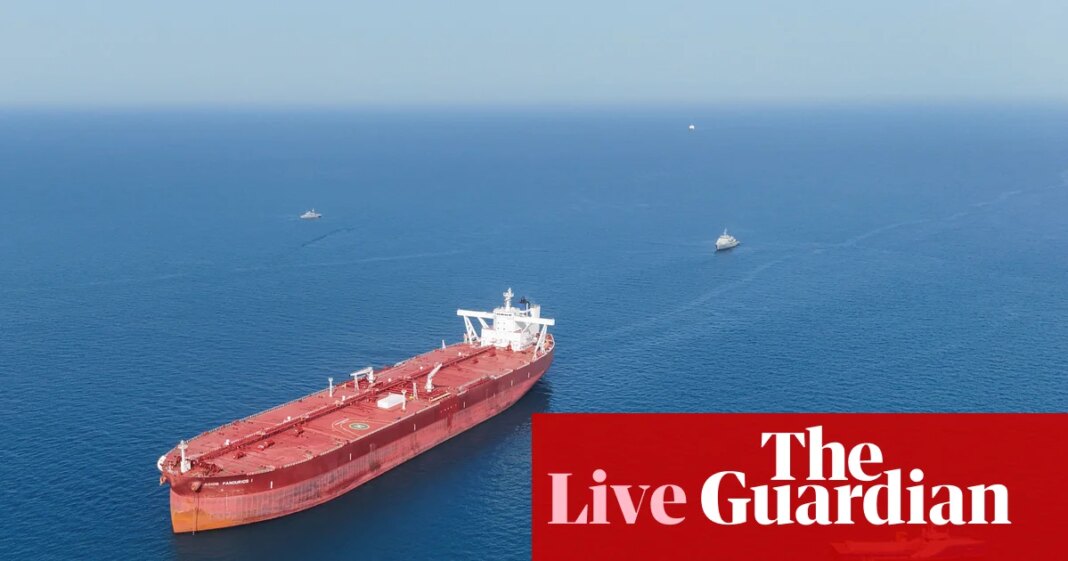
There’s no let-up in that challenge today, with the strait of Hormuz still badly disrupted and reports that the US is planning for a lengthy blockade of Iranian ports.
According to the Wall Street Journal, US President Donald Trump has instructed aides to prepare for an extended blockade of Iran.
UK companies are already pessimistic about the economic outlook, and expect activity to fall in the next three months according to the CBI’s latest Growth Indicator.
It has found that business volumes in the services and manufacturing sector are anticipated to fall over the quarter,
Alpesh Paleja, CBI deputy chief economist, explains::
“Business’ expectations for activity have weakened further, as companies continue to grapple with uneven trading conditions, strong cost pressures and renewed uncertainty.
“These challenges have been exacerbated by the conflict in the Middle East, which is increasingly hitting a broad swathe of UK businesses. Our surveys suggest that the additional pressure on costs and supply chains is feeding through to pricing intentions – but not nearly enough to offset the burden facing firms.
The agenda
-
10am BST: Eurozone economic sentiment data
-
2.45pm BST: Bank of Canada interest rate decision
-
7pm BST: US Federal Reserve interest rate decision
-
7.30pm BST: Federal Reserve press conference
Key events
Russia hopes UAE exit does not spell the end of OPEC+, and pledges to stay put
Russia is hoping that yesterday’s shock news that the United Arab Emirates is leaving the Opec+ group doesn’t prompt the end of the alliance.
Kremlin spokesman Dmitry Peskov said today that Russia will stay in Opec+, and hopes it will continue, Reuters reports.
Peskov argued that Opec+ played an important role, saying:
“This format helps to substantially, let’s say, minimise fluctuations in energy markets and makes it possible to stabilise those markets”.
The UAE sent shockwaves through the oil sector yesterday by announcing it was will quit the Opec oil cartel on Friday, in a heavy blow to the group and its de facto leader, Saudi Arabia
The shock loss of the UAE, Opec’s third-largest oil producer, is expected to weaken the group, which for decades has worked together to use its collective oil production to influence global oil market prices by setting quotas for its members.
Russia is a powerful member within Opec+, which is made up of Opec and its allies.
UAExit, as some wags have dubbed it, is a win for Donald Trump, who has previously accused Opec of “ripping off the rest of the world” by artificially inflating oil prices by holding back production.
Analysts have been speculating about which other Opec members could follow the UAE. Marketwatch reports that “Kazakhstan and perhaps Iraq” are seen as the two countries most likely to leave the oil bloc’s sphere.
Best case scenario for Iran war? £35bn off UK GDP
The Iran war will knock £35bn off the size of the UK economy over 2026 and 2027, in a “best case” scenario where hostilities end soon.
That’s according to the National Institute of Economic and Social Research’s latest quarterly Economic Outlook, released this morning.
NIESR predicts that UK growth will stall in the second half of the year, as the Middle East conflict has “materially weakened the UK outlook” by pushing up global energy prices, raising inflation and reducing household spending power.
David Aikman, NIESR director, says:
“This is a serious blow to the government’s mission to get the UK economy growing again.
The Middle East conflict has laid bare the fact that the UK remains highly exposed to global energy shocks. Even if hostilities ease rapidly, higher energy prices will leave households poorer, businesses facing higher costs, and the economy materially smaller than we expected only a few months ago.”
Difficult to get Adidas goods into Middle East due to war, CEO says
The CEO of Adidas has revealed the company has faced difficulties getting products into the Middle East due to the Iran war.
Bjørn Gulden told reporters this morning:
“I don’t think we have any clear disruption now [due to the war], unless, of course, it’s difficult to get products in the Middle East.”
Gulden also flagged that transportation costs are “starting to explode” due to a surge in oil price – so he won’t be happy to see Brent crude up 3% this morning.
He was speaking after Adidas reported a rise in sales in the last quarter, with revenues up 14% and operating profits rising by 16%.
EU economic sentiment tumbles
Economic confidence and employment expectations have punged across the European Union this month, as consumer confidence is hit hard by the Iran war.
The European Commission’s Economic Sentiment Indicator for the EU dropped by 2.9 points this month to 93.5 points, while its Employment Expectations Indicator fell by 4 points to 93.2, both below their long-term averages.
The decline of the ESI was driven by plummeting confidence among EU consumers, as well as managers in services and retail trade, while confidence in construction and industry held up broadly stable.
The EC adds:
Among the largest EU economies, the ESI deteriorated significantly in Germany (-3.9), France (-3.0), Italy (-2.8) and the Netherlands (-2.5), while it decreased less dramatically in Spain (-0.9) and Poland (-0.8).
DCC receives takeover approach
Irish international sales, marketing and support services group DCC has received a takeover approach, sending its shares up 14%.
DCC has told the City that it has received an “indicative cash proposal” from a consortium made up of investment firms Energy Capital Partners, and Kohlberg Kravis Roberts.
It added:
The Board of DCC is evaluating the Proposal together with its advisers and a further announcement will be made in due course.
There can be no certainty that any firm offer will be made for the Company, nor as to the terms on which any firm offer might be made. Shareholders are urged to take no action at this time.
Shares in DCC, which has been valued at £4.6bn before the annoucement, have jumped to the top of the FTSE 100 risers.
Oil is pushing higher… it’s now hit $115 a barrel, a rise of 3.3% today.
Today’s reports that “President Trump has instructed aides to prepare for an extended blockade of Iran” creates additional challenges for the Bank of England’s MPC and other central banks.
Professor Costas Milas, of the University of Liverpool’s Management School, explains:
This is because quantitative (or econometric) models of the UK economy (and other economies) usually find a small impact of oil prices on UK inflation.
In other words, forecasts provided by tomorrow’s Monetary Policy Report are likely to underestimate inflation even if the MPC assumes oil prices of $120-$150 for six (or more) months. It will be good if the MPC also focuses on the global supply chain pressure index of the Fed of New York to provide alternative and arguably more reliable inflation forecasts!
The jump in energy prices this month has pushed up inflation in three German states this month.
In Bavaria, the inflation rate rose in April to 2.9% from 2.8% in the previous month. In Lower Saxony, it accelerated to 3.0% from 2.6%, and in Baden-Wuerttemberg to 2.6% from 2.5%.
In North Rhine-Westphalia, the consumer price index stood unchanged at 2.7%.
These readings suggest Germany’s headline inflation rate will also rise this month.
Oil at one month high as Trump plumps for ‘extended blockade of Iran’
The oil price has hit its highest level in a month, following reports that President Trump has instructed aides to prepare for an extended blockade of Iran.
Brent crude has risen by 1.8% this morning to above $113 a barrel, the highest since 31 March, a week before the US-Iran ceasefire was agreed.
Crude prices rose after the Wall Street Journal reported that Trump has decided to target Tehran’s coffers by squeezing Iran’s economy and restricting oil exports by preventing shipping to and from its ports, in an attempt to force it to dismantle all its nuclear work.
The WSJ reports:
He assessed that his other options—resume bombing or walk away from the conflict—carried more risk than maintaining the blockade, officials said.
Yet continuing the blockade also prolongs a conflict that has driven up gas prices, hurt Trump’s poll numbers and further darkened Republicans’ prospects in the midterm elections. It has also caused the lowest number of transits through the Strait of Hormuz since the war began.
Brent crude had been trading around $70 a barrel before the conflict began, before hitting $119.50 a barrel in mid-March.
FTSE 100 lowest since 1 April
Britain’s main stock index has dropped to its lowest level in almost a month, on a busy morning for corporate news.
The FTSE 100 share index dropped by 52 points, or 0.5%, in early trading to 10,280 points, its lowest level since 1 April.
Wealth manager St James’s Place are the top faller, down 6.3%, after reporting a drop in net inflows in the first quarter of 2026 amid “heightened geopolitical uncertainty and market volatility”.
British drugmaker GSK are down 2.7%, after reporting first-quarter profit and sales above analysts’ expectations. Fellow pharmaceuticals giant AstraZeneca (1%) are also among the fallers, despite beating profit expectations this morning thanks to strong demand for its cancer and rare-disease drugs.

Jennifer Rankin
Meta now has the chance to examine the commission’s investigation file and mount a defence against the charge that it has breached of EU law for failing to prevent children under 13 from using its Facebook and Instagram platforms.
If the finding against the Silicon Valley company is upheld, it could be fined up to 6% of its global annual turnover. Meta reported revenue of $201bn (£148bn) for 2025.
EC: Meta failing to prevent minors under 13 from using Instagram and Facebook
Newsflash: The European Commission has preliminarily found Instagram and Facebook in breach of Europe’s Digital Services Act (DSA) for failing to protect minors.
The EC says the two services, both owned by Meta, failed to “diligently identify, assess and mitigate the risks of minors under 13 years old accessing their services”.
It is proposing that Instagram and Facebook must change their risk assessment methodology, and strengthen their measures to prevent, detect and remove minors under the age of 13 from their service.
In a statement outlining its preliminary findings, the EC says there are no effective controls to prevent a minor below the age of 13 from entering a false birth date, and labels Meta’s tool for reporting minors under 13 on the platform as “difficult to use and not effective”
Henna Virkkunen, executive vice-president for Tech Sovereignty, Security and Democracy, says:
Meta’s own general conditions indicate their services are not intended for minors under 13. Yet, our preliminary findings show that Instagram and Facebook are doing very little to prevent children below this age from accessing their services. The DSA requires platforms to enforce their own rules: terms and conditions should not be mere written statements, but rather the basis for concrete action to protect users – including children.
Elsewhere in banking, Santander UK is taking an extra £179m provision to cover the cost of the motor finance scandal.
The charge has pulled Santander UK’s pre-tax profits in Q1 2026 down to £202m, from £358m a year earlier.
It also lifts the company’s total provision to £633m, which is ‘at the upper end of the previously assessed range.’
This comes after the Financial Conduct Authority issued its plans for a compensation scheme for customers who were overcharged for loans when buying a car, due to commission payments between lenders and car dealers between 2007 and 2024.
Santander UK has decided not to challenge the scheme, and has updated its scenarios and assumptions including operational and legal costs. However, the FCA’s proposals is now being challenged by Consumer Voice, who argue it does not compensate enough customers affected.
Lloyds profits jump despite £151m impairment charge from Middle East conflict
Lloyds Banking Group has shrugged off the economic uncertainty caused by the Iran war, by beating profit expectations for the first three months of the year.
Earnings at Lloyds jumped by a third in the first three months of 2026 to £2bn, up 33% compared with a year ago, and ahead of analyst forecasts of £1.8bn.
Lloyds chief executive Charlie Nunn said the banking group’s business model was “resilient in the context of the current economic uncertainties”, adding:
“We remain focused on supporting UK households and businesses as they look to strengthen their financial positions and achieve their goals.”
Lloyd also took a £151m impairment charge to reflect “the deterioration in economic outlook as a result of the Middle East conflict”. However, that was partly countered by a £50m improvement in “global tariff and political disruption risks”.
The uncertainty over the Middle East conflict means many holidaymakers are delaying their bookings until closer to departure time.
Jet2, the flights and package holiday firm, has reported this morning that since the conflict began, its customers’ “booking profile has become increasingly close to departure”, adding:
At present, Q1 (April, May, June) combined average load factor is in line with the prior year, with the current geopolitical uncertainty limiting visibility for the peak summer season and beyond.
As previously stated, we continue to invest in load factor and remain fully committed to pricing that is attractive and represents real value to our Customers.
Passenger bookings for summer 2026 are up 6.2% compared with the previous year, while Jet’s capacity is currently 7.7% higher than in summer 2025.
The company adds that it has ‘a high degree of cost certainty’ about its jet fuel costs, as it has hedged 87% of its summer requirements.
Heathrow has warned that it faces an ‘uncertain outlook’, after a positive start to the year.
London’s largest airport has reported a 3.7% rise in passengers in the first quarter of this year, up to 18.9m.
It says:
Following airspace closures in the Middle East, there was an increase in transfer passengers across Heathrow’s network. While Heathrow has temporarily absorbed demand from elsewhere, passenger numbers for the rest of the year are likely to be impacted whilst there is significant uncertainty in the Middle East.
Heathrow adds that it has “seen some impact from recent Middle East disruption”, but has not yet updated its outlook for 2026.
More UK firms fall into financial distress
The number of UK businesses in “critical financial distress” has jumped by more than a third amid fresh pressure linked to the conflict in the Middle East, according to new research.
Hotels and leisure firms are in particular distress after facing higher labour costs and taxes over the past year, latest research from Begbies Traynor Group (BTG) has shown.
BTG’s latest quarterly red flag report indicated that more firms edged closer to collapse in the first quarter of 2026 – the number of companies considered in “critical financial distress” rose by 36.9% to 62,193 for the quarter, compared with the same period a year earlier.
The number of businesses in “significant” financial distress meanwhile rose by 9.6% year on year to 634,867.
Ric Traynor, executive chairman of BTG, said:
“The shockwaves from a war in the Middle East will be felt across every corner of the global economy for some time to come.
After initial signs that the UK’s GDP was improving at the very start of the year, it now feels like after taking a step forward, the UK has taken a few steps backwards following one of the most severe energy shocks in living memory.”
Introduction: UK exports to Middle East drop 20 % since war began
Good morning, and welcome to our rolling coverage of business, the financial markets, and the world econony.
UK trade to the Middle East has shrunk since the Iran war began eight weeks ago, new data shows.
The British Chambers of Commerce has reported that the number of certificates of origin issued by Chambers of Commerce for exports to the region fell by 20% year-on-year in March, down from 15,437 in March 2025 to 12,360 in March 2026
This decline indicates goods are either being delayed, rerouted or not shipped at all.
Companies classified as Arab League countries for certificates of origin include Algeria, Bahrain, Comoros, Djibouti, Egypt, Iraq, Jordan, Kuwait, Lebanon, Libya, Mauritania, Morocco, Oman, Qatar, Saudi Arabia, Somalia, Sudan, Syrian Arab Republic, Tunisia, United Arab Emirates and Yemen.
Steven Lynch, director of international trade at the British Chambers of Commerce, says UK firms are dealing with less reliable trade routes, rising costs and geopolitical risks, adding:
“Our documentation data shows a clear and immediate shock to UK trade flows linked directly to disruption across the Middle East. The fact that exports tied to Arab markets are falling far faster than elsewhere tells us this is a targeted, region‑specific impact, not a broad‑based downturn.
“Firms are reporting increased delays, rerouting via longer and more expensive pathways, enduring rising insurance premiums and facing stretched lead times. For SMEs in particular, this squeezes cashflow and confidence at a time when exporting is already challenging.
There’s no let-up in that challenge today, with the strait of Hormuz still badly disrupted and reports that the US is planning for a lengthy blockade of Iranian ports.
According to the Wall Street Journal, US President Donald Trump has instructed aides to prepare for an extended blockade of Iran.
UK companies are already pessimistic about the economic outlook, and expect activity to fall in the next three months according to the CBI’s latest Growth Indicator.
It has found that business volumes in the services and manufacturing sector are anticipated to fall over the quarter,
Alpesh Paleja, CBI deputy chief economist, explains::
“Business’ expectations for activity have weakened further, as companies continue to grapple with uneven trading conditions, strong cost pressures and renewed uncertainty.
“These challenges have been exacerbated by the conflict in the Middle East, which is increasingly hitting a broad swathe of UK businesses. Our surveys suggest that the additional pressure on costs and supply chains is feeding through to pricing intentions – but not nearly enough to offset the burden facing firms.
The agenda
-
10am BST: Eurozone economic sentiment data
-
2.45pm BST: Bank of Canada interest rate decision
-
7pm BST: US Federal Reserve interest rate decision
-
7.30pm BST: Federal Reserve press conference