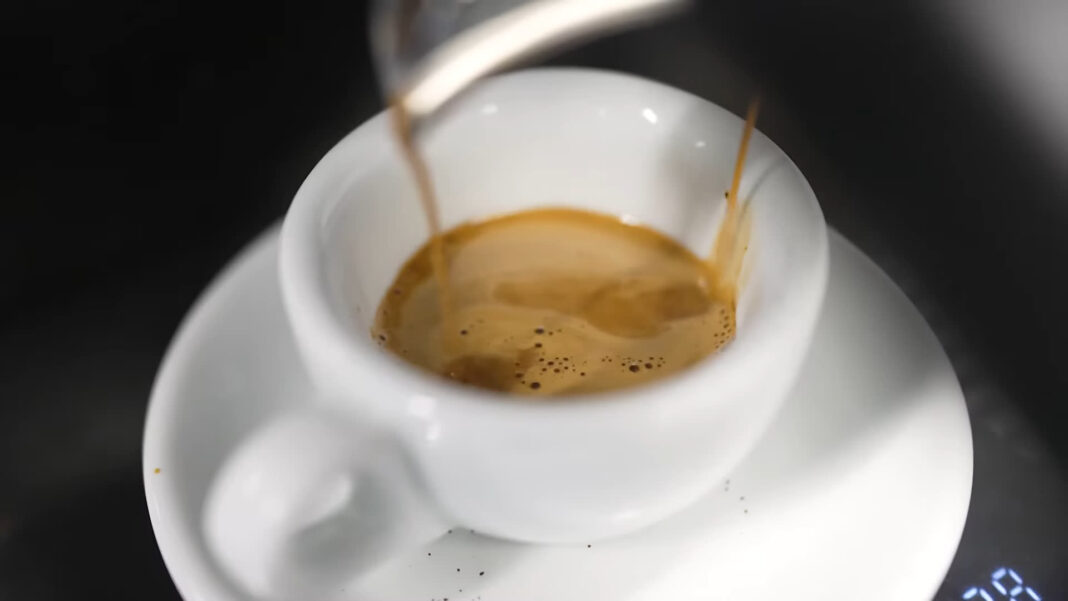
The takeaway: New research is challenging a basic assumption about espresso: that it has to be made with hot water. Instead of relying on near-boiling water, researchers have shown that high-frequency sound waves can produce an espresso-style shot with similar strength and taste – no heat required.
Developed by engineers and food scientists at UNSW Sydney, this new method is called “ultrasonic espresso” and replaces heat with mechanical energy. It runs at room temperature, using sound waves to pull flavor from finely ground coffee, and reaches espresso-level intensity in under three minutes despite the cold-water start.
The setup still begins with a standard espresso basket. A small metal transducer is mounted against its wall, and once activated, it emits ultrasound – sound waves above the range of human hearing – that travel through the water and coffee bed.
What happens next is the key step.

The sound waves trigger acoustic cavitation, a process where tiny bubbles form in the liquid and collapse in rapid succession. When those bubbles implode near coffee particles, they generate microscopic bursts of force that chip away at the grounds, speeding up the release of oils, flavor compounds, and caffeine into the water.
In effect, the system swaps heat for controlled agitation at a microscopic level, using pressure changes and localized mechanical action instead of temperature to drive extraction.
That distinction matters more at scale than it does on a kitchen counter. For a home user, skipping the heating step might not move the needle much. But in industrial settings – particularly ready-to-drink coffee production – energy consumption becomes a central concern, and the researchers estimate that eliminating the need to heat water could cut energy use by up to 75%.
The process also introduces some logistical flexibility. Because the coffee is produced at room temperature, it can go straight into bottled drinks or milk-based products, or be shipped as a concentrated liquid and diluted later, potentially simplifying production and distribution.
Ultrasound is not entirely new to coffee science. Earlier work from the same UNSW team explored its ability to speed up cold brewing, compressing what is typically a 12 to 24-hour process into a matter of minutes. But espresso presents a different challenge: it is not just about extracting caffeine or basic flavor, but about achieving a specific balance of bitterness, aroma, and body typically associated with high heat and pressure.
To hit that target, the researchers, led by Dr. Francisco Trujillo, fine-tuned several variables. Grind size played a clear role, with finer particles allowing faster extraction. The water-to-coffee ratio had to be carefully controlled to avoid under-extraction or dilution, and timing proved equally important, with the optimal window landing between two-and-a-half and three minutes of ultrasonic exposure.
Matching the chemistry of espresso is only part of the equation, though. The more practical question is whether people can actually taste the difference.

To test that, the team ran a blind evaluation with about 100 regular coffee drinkers, those findings are published in the Journal of Food Engineering. Participants sampled four coffees: traditional espresso, ultrasonic espresso, and both traditional and ultrasonic filter coffee, served at the same temperature and in random order.
The results were strikingly close. Participants couldn’t reliably distinguish between the traditional espresso and the ultrasonic version, with the two performing nearly identically across aroma, flavor, bitterness, and overall preference. In the filter category, the ultrasonic version was actually favored, with tasters describing its bitterness as more balanced.
The findings suggest that heat may not be as essential to espresso as long assumed. By using ultrasound to accelerate extraction, the process reproduces the defining characteristics of espresso while significantly reducing energy input. For an industry built around heat-driven methods, this opens up a different way of thinking about how coffee can be made.
Image credit: The Conversation