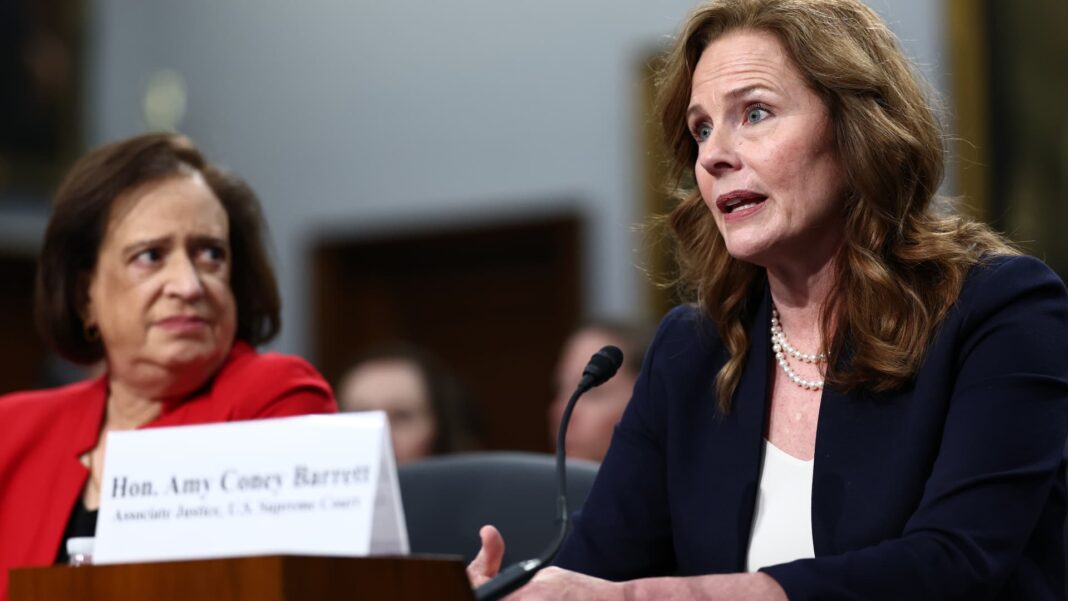
Supreme Court Justice Amy Coney Barrett told a House subcommittee on Tuesday that “the threat level” against her and other federal judges “is really high” as she testified about the high court’s 2027 budget request.
“Those statistics sound abstract, but being on the receiving end of them is not,” Barrett told the House Appropriations Subcommittee on Financial Services and General Government, before she shared several anecdotes about threats affecting her and her family.
The Supreme Court is asking Congress to appropriate $228.4 million for fiscal 2027, a nearly 10% increase since the $207.8 million appropriated for 2026. The increase reflects higher spending on security-related measures, both for the protection of justices and for cybersecurity.
Justice Elena Kagan, who was testifying with Barrett, noted that the chief of the U.S. Capitol Police recently testified that threats against Congress are up 50% this year compared to 2025.
“The Supreme Court Police expect a smaller but still very substantial 38% annual increase in threats this year, which follows a 25% increase last year” in threats to the court and its justices, Kagan said.
“For some of us, those threats have come very close, and all of us live with the knowledge that they may again materialize,” she said.
According to data from the U.S. Marshals Service, since the beginning of 2026, there have been a total of 512 investigations of threats to federal judges, of which there are 2,600 active judges. That compares to 807 investigations of threats for all of 2025.
Barrett and Kagan are the first Supreme Court justices to testify to Congress since 2019. That year, Kagan and Justice Samuel Alito testified about the court’s budget request.
The two justices are scheduled to testify on Tuesday afternoon to the Senate Appropriations Subcommittee on Financial Services and General Government.
Barrett said the increased threats “have required me to my children to think about and see things that children should not have to see or think about.”
She told the panel that in the spring of 2022, “My security detail sent me home with a bulletproof vest” when threats to her life escalated after the leak to a media outlet of a draft Supreme Court opinion that more than a month later reversed a 1973 decision that had said there was a constitutional right to abortion.
“I carried it into my house, put it into my bedroom, dropped it down on a table, turned around, and my 12-year-old son was standing in the doorway of my bedroom, and he wanted to know what it was and why I had it,” Barrett said.
“I didn’t know how to respond because maybe I lack imagination, but I didn’t expect that performing this service was going to put me in the position of explaining to my children what a bulletproof vest was and why I had to wear one.”
Barrett, who was nominated to the court by President Donald Trump in his first term, also discussed having recently been the target of a “swatting” attack.
“My teenage son, one of my teenage sons, opened the door to go out with friends and saw in our street, it was full of police cars, who had responded to a false report of gunshots and raised voices in my home,” Barrett said.
“I was very, very grateful that I had Supreme Court Police outside my home because they were able to stop and meet with and explain to the county police that it had been a false alarm, and so the police did not actually attempt to enter our home.”
She also said that “any of us, me included, have received threatening anonymous deliveries designed to intimidate and harass us.”
The hearing comes nine months after a 29-year-old California man, Nicholas Roske, was sentenced to more than eight years in prison for his 2022 plot to assassinate Supreme Court Justice Brett Kavanagh at his Maryland home. Roske told police after his arrest that he was upset about the leaked Supreme Court decision on abortion.
Kagan, in her testimony, noted that “the majority of last year’s funding increase went to shifting the responsibility for residential security of the justices from the Marshals Service to the Supreme Court Police.
Kagan said that when she first joined the court in 2010, after being nominated by President Barack Obama, “Our security was very different at the time.”
“The Supreme Court Police focused almost exclusively on protecting the building, and our IT department focused on supporting the latest BlackBerry devices,” she said.
“I didn’t have a security team of my own, and I was accompanied by security personnel only when I participated in work-related public events,” Kagan said. “We began expanding our security program in earnest in 2017, initially at the behest of members of Congress.”
Barrett said that in addition to increased threats to judges personally, “the cybersecurity attacks have been up … by magnitudes year after year.”
“The rapid advancement of AI is making that more and more possible,” Barrett said. “We haven’t suffered the kind of paralyzing attacks that some of the lower courts have, but in seeing that, that has caused us to try to ramp up very quickly our cybersecurity protection, and so some of the funding that we’re seeking is for additional cybersecurity experts.”
The subcommittee’s chairman, Rep. Dave Joyce, R-Ohio, opened the hearing by saying, “Whatever one’s view of the specific Supreme Court ruling, judicial officers — up to and including the justices of the Supreme Court — must be able to do their jobs without fear for their safety or their family’s safety.”