
For years, allegations of forced organ harvesting in China have prompted calls for greater transparency and independent investigation. Now, a bipartisan U.S. Senate bill seeks to move the issue toward a formal accountability mechanism, including sanctions against people found responsible for the practice.
“Today, the Senate has sent an unmistakable message to Beijing: those who carry out this crime will no longer do so with impunity,” Browde said.
What the Bill Would Do
The Senate-passed version defines “forced organ harvesting” as removing one or more organs from an individual through “coercion, abduction, deception, fraud, or abuse of power or a position of vulnerability.”
If enacted, the bill would require the president, within 180 days, to submit to Congress a list of foreign individuals determined to have knowingly and directly engaged in or facilitated forced organ harvesting in China.
Those listed would face sanctions including the blocking of property and financial transactions involving assets in the United States. They would also be barred from entering the United States or obtaining U.S. visas or other immigration benefits.
The bill would also direct the secretary of state, in consultation with U.S. health and intelligence officials, to submit a report to Congress within one year on China’s organ-transplant policies and practices.
Among other things, the report would be required to assess whether the Chinese communist regime conducts systematic forced organ harvesting and look into where the organs are from, how fast they are obtained, and whether that timetable is plausible in the country.
Should it find the abuse to be taking place at scale, U.S. officials would evaluate whether forced organ harvesting in China constitutes an atrocity.
Bipartisan Effort
Sens. Ted Cruz (R-Texas) and Jeff Merkley (D-Ore.) introduced the legislation in March 2026, building a bipartisan coalition around the issue.
The measure attracted support from senators including Sens. Todd Young (R-Ind.), Adam Schiff (D-Calif.), Ron Johnson (R-Wis.), Ron Wyden (D-Ore.), Mike Rounds (R-S.D.), Catherine Cortez Masto (D-Nev.), Roger Marshall (R-Kan.), Raphael Warnock (D-Ga.), Dave McCormick (R-Pa.), and James Lankford (R-Okla.).
Cruz said he was “proud to have worked with Senator Merkley to get this bipartisan bill through the Senate,” and urged his colleagues in the House to “pass it and send it to the President’s desk.”
In the same statement, Merkley said China’s campaign of repression and human rights abuses has included “reports of forced organ harvesting from vulnerable groups across the PRC.”
“We must stand up for the victims of these crimes, and our bipartisan effort holds the Chinese government accountable for its abuses,” he said.
Other lawmakers have also highlighted bipartisan support.
Young said the United States must “continue to stand up for fundamental human rights and speak out against the Chinese Communist Party’s persecution of religious minorities.”
“I’m pleased the Senate unanimously passed this bipartisan legislation to combat these horrific abuses and stand with Falun Gong practitioners and other victims of persecution in China,” Young told NTD in a recent interview.
He called the measure “an important step in defending religious freedom and human dignity in the face of the CCP’s ongoing abuses.”
“The CCP’s long history of human rights violations and systematic torture of political dissidents and religious minorities is well-known,” Rep. Tom Tiffany (R-Wis.) told NTD. “Passage of this legislation will help ensure that those responsible for these abuses are held accountable,” Tiffany said.
Rep. Gus Bilirakis (R-Fla.) told NTD that forced organ harvesting is a “horrific violation of human dignity.”
“Forced organ harvesting is a horrific violation of human dignity, and those responsible must be held accountable. This legislation would impose sanctions on perpetrators in China and strengthen scrutiny of these abuses,” Bilirakis said, adding that he looked forward to working with House colleagues to advance the measure.
Survivor Speaks Out
One survivor whose account has drawn wide attention to the issue is Cheng Peiming, a Falun Gong practitioner who escaped China and came forward publicly in 2024.
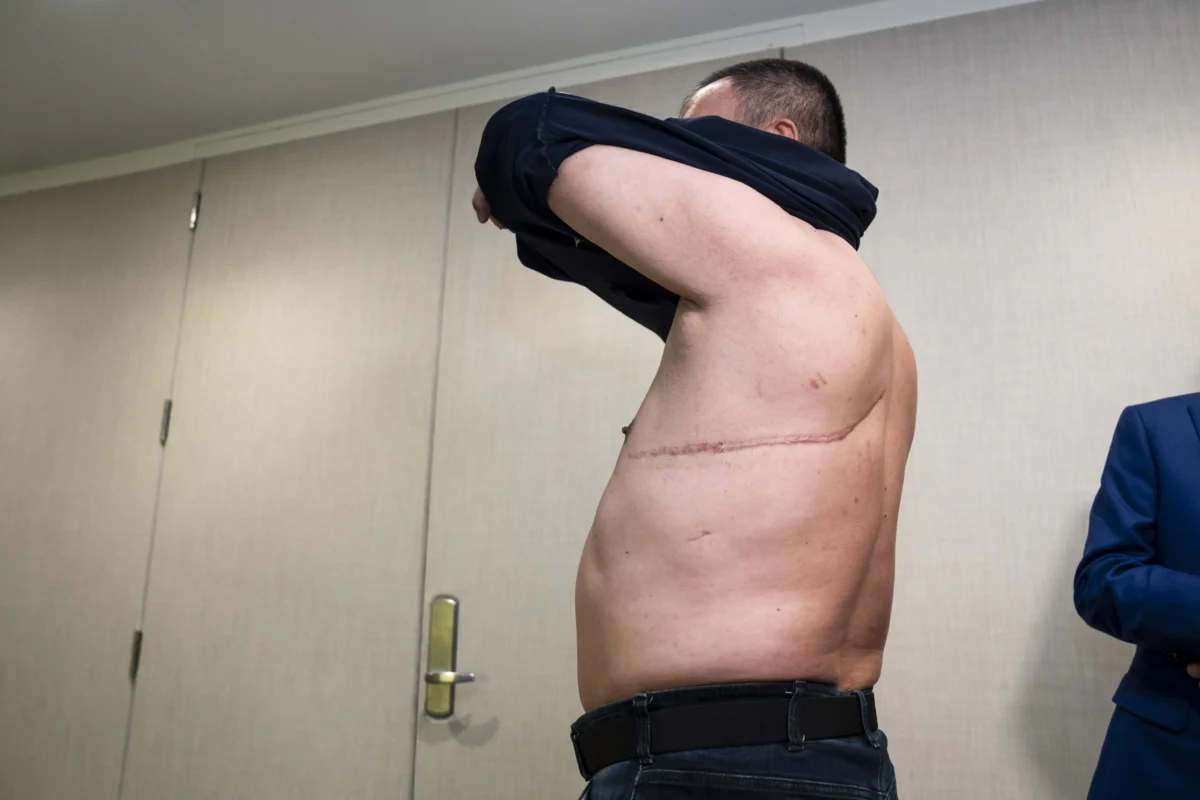
Cheng Peiming, a Falun Gong practitioner who had portions of his liver and lung forcibly removed in China, shows his scar after a press conference in Washington on Aug. 9, 2024. Madalina Vasiliu/The Epoch Times
After reaching the United States in 2020, Cheng underwent medical examinations that found portions of his liver and lung were missing. The Epoch Times reported that three medical transplant doctors who reviewed his case said the absence of the tissue was consistent with forced organ removal.
Cheng has said he survived another attempted surgery in 2006 after escaping from a Chinese hospital while under guard. He later left China and eventually reached the United States.
Eva Fu contributed to this report.