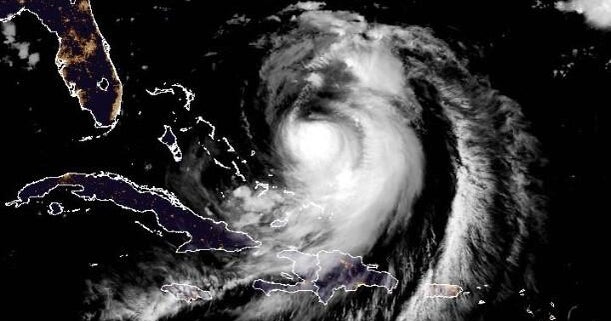
Hurricane Erin was on a path to head north more or less parallel to the East Coast and will probably grow “substantially” and bring dangerous rip currents to that coast this week, the National Hurricane Center in Miami said early Tuesday. The hurricane wasn’t expected to make landfall over the U.S., but people in North Carolina’s Outer Banks were warned of possible coastal flooding. That triggered evacuation orders.
Erin, the first Atlantic hurricane of 2025, weakened back into a Category 3 storm late Monday night as it churned over the Atlantic Ocean north of the Caribbean. It previously exploded to a Category 5 on Saturday before weakening to a Category 3 early Sunday morning, then regaining strength again later in the day.
As of 5 a.m. EDT Tuesday, Erin had maximum sustained winds of 115 mph and was slowing down, moving northwest at 7 mph. The storm’s center was about 675 miles southwest of Bermuda and about 750 miles south-southeast of Cape Hatteras, North Carolina.
A Category 3 hurricane is defined as having maximum sustained winds from 111-129 mph and is considered a major storm, capable of causing devastating damage. Hurricanes lose that label when their maximum sustained winds fall below 110 mph.
NOAA 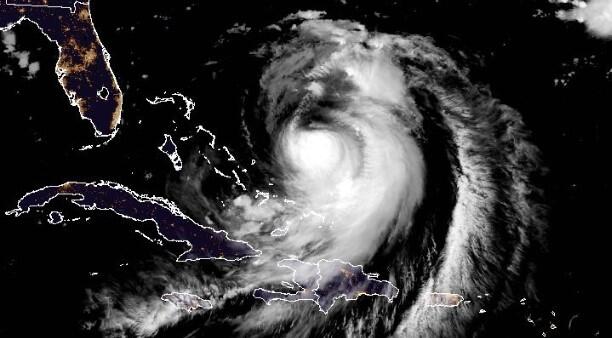
Maps show Hurricane Erin’s forecast path
The center of the storm was expected to turn to the north on Tuesday and move between Bermuda and the U.S. East Coast Wednesday and Thursday, the hurricane center said.
CBS News 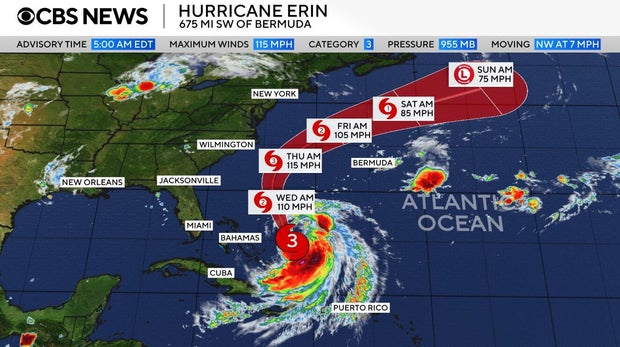
Erin is already a large storm, with hurricane-force winds extending outward up to 80 miles from the center and tropical storm-force winds extending up to 205 miles from the center, forecasters said.
Tropical storm warnings were in effect for Turks and Caicos and the southeast Bahamas, the hurricane center said. Tropical storm watches were issued for the central Bahamas and North Carolina’s Outer Banks. A tropical storm warning means tropical storm conditions are expected somewhere within the warning area, while a watch means they are possible.
A storm surge watch was also issued for the Outer Banks, alerting people to the possibility of life-threatening inundation from coastal flooding starting Wednesday.
Hurricane Erin’s “spaghetti models”
A “spaghetti map” of the forecast models shows the storm skirting the Caribbean islands and remaining well offshore of the U.S. East Coast as it moves north and curves back over the Atlantic.
CBS News 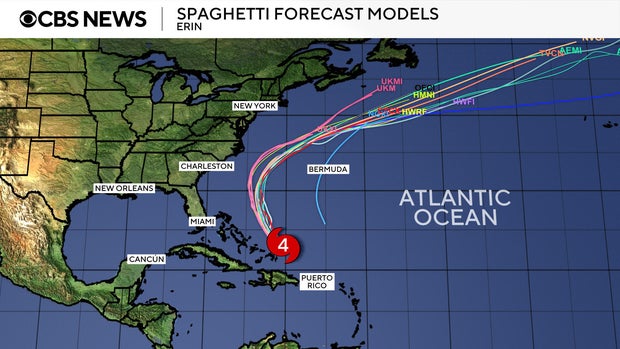
A high-pressure system in the Atlantic was expected to steer Erin away from the U.S. coast while a cold front was also forecast to push the hurricane offshore, CBS News Bay Area meteorologist Jessica Burch reported.
How will Hurricane Erin affect the U.S.?
Erin isn’t forecast to hit the U.S. directly, but coastal areas along the Eastern Seaboard will feel its effects with dangerous rip currents and high waves of 10 to 20+ feet over the next several days.
CBS News 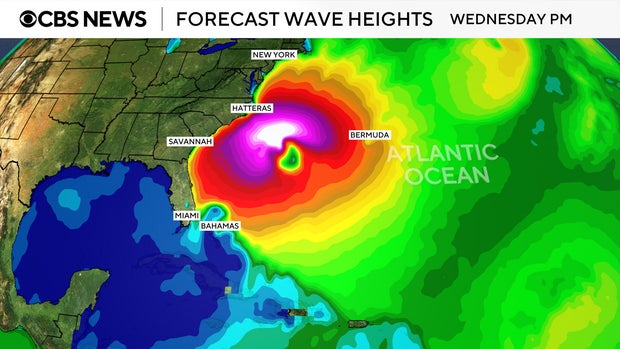
Mike Brennan, the hurricane center’s director, said the dangerous conditions were expected to last for much of the week across almost the entire East Coast. He urged people to heed any warnings from local officials.
“It’s just not going to be a very safe environment to be in the ocean,” Brennan said.
The Outer Banks, in particular, should monitor the progress of Erin, the hurricane center advised, noting that in addition to rip currents, there is a risk of strong winds associated with the outer rainbands during the middle part of the week. Mandatory evacuations were ordered for Hatteras Island and Ocracoke Island.
Along the Outer Banks, the National Weather Service warned of the potential for severe flooding to reach buildings and roads. Many roadways will likely be under several feet of water and inaccessible for several days due to the flooding.
Rip currents a potentially deadly threat
Rip currents are narrow channels of fast-moving water that commonly occur along U.S. coastlines and can pull even strong swimmers away from shore. They’re the reason for more than 80% of beach rescues.
In addition to the warnings along the North Carolina coast, some beaches farther up the Mid-Atlantic coast are also taking precautions.
Erin is expected to bring dangerous rip currents along the Jersey Shore and south-facing New York beaches on Tuesday, CBS News New York reported, with the risk continuing through the week. Officials at some New Jersey beaches and the popular summer destination of Rehoboth Beach, Delaware, have already prohibited swimming as a precaution, and more closures may follow.
“You’re allowed on the beach, but you will not be allowed in the water because we have treacherous conditions going on right now,” said Ed Schneider, beach patrol captain in Wildwood, New Jersey, told CBS News Philadelphia. “We have a rip current warning, we have [a] rough surf warning, we have [a] storm warning, and conditions are bad.”
First hurricane of the Atlantic season
Erin formed as a tropical storm last week west of the island nation of Cabo Verde, a few hundred miles off Africa’s western coast. It is the fifth named storm of the 2025 Atlantic hurricane season, which started in June and runs through November. Erin strengthened to a hurricane on Friday.
So far this year, Tropical Storm Chantal is the only one to have made landfall in the U.S., bringing deadly flooding to North Carolina in early July. In June, Barry made landfall as a tropical depression on Mexico’s eastern coast.
Erin’s increased strength comes as the Atlantic hurricane season approaches its peak in September. According to the hurricane center, most of the season’s activity typically happens between mid-August and mid-October. In the eastern Pacific Ocean, hurricane season starts on May 15 with a peak in activity typically seen in late August.
CBS News 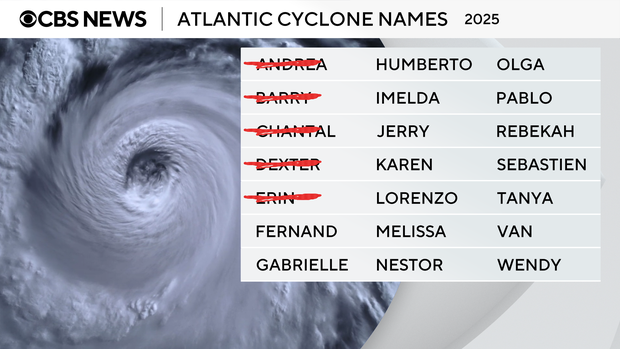
The U.S. National Oceanic and Atmospheric Administration, or NOAA, forecast an above-normal season for the Atlantic this year, expecting between 13 and 18 named storms.
Tropical storms have maximum sustained winds of at least 39 mph. Forecasters with NOAA anticipated that between five and nine of the storms this year could become hurricanes, which have sustained winds of at least 74 mph. Hurricanes are rated on a scale based on their wind speeds, ranging from Category 1, the weakest, to Category 5, the most severe rating.
NOAA forecasters predicted there could be between two and five major hurricanes in the Atlantic this season.
Nikki Nolan
contributed to this report.