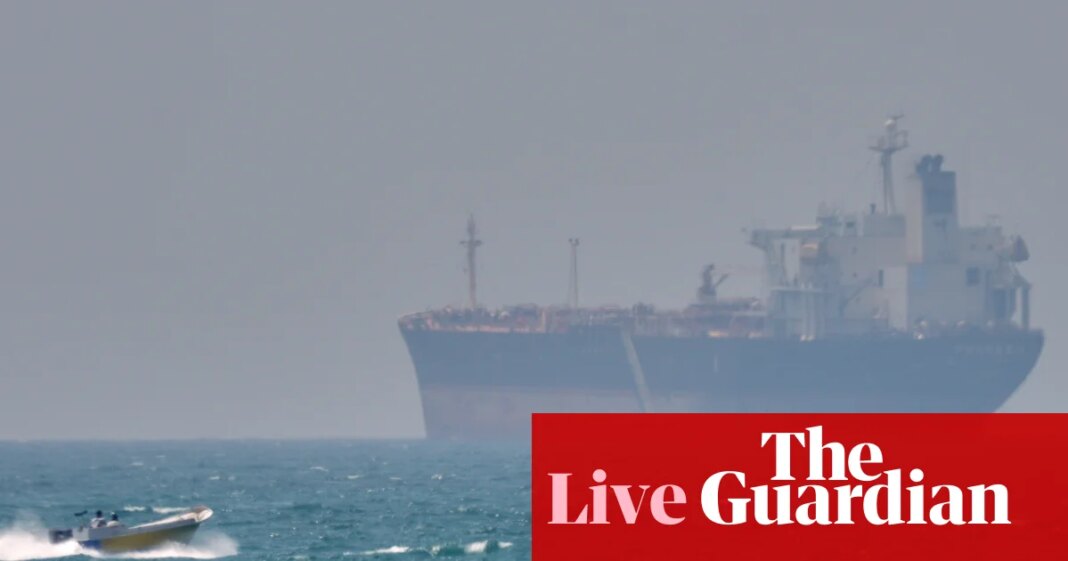
European stocks fall as ‘Hormuz chaos’ leaves markets on edge
European stock markets have dropped at the start of trading, as last Friday’s optimism about a Middle East peace deal evaporates.
In London, the FTSE 100 has dropped by 42 points, or 0.4%, to 10,626 points, away from a six-week high at the end of last week.
Germany’s DAX has fallen by 1.3%, and Italy’s FTSE Mib is down 1.1%.
The “chaos” over the strait of Hormuz has left the markets on edge, reports Chris Beauchamp, chief market analyst at investing and trading platform IG:
“Friday’s euphoria has given way to confusion around the status of Hormuz. While Iran has declared it closed, markets seem to be, as ever during this crisis, looking on the bright side.
US futures are down, and Europe is expected to open lower, but most of the gains are still intact. And oil futures aren’t back to where they were early Friday. If talks do get underway that will help support risk appetite, but this is far from a foregone conclusion that they will even begin right now.
A clear way out of the crisis is still impossible to foresee, and meanwhile the energy crisis continues to worsen by the day.”
Key events
Property asking prices rise in April despite higher UK mortgage rates
The Iran crisis hasn’t deterred UK homeowners from lifting the average asking price on British property.
Average new seller asking prices rose by 0.8% (+£2,929) in April to £373,971, new data from Rightmove shows, below the long-term April average of 1.2%.
Rightmove reports that the UK housing market has remained “surprisingly resilient” despite the jump in mortgage rates since the Middle East crisis began.
But… prices are rising fastest at the top of the market, where buyers are more likely to be paying cash, and in cheaper parts of the country (where a smaller mortgage would be needed).
Colleen Babcock, property expert at Rightmove, explains:
“With mortgage rates remaining elevated due to the war in Iran, it’s not a surprise that price growth is proving strongest in parts of the market less exposed to higher borrowing costs, such as top-of-the-ladder homes, while sectors more exposed to interest rates are seeing slower momentum.
Across Great Britain, Scotland stands out as an example of resilience, with average prices rising by over 4%. Lower average asking prices and a faster home-buying process continue to support price growth in the Scottish market.
However, for most of the market, the combination of rising mortgage rates and the number of homes for sale being at its highest level for the time of year over a decade, means that competitive pricing is crucial for sellers looking to attract buyer interest and secure a sale this spring.”
UK consumer confidence hits 33-month low
UK households’ confidence has fallen to a near three-year low as people grow more concerned about inflation and the jobs market.
Data provider S&P Global has reported that its Consumer Sentiment Index (CSI) survey has dropped to a 33- month low in April, dropping to 42.3 points from 44.1 in March.
Maryam Baluch, economist at S&P Global Market Intelligence, says:
“Consumer sentiment weakened further at the start of the second quarter, as the conflict in the Middle East weighed heavily on confidence. Views on the labour market soured for the first time in almost three years, while all other measures signalled more acute drags on overall sentiment, underscoring a growing unease among households.
“Increased energy-market disruption raises the odds of further spikes in fuel and utility bills, with headwinds keeping near-term inflation stickier than policymakers would like. Against this backdrop, households’ rate expectations have turned more hawkish, with a growing share of households now anticipating a tightening of monetary policy by the Bank of England.
“The strain on finances and an uncertain central bank policy outlook is showing up in consumer behaviour as households bear down on spending, particularly on big-ticket items, while running down savings at the fastest pace in a year. Debt undertakings, too, edged higher with the need for loans growing to the greatest extent in over two-and-a-half years.”
The renewed tensions in the Middle East have pushed the US dollar up to a one-week high against a basket of other currencies.
The dollar index is up 0.2% to its highest level since last Monday.
That’s nudged the pound down to below $1.35.
BoE deputy governor: Middle East conflict increases dangers of financial risks crystallising
The Bank of England’s deputy governor is warning that vulnerabilities in the financial world could lead to “a rocky ride” in the markets.
Sarah Breeden has singled out private credit markets, leveraged government bond markets and stretched asset valuations as three risk factors – should they all crystallise together, there could be a
Speaking at the HLS-PIFS Symposium on “Building the Financial System of the 21st Century: An Agenda for Europe and the United States” today, Breeden points out that the global financial crisis showed that crises often involve multiple vulnerabilities crystallising together.
Breeden says:
Across all three of these risks you can hear echoes of the past. The combination of leverage, complexity, concentrations and opacity rhyme with the vulnerabilities brought about by the rise of CDOs in 2007 and, more distantly, the development of investment trusts in 1920s. All at a time when the disconnect between high risky asset prices and real economy uncertainty seems marked.
I am not predicting the next crisis. But history suggests that when these conditions coincide, the system becomes more fragile.
The conflict in the Middle East raises the odds that one or more of these vulnerabilities could crystallise at the same time. Shocks to growth, inflation and interest rates hit all borrowers simultaneously. Because the system is interconnected, stress in one area can amplify behaviour in others.
UK government bond yields rise amid Iran conflict and Mandelson scandal
UK bond prices are weakening in early trading, hit by geopolitical tensions and domestic political uncertainty.
This has pushed up the interest rate (yield) on short and long-dated British bonds.
The yield on 10-year UK bond yields are up 5 basis points to 4.8%, while shorter-dated two-year bond yields are also up 5bps to 4.16%.
US government bond yields have also risen, but not by quite as much.
The higher oil price will add to inflationary pressures, potentially leading to higher interest rates.
Bond investors will also be watching the UK parliament today, where prime minister Sir Keir Starmer will explain to MPs how Peter Mandelson was appointed as the UK’s ambassador to the US having failed his vetting (as the Guardian revealed last week).
Richard Flax, chief investment officer at European digital wealth manager Moneyfarm, says this latest UK political scandal has brought renewed attention to the link between politics and bond markets, saying:
The Prime Minister is facing another tense period, between the latest revelations over Peter Mandelson and the prospect of difficult local elections in early May. Looking at prediction markets like Kalshi or Polymarket, we see that bettors reckon it’s 50-50 that Keir Starmer will still be in office in September.
We think this sort of uncertainty will make bond investors wary. Most replacements for Starmer within the Labour party would probably like to spend more freely than the current administration, suggesting higher taxes or a larger deficit. We’d argue that some of this is already reflected in starting UK government bond yields, which are high compared to their developed market peers. But we’d still prefer to take our UK government bond exposure in shorter-dated bonds, rather than add to longer-dated positions that could face more volatility.
The pound has also dropped by around 0.15% against both the US dollar and the euro.
Oil company shares rise
Energy producers are benefitting from the jump in the oil and gas price.
BP (+2.7%) and Shell (+2.4%) are leading the FTSE 100 risers.
Airline shares fall
European airlines are among the big fallers this morning.
Shares in IAG, which is British Airways parent company, are down 2.8% in early trading. Wizz Air (-4.2%) and easyJet (-3.5%) are also down.
Across Europe, Lufthansa (-3.5%) and Air France (-3.6%) are also weaker.
The re-closing of the strait of Hormuz last week may add to fears of jet fuel shortages in the coming weeks – last week, the head of the International Energy Agency said Europe has only six weeks of jet fuel left.
European stocks fall as ‘Hormuz chaos’ leaves markets on edge
European stock markets have dropped at the start of trading, as last Friday’s optimism about a Middle East peace deal evaporates.
In London, the FTSE 100 has dropped by 42 points, or 0.4%, to 10,626 points, away from a six-week high at the end of last week.
Germany’s DAX has fallen by 1.3%, and Italy’s FTSE Mib is down 1.1%.
The “chaos” over the strait of Hormuz has left the markets on edge, reports Chris Beauchamp, chief market analyst at investing and trading platform IG:
“Friday’s euphoria has given way to confusion around the status of Hormuz. While Iran has declared it closed, markets seem to be, as ever during this crisis, looking on the bright side.
US futures are down, and Europe is expected to open lower, but most of the gains are still intact. And oil futures aren’t back to where they were early Friday. If talks do get underway that will help support risk appetite, but this is far from a foregone conclusion that they will even begin right now.
A clear way out of the crisis is still impossible to foresee, and meanwhile the energy crisis continues to worsen by the day.”
European gas prices have also risen.
Europe’s benchmark month-ahead gas contract is up 5.7% at around €41 per megawatt hour.
UK to ‘flirt’ with recession as Iran war oil shock bites, report warns
The economic damage from the Middle East crisis will leave the UK skirting recession, economists predict.
The EY Item Club are forecasting today that the UK economy will flatline in the second and third quarters of this year, while unemployment is set to rise.
UK gas price rises
Gas prices are also rising this morning.
The month-ahead UK gas price is up over 6% at 103p a therm.
That’s still below last month’s high of 180p, but further above the 80p/therm levels recorded before the Iran war began.
UK advertising group M+C Saatchi has warned this morning that the Iran war is likely to hit its business this year.
M+C Saatchi told shareholders this morning:
Macroeconomic challenges remain, while the conflict in the Middle East is likely to significantly impact our sport and entertainment and consumer-facing business.
M+C Saatchi also reported a 7.3% drop in like-for-like net revenues, which it blames on last year’s US government shutdown in Q4, the fallout from Donald Trump’s tariffs, and a “tough macroeconomic environment”. Like-for-like profts fell 26%.
Middle East crisis: What the analysts say
Mohit Kumar of investment bank Jefferies remains hopeful that the US and Iran are moving towards a peace deal, despite the re-closure of the strait of Hormuz:
Markets are in a risk off mode this morning as tensions have escalated with Iran closing the Strait of Hormuz and US blockade still in place. US seized an Iran cargo ship and Trump threatened to destroy power plants and bridges in Iran. Tensions have also escalated between Israel and Hezbollah with the killing of two Israeli soldiers and attacks on Southern Lebanon. This follows constructive talks last week, where US and Iran were moving towards a deal and Iran had agreed to open the Strait of Hormuz.
Our view remains that we are moving towards a deal. Not because we believe that US and Iran have found a solution, but because of the MAD (Mutually Assured Destruction) principle. We are at a stage where it is not in the interest of either parties to carry on with the war. The MAGA base of Trump does not war to continue and Trump wants a deal. For IRGC, the objective is survival and destruction of infrastructure and economic hardship could sow the seeds of rebellion down the line. For Israel, the main objective is the weakening of Hezbollah and would not hinder a US Iran deal.
Jim Reid of Deutsche Bank suggests the stock markets – which have rallied strongly in recent weeks – may have got ahead of themselves:
Recent developments can be framed in two ways: either five steps forward towards peace and three back (seems more apt than three and two), or as evidence that the two sides remain far enough apart that a lasting deal will be extremely hard to achieve and markets have become far too optimistic. I lean more towards the former, but the comparison with recent history is uncomfortable.
Remember the 10%+ S&P 500 rally in the early weeks of the war in Ukraine, when hopes briefly grew of an early negotiated settlement, only to be disappointed. That episode is a clear warning sign.
It was a chaotic weekend in the strait of Hormuz, as shipping restrictions were first lifted and then reimposed.
According to Reuters, more than a dozen tankers, including three sanctioned vessels, passed through the Strait of Hormuz after a 50-day blockade was lifted on Friday.
They benefited from the brief window of opportunity before Iran reimposed restrictions on Saturday. A UK maritime agency reported that Islamic Revolutionary Guard Corps (IRGC) ships had fired at a tanker as it attempted to pass through the strait on Saturday
Bloomberg says there was “a chaotic 24 hours” as operators tested the openness of the strait – and while a small number of vessels did make it through the waterway on Saturday, most others turned around and abandoned their attempts.
Introduction: Oil rises with US-Iran ceasefire ‘on tenterhooks’
Good morning, and welcome to our rolling coverage of business, the financial markets and the world economy.
Complacency that the Middle East confict might have been approaching an end has vanished from the markets today, as concern grows that hat the ceasefire between the United States and Iran might not hold.
After tumbling on Friday, when the strait of Hormuz was declared open again, oil is now pushing higher after Iran announced the waterway was closed again.
Tehran blamed Washington DC for maintaining its own blockade on Iranian ports; the US responded by seizing an Iranian-flagged cargo ship that tried to get through.
Donald Trump posted on social media:
“We have full custody of their ship, and are seeing what’s on board!”
With Iran state media reporting that Tehran is not currently planning to take part in new talks with the US, the oil price has jumped.
Brent crude, which fell 9% on Friday, has now risen by 5% so far today, back to $95.60 a barrel.
Kyle Rodda, senior financial market analyst at capital.com, says there had been “a high degree of complacency” that the ceasefire would hold and a peace deal would materialise. Those de-escalation hopes are now at risk, he adds:
The markets are set for a spicy start to the week, with initial moves in futures and FX violent. Tensions about the control and closure of the Strait of Hormuz have flared again, threatening peace talks between the US and Iran.
While the ceasefire hasn’t formally broken down, it is on tenterhooks after Iran reversed its decision to end its blockade on the grounds that the US is still blockading Iranian ports. Iran has fired on ships trying to pass through the Strait and turned them around, while the US took control of an Iranian flagged vessel by force.
While hopes remain that it is in both sides best interests to de-escalate, there is the elevated risk that it doesn’t, plunging the global economy deeper into an energy crisis.
The agenda
-
7am BST: German producer prices for March
-
10am BST: Eurozone construction output for February
-
1.30pm BST: Canadian inflation for March