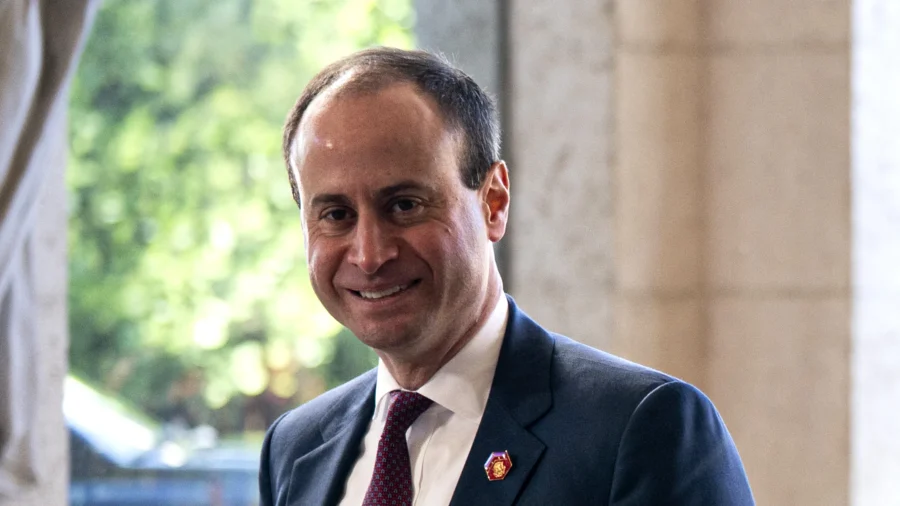
President Donald Trump announced Aug. 9 that Will Scharf, his White House staff secretary, will become Assistant to the President and White House counsel effective Sept. 1.
Scharf replaces David Warrington, who is leaving the administration for the private sector. Trump wrote on Truth Social on Sunday that Warrington had done “a truly outstanding job” in the role and previously on his presidential campaign.
“Will is Tough, Strong, and Smart! He also loves our Country, and respects the Law,” Trump wrote in his post. “Will Scharf will do a great job as White House Counsel!”
Trump said Scharf had represented him in numerous cases, including at the Supreme Court, during what the president called the Biden administration’s “corrupt and illegal campaign of Weaponization.”
He also cited Scharf’s work as a federal prosecutor and in private practice, two federal appeals court clerkships, and degrees from Princeton University and Harvard Law School. Scharf will hold the title of assistant to the president.
The White House counsel advises on legal and policy questions tied to the presidency. The office is the primary White House point of contact for the Justice Department, handles presidential pardons, works on judicial appointments, and reviews legislation. It also manages congressional investigations into the administration and lawsuits filed against the president in his official capacity.
The change comes months before the midterm elections, in which Republicans are fighting to keep control of Congress. Democrats have indicated they will pursue investigations into Trump and his administration if they win in November.
Trump also noted Scharf’s role as chairman of the National Capital Planning Commission, the executive branch agency with jurisdiction over construction and major renovations to government buildings in the Washington area. Trump named him to that post in July 2025.
The commission gave final approval in April to Trump’s $400 million White House ballroom project.
The panel wrote that Congress is the entity that appropriates funds for the maintenance of the White House or its improvements. In an example, the panel noted that Congress “authorized the repair and reconstruction of the White House after the British attempted to burn it down during the War of 1812.”
The dissenting judge, U.S. Circuit Judge Neomi Rao, wrote that the preservation group did not have standing to sue the administration and said that construction of the ballroom likely falls within Trump’s authority.
“The district court seized supervision of construction at the White House, and my colleagues affirm this judicial overreach,” Rao wrote in dissent. “Because the injunction is beyond the proper province of the federal courts, construction should be allowed to continue.”
Jack Phillips and The Associated Press contributed to this report.