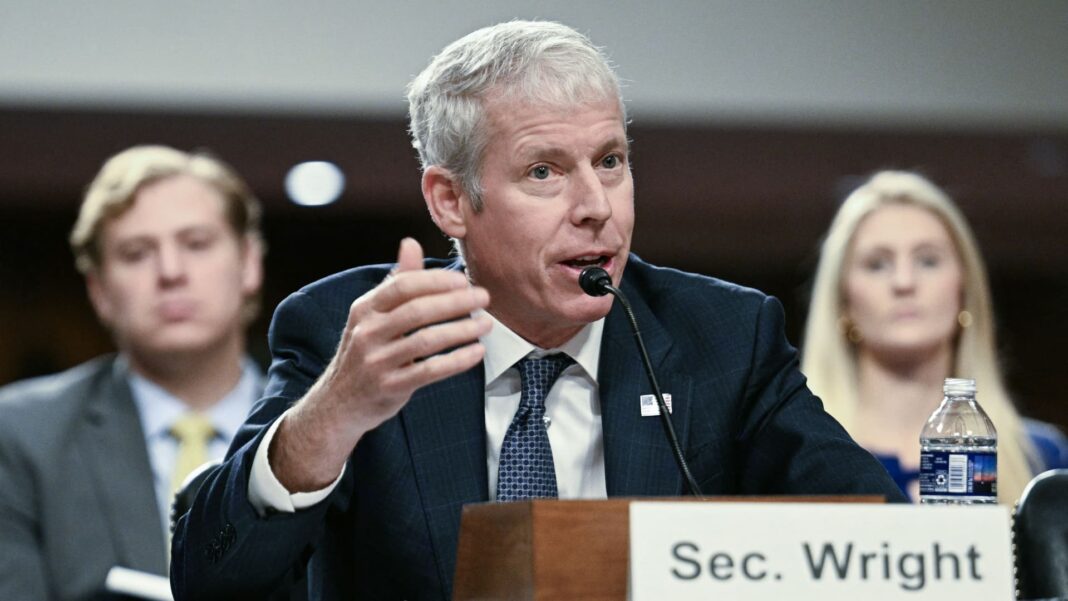
US Energy Secretary Chris Wright testifies before a Senate Committee on Armed Services Committee hearing to examine the 2027 budget for the Department of Energy and National Nuclear Security Administration on Capitol Hill in Washington, DC, on May 13, 2026.
Jim Watson | Afp | Getty Images
U.S. Energy Secretary Chris Wright on Sunday said the U.S. may not reach an elusive deal to constrain Iran from obtaining a nuclear weapon, as the U.S.-Iran conflict enters its seventh month.
“There may not be a nuclear agreement. It may be simply destroying their capabilities to do it,” Wright said on ABC News’ “This Week.” “An agreement may await the next administration in Iran. We simply don’t know that.”
Trump has repeatedly said preventing Iran from obtaining a nuclear weapon is a central objective of the U.S. campaign. He has also sought a negotiated deal with Iran throughout the war, which has sent energy prices soaring worldwide.
Wright’s comments suggest the administration may pursue its goal of preventing an Iranian nuclear weapon without reaching a negotiated nuclear agreement.
Pressed on whether Wright’s comments mean the U.S. will continue striking Iran when it attempts to rebuild its nuclear infrastructure, the energy secretary said, “You have to destroy their capabilities to do it.”
“We are degrading their capacity to develop nuclear weapons and ultimately to deliver them if they develop them,” he said. “It is a 47-year-long effort. This is not trivial, but the United States will get the job done and we will work in cooperation with our allies in the region.”
Asked about his comments again later during an appearance on CBS’ “Face the Nation,” Wright said President Donald Trump’s preference “is always to have a negotiated settlement and not use a military solution unless absolutely necessary.”
“The biggest role of our military in the region right now is to stop the export of any Iranian crude or crude-related products, natural gas, whatever,” he said. “We are strangling their economy to try to bring either a change in policy from the existing regime or a new regime.”
Iran threatens the U.S.
“If they haven’t understood by now, they should understand before it’s too late that the rules of the game have changed and that from now on, any violation of Iran’s interests and security will receive a ‘faster, heavier, and more painful’ response,” Ghalibaf said in a post on Telegram.
But Ghalibaf added that alongside the military conflict, Iran faces severe economic pressures.
“Severe fluctuations in the exchange rate, inflation, unemployment, and market management are fundamental challenges that have put serious pressure on people’s livelihoods,” Ghalibaf said.
He also stressed the need to rely more on domestic production and use technology to “devise short-term and permanent solutions.”
Ghalibaf’s remarks come after U.S. forces struck three Iranian crude oil carriers. U.S. Central Command said it permanently disabled one crude oil carrier off the coast of Kharg Island and one near Jask. Another oil tanker was attacked in the Gulf of Oman.
CENTCOM said the attacks were in retaliation for ballistic missiles the Islamic Revolutionary Guard Corps launched toward two Navy warships in the region. According to CENTCOM, a U.S. aircraft carrier and guided-missile destroyer successfully evaded multiple attacks, and no American personnel were harmed.
“Let the message to the IRGC be clear: If you shoot at two of our ships, we will impose an even higher economic cost —taking out three of yours,” Admiral Brad Cooper, CENTCOM commander, said in a statement Saturday. “We will not hesitate to defend American forces, and if necessary, destroy Iran’s limited and exposed oil fleet.”
Defense Sec. Pete Hegseth later wrote in a post on X: “It’s simple: if Iran shoots at U.S. ships, we will destroy (and sink) their oil tankers. All they have to do is not shoot at @USNavy.”
Iran is the third-largest producer in the Organization of the Petroleum Exporting Countries and exported 90% of its crude via Kharg Island before the war. Flows have been disrupted by a U.S. blockade of Iranian oil exports, which began in mid-April.
The conflict between Iran and the U.S. has effectively shut the Strait of Hormuz, a key waterway for the world’s oil supply before the war began on Feb. 28 with American and Israeli airstrikes.
U.S. President Donald Trump threatened in June to seize Kharg Island as the U.S. continued military strikes against Iran. Most recently, on Aug. 31, he posted an artificial intelligence-generated video of Kharg Island being blown up.
Tightening sanctions
The strike on the oil tankers came a day after the Treasury Department announced sanctions against a small Turkish investment bank and two of its subsidiaries, which the U.S. accuses of facilitating funds for an arm of Iran’s Revolutionary Guard.
The measures are part of sweeping sanctions the Trump administration launched in late August targeting Iran’s access to digital assets, advanced technology procurement, gold reserves, commercial aviation and shipping.
Iranian President Masoud Pezeshkian said late last month that the country’s trade has fallen sharply.
Iran’s gross domestic product is estimated to have contracted by 2.7% in the year ending March, according to the World Bank, citing economic disruption from last year’s widespread protests and intensified hostilities in the region.
Inflation surged to 62.2% in February, with food price inflation reaching a historical high of 99%, according to the World Bank. An Iranian official estimated that the war has caused the loss of one million jobs, according to the New York Times.