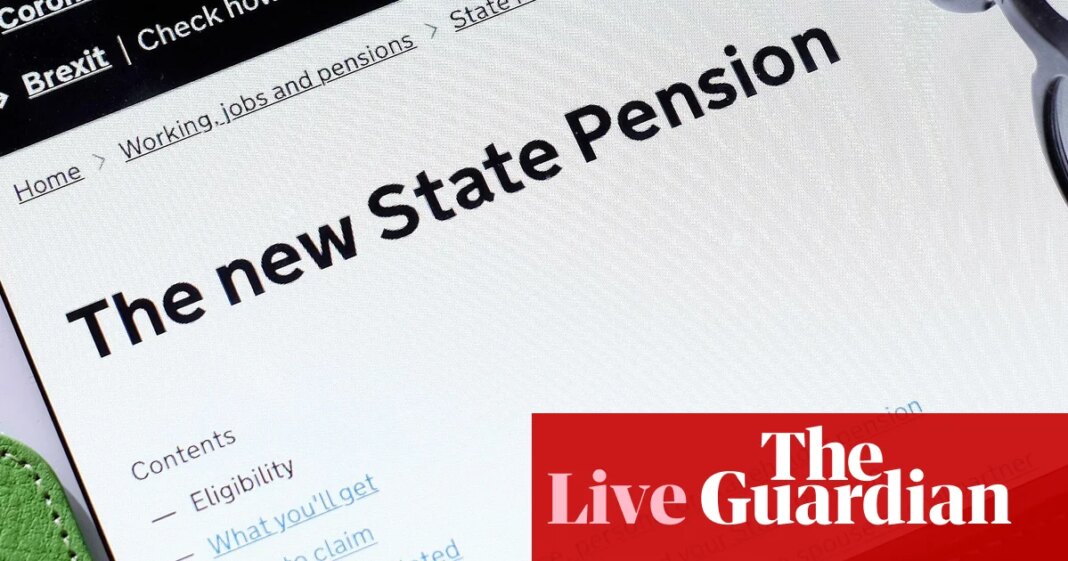
State pension set to rise by 3.9% after wage growth data
The UK state pension is set to rise by 3.9% next year, it appears, following today’s wage growth figures.
Under the triple-lock system, pensions rise by the highest of average earnings, inflation, or 2.5%.
So today’s data showing that total pay rose by 3.9% over the last year is likely to be the figure used to set the pension increase (unless we get a surge of inflation in September’s data to 4% or higher).
Assuming, of course, that the government continue to stick with the triple-lock – as there are calls to suspend it.
Jon Greer, head of retirement policy at Quilter, says:
“Today’s earnings figures show wage growth running at 3.9%, which puts a State Pension increase of a similar magnitude firmly on the cards next April under the triple lock.
“If confirmed, this would see the full New State Pension rise to over £13,000. While we will need to wait for September’s inflation figure before the uprating mechanism is formally confirmed, inflation is currently expected to remain below earnings growth, making an earnings-led increase the most likely outcome.
“For pensioners, another above-inflation increase will be welcome news and reflects the success of the triple lock in strengthening the value of the State Pension over time. The State Pension remains a crucial source of retirement income for millions of people and continues to provide the foundation upon which many build the rest of their retirement plans.
Key events
European markets in the red as US Treasury 10-year yield rises over 5%
European stock markets are in the red this morning, as investors fret about the ongoing sell-off in the bond market and the rising oil price (the two are linked!).
Britain’s FTSE 100 share index has lost 90 points, or 0.85%, to 10,606 points this morning.
Germany’s DAX and France’s CAC 40 are both down around 0.7%.
Neil Wilson, investor strategist at Saxo UK, says “Financials and miners are bearing the brunt in Europe, while AI stocks are down across Asia and the US.”
Investors seem rattled that the US 10-year Treasury yield has risen over 5% this week.
Wilson adds:
The US Treasury 10-year yield broke 5% for the first time since 2023 on Monday and advanced to a 19-year high as it touched 5.03% this morning…is this the point at which markets break?
5.25% is really when it gets dicey. Markets are pricing in a 93% chance the Fed hikes rates this week. While there are lots of reasons behind the bond rout, BMO says Treasury yields and oil prices haven’t been this closely correlated for seven years.
Today’s jobs report also shows that the retail and hospitality sector continued to lose jobs over the summer.
The British Retail Consortium has calculated that there are 122,000 fewer jobs in retail than two years ago, which will limit job opportunities for young people.
Stephen Evans, chief executive at Learning and Work Institute (L&W), explains:
“Headline stability in the job stats masks two underlying and related challenges. The first is that one million young people are not in education, employment or training, risking long-term harm to their career prospects. Ramping up efforts to change that can’t wait.
The second is the stalling of job growth in parts of the private sectors like retail and hospitality, down 150,000 payroll jobs since last year. This limits first job opportunities for young people and reflects underlying economic weakness that ongoing international uncertainty won’t help.
The employment rate is relatively high by international standards, but risks trending in the wrong direction with 3.9 million people not in work but saying they want a job.”
The drop in company vacancies over the last few months suggests demand for workers is weakening, warns Suren Thiru, chief economist at the Institute of Chartered Accountants in England and Wales:
“The ongoing drop in vacancies should set alarm bells ringing for the jobs market, as it suggests that demand for workers is wilting under the weight of soaring staffing costs, onerous regulation and increased automation.
“The UK labour market could be heading for a rockier autumn, as rising energy bills and pre-Budget tax uncertainty increasingly curb hiring intentions, resulting in moderately higher unemployment and lower pay growth.
The debate over the triple lock is set to be reignited by today’s news that the state pensions could rises by 3.9% next year.
So predicts Susannah Streeter, chief investment strategist at Wealth Club:
Pay growth is cooling, with regular earnings growth (including bonuses) easing to 3.9%, but that is hardly enough to make the inflation problem disappear. This snapshot points to a 3.9% rise in the state pension next April under the triple lock, with average earnings growth, the measure used for the calculation, being pushed higher by particularly strong public sector pay growth. Public sector pay is running at 6.3%, more than twice the 2.9% pace in the private sector, which reflects the impact of pay awards and the timing of them.
That’s likely to reignite the debate around the triple lock, particularly when government debt is already so high, and the cost of servicing it is painfully expensive. It may be even more controversial given that a pay measure which has been boosted by public sector wage awards is helping drive up the state pension bill at the same time as the government is already under pressure to contain spending and borrowing.
US government borrowing costs hit 19-year high
The bond market sell-off is continuing this morning, although the UK is avoiding the worst of it.
US government bonds, or Treasuries, are weakening, which is driving up the yield (or interest rate) on 10-year bonds back over 5% to the highest level since 2007.
UK bond yields are only slightly higher. They might be being suppressed by reports that the Bank of England will halt its sale of long-dated government bonds later this week.
That “quantitative tightening” programme has been blamed for boosting supplies of bonds in the market, pushing up yields.
How some pensioners could still avoid tax
If the state pension rises to £13,000 next year, it will probably breach the UK’s tax-free personal allowance (currently £12,570) – the amount you can earn before paying income tax.
However, pensioners who don’t receive any other income should still be exempt from paying tax if the state pension exceeds the personal allowance.
The House of Commons Library explains:
In the 2025 Budget the government announced the personal allowance would be frozen at its current level up to April 2031.
It also announced that pensioners whose sole income is the basic or new state pension would not have to pay small amounts of tax via simple assessment from 2027/28 if the new or basic state pension exceeded the personal allowance from that point. To date the government has not published any further details of how this is to be done.
However, if you had a private pension too, or earnings from dividends or bank interest, then you would be taxed on the earnings over the personal allowance.
Martin Beck, chief economist at WPI Strategy, has spotted that private sector employment has dropped since the start of the year.
He says:
“The latest UK jobs numbers suggest the labour market remains subdued. Unemployment was little changed over the summer, but payroll employment and vacancies continued to drop.
“Payroll employment fell 26,000 in August, while July’s 13,000 fall was revised bigger. The public sector continued to flatter the numbers. Private-sector employment fell, leaving it almost 141,000 lower than at the start of the year, but the public sector headcount continued to rise, up almost 36,000 since January.
Resolution: Pensioners are big winners today, private sector workers are the losers
The Resolution Foundation have spotted that private sector pay growth in the UK has fallen to its weakest level since the start of the decade.
At just 2.9% per year in May-July, pay growth in the private sector is the joint lowest rate since October 2020.
That’s weaker than the overall total pay growth of 3.9%, which is likely to be used to set the triple lock next year (see earlier post).
Worryingly, Resolution Foundation also forecasts that wages are “set to shrink significantly in the second half of the year as inflation rises”.
Julia Diniz, economist at the Resolution Foundation, said:
“The big winners from today’s ONS data are pensioners, who are set for another large rise in the state pension next spring thanks to the triple lock.
“The biggest losers are workers in the private sector who are already earning less than they were last autumn. With wage growth slumping to its lowest rate in nearly six years, the UK’s private sector pay squeeze will tighten over the coming months as inflation rises.
“With unemployment settling at around five per cent and the number of job vacancies continuing to fall, conditions are also tough for those looking for work, especially young people.”
The slowdown in total pay growth over the summer, and the drop in payrolled employeers, may deter the Bank of England from raising interest rates at its next meeting later this week.
The money markets indicate there’s a 67% chance that the Bank holds interest rates on Thursday.
Sanjay Raja, chief UK economist at Deutsche Bank, says the labour market still looks “sluggish”:
While economic growth continues to outpace expectations, the staggering fact is that it’s happening with fewer employees. Productivity growth, by definition, is pushing higher.
That said, there’s no evidence yet that the UK labour market is out of the woods just yet. For the MPC, this will matter. A still sluggish labour market will give the Bank some confidence that Bank Rate remains restrictive.
Supporters of the pension triple lock point out that it has lifted the living standards of the UK’s poorest pensioners.
Critics, though, argue that it has been more expensive than expected, and ties the government into increasing the pension bill each year regardless of economic conditions.
The Institute for Fiscal Studies (IFS) have worked out that by 2050, the triple lock could have cost as much as £40bn, although the calculations are rather murky.
They say:
-
The triple lock has increased annual spending on the state pension by around £16 billion, compared with uprating in line with average earnings growth since 2010.
-
Current forecasts from the Office for Budget Responsibility suggest that the triple lock will push up state pension spending by £600 million per year in 2029–30, compared with a baseline of increases in line with average earnings.
-
While this is small compared with total state pension spending (of £154 billion per year), each increase adds up over time and the triple lock’s ratcheting effect permanently locks in increases in spending. This is both costly and very uncertain in the long run, because it depends on the exact path of inflation and earnings.
-
We estimate that by 2050 keeping the triple lock would, in expectation, cost around £20 billion per year in today’s terms. But the high uncertainty means that, in fact, the cost could reasonably be anywhere between £5 billion and £40 billion per year.
Hargreaves Lansdown: Pensioners to get £490 boost under triple lock
Helen Morrissey, head of retirement analysis at Hargreaves Lansdown, is also expecting the state pension to rise by 3.9% next year under the triple-lock system.
Morrissey explains:
“Pensioners stand to be almost £490 better off next year as today’s earnings figures have a huge impact on next year’s state pension. The data, alongside September’s inflation figure and 2.5%, is a key component of the triple lock formula used to increase state pensions. With CPI inflation currently sitting at 2.9% it seems increasingly likely that today’s 3.9% increase in average earnings will be the figure used.
This would put someone on the full new state pension on course to receive £250.70 per week from next April – up from the current £241.30 per week. Someone on a full basic state pension would receive £192.10 per week – up from £184.90.
State pension set to rise by 3.9% after wage growth data
The UK state pension is set to rise by 3.9% next year, it appears, following today’s wage growth figures.
Under the triple-lock system, pensions rise by the highest of average earnings, inflation, or 2.5%.
So today’s data showing that total pay rose by 3.9% over the last year is likely to be the figure used to set the pension increase (unless we get a surge of inflation in September’s data to 4% or higher).
Assuming, of course, that the government continue to stick with the triple-lock – as there are calls to suspend it.
Jon Greer, head of retirement policy at Quilter, says:
“Today’s earnings figures show wage growth running at 3.9%, which puts a State Pension increase of a similar magnitude firmly on the cards next April under the triple lock.
“If confirmed, this would see the full New State Pension rise to over £13,000. While we will need to wait for September’s inflation figure before the uprating mechanism is formally confirmed, inflation is currently expected to remain below earnings growth, making an earnings-led increase the most likely outcome.
“For pensioners, another above-inflation increase will be welcome news and reflects the success of the triple lock in strengthening the value of the State Pension over time. The State Pension remains a crucial source of retirement income for millions of people and continues to provide the foundation upon which many build the rest of their retirement plans.
Vacancies dip again.
The estimated number of vacancies in the UK decreased in the latest quarter.
The ONS esimates that in June to August there was a decrease of 8,000 (1.1%) to 702,000, compared with March to May 2026.
ONS director of economic statistics Liz McKeown says:
“Vacancies remain at their lowest level outside the pandemic period for more than a decade, with smaller businesses continuing to report that increased labour costs are affecting hiring decisions.”
The Office for National Statistics has also found that the number of ‘workforce jobs’ in the UK has dropped.
It says:
The estimated number of workforce jobs in the UK was 36.7 million in June 2026. This is a decrease of 48,000 (0.1%) from March 2026, with decreases of 43,000 (1.0%) in the self-employment jobs component and a decrease of 10,000 (0.0%) in the employee jobs component.
Introduction: UK jobs market under the spotlight
Good morning, and welcome to our rolling coverage of business, the financial markets and the world economy.
UK companies continued to shed jobs over the summer, as wage growth slowed, new data shows.
The latest labour market report, just released, shows that the number of employees on company payrolls fell by 26,000 in August, and dropped by 145,000 compared with August 2025.
Despite that drop, though, the UK’s unemployment rate for people aged 16 years and over remains at 4.9% for the May to July quarter.
Workers’ pay packets are being squeezed, though, especially in the private sector.
Total pay growth (including bonuses) slowed to 3.9% in May to July, down from 4.2% on the previous three-month period. Regular pay (excluding bonuses) growth stuck at 3.5%.
But while private sector pay rose by 2.9%, annual average regular earnings growth was 6.3% for the public sector. That’s because NHS staff pay rises were paid out earlier this year.
ONS director of economic statistics Liz McKeown says:
“The labour market remains broadly stable, with employment and unemployment rates largely unchanged in the latest period. However, payrolled employee numbers continue to edge down, with falls over the past year particularly evident in the retail and hospitality sectors.
“Regular wage growth has remained relatively stable in recent months, while total pay growth, which includes bonuses, has eased and was last lower nearly six years ago. There remains a notable difference between public and private sector pay growth, with public sector figures continuing to be affected by the timing of NHS pay awards this year.”
The agenda
-
7am BST: UK labour market report
-
8am BST: UK grocery inflation report
-
10am BST: Eurozone industrial production report for July
-
1.30pm BST: US retail sales report