Nvidia ‘honeytrap spy scandal’ overshadows AI
Good morning, and welcome to our rolling coverage of business, the financial markets and the world economy.
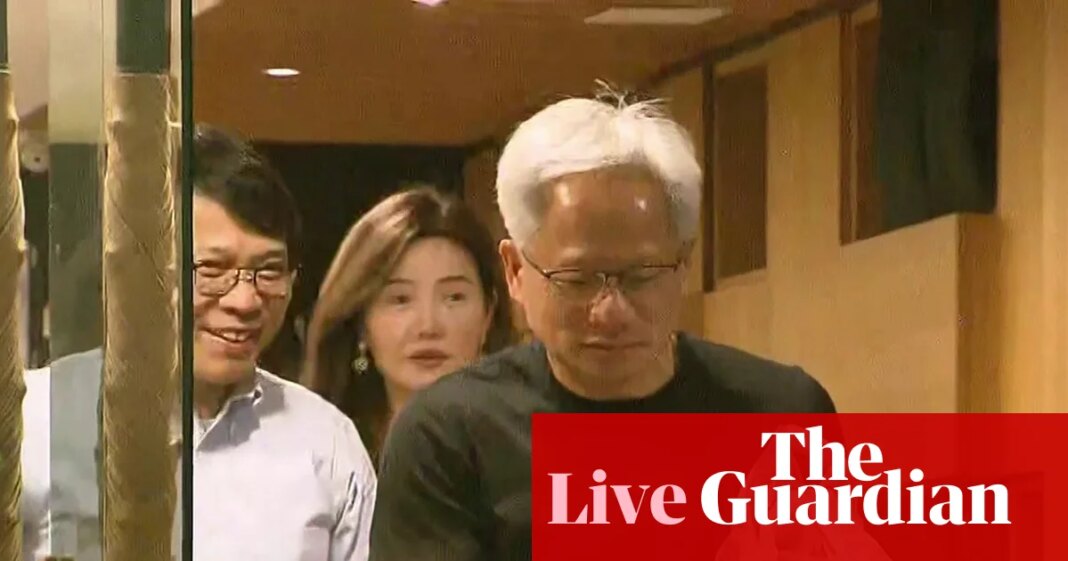
An apparent honeytrap scandal involving the boss of the world’s most valuable company and a suspected Chinese spy is rocking the AI sector.
Overnight, Nvidia announced it is launching an independent investigation following reports that founder and CEO Jensen Huang has been the target of “a foreign intelligence effort”.
That effort, reports claim, led to Huang conducting a romantic relationship with a Chinese woman, Alice Huang, who was recruited to spy for China’s Ministry of State Security intelligence agency.
Last night, Jensen Huang admitted having an affair, telling Nvidia staff:
“I owe my family and all of you an apology.
“I was unfaithful to my wife. My actions hurt her and our children. There is no excuse for what I did. I am deeply sorry.”
Jensen Huang added that he was “fully committed to Nvidia” and would work to earn back employees’ confidence.
However, the issue goes much further than simply a CEO’s conduct. It falls squarely within Washington’s concerns that it could lose the AI race to China.
Alice Huang worked for a Singapore-based datacentre company called Megaspeed, which has been suspected of routing Nvidia chips to China and evading export controls.
Jensen Huang has been a critic of those restrictions, arguing in May 2025 that US export controls designed to limit China’s access to AI chips were “a failure”, and had simply encouraged China to develop its own alternatives.
The revelation comes just a few days after shares in AI-linked companies tumbled, before a late recovery on Wall Street on Friday.
Today, Asia-Pacific markets are staging a recovery – Japan’s Nikkei has jumped by 2.2%, while Taiwan’s TAIEX has surged almost 5%.
South Korea’s Kospi is missing out, though, down by 0.6%.
The agenda
Key events
Nvidia is set to miss out on a Wall Street reccovery today.
In the futures markets, the tech-focused Nasdaq 100 index is up 1%, extending its recovery on Friday afternoon.
The futures contract for the Dow Jones Industrial Average, the famous (but narrow) US stock index is up 1.1%.
On the streets of Beijing today, people interviewed by the AFP newswire were mostly unaware of Jensen Huang’s affair and expressed scepticism at claims that he was linked to a Chinese spy.
One man surnamed Ma said that he did not think Huang’s affair was “a big deal”, doubting the incident would affect a potential meeting between Chinese President Xi Jinping and US President Donald Trump on the sidelines of the APEC summit next week.
Wen, a 56-year-old retiree, told AFP it was “a real shame” for Huang to have been caught cheating, as the entrepreneur is widely admired in China for his success in an “extremely critical” part of the tech industry.
The White House also has questions to answer about the Nvidia crisis.
The New York Times reported on Sunday that US secretary of state Marco Rubio drafted a memo which circulated among top policymakers in the Trump administration, citing intelligence that Nvidia’s chief executive, Jensen Huang, was in a close relationship with a Chinese spy.
The memo was circulated to administration officials with high-level security clearances ahead of Donald Trump’s trip to China in May.
Huang was initially left off the list of major business and tech executives invited to join Trump in China, but then added after media coverage about his absence.
How one hedge fund called out Jensen Huang’s ‘close relationship’ months ago
A New York-based short-selling firm raised concerns about the chipmaker’s business in China and its chief executive, Jensen Huang six months ago.
Back in May, Culper Research released a report which claimed that Nvidia had “a significant China problem”.
The report disputed Nvidia’s claim that its business in China went to “zero” after the US introduced trade restrictions on AI chips in April 2025, arguing that Nvidia chips were still reaching China through “sales to non-restricted intermediaries and diversion.”
Culper estimated that “over 20% of Nvidia’s FY 2026 compute revenues remained driven by China”, and that the company was still servicing Chinese demand via sales to non-restricted intermediaries and diversion.
The report also identified that Huang had maintained “an uncomfortably close relationship with Megaspeed’s Alice Huang, a Chinese national”….
…and claimed that Megaspeed – the Singapore-based cloud computing company – has been secretly financed by Alibaba via a series of apparent shell companies.
Culper warned:
We are short Nvidia and think shares are headed lower.
Nvidia’s shares have indeed fallen since May, when they traded around $225 each. Last Friday they closed at $186, and are expected to drop today.
Nvidia’s shares are still expected to drop around 5% when Wall Street opens at 9.30am in New York (or 2.30pm GMT).
But while the company has been plunged into unusual uncertainty, Amish Patel, head of equity research at Raymond James, argues that the wider AI industry still presents a big opportunity:
“Underlying demand for AI computing power remains exceptionally strong, while constraints around power and data-centre capacity are not going away.
That doesn’t mean the risks haven’t increased. The political debate around data-centre development has become more challenging in the US, while the situation around Nvidia creates additional uncertainty. At the same time, policymakers have to balance those concerns against the strategic importance of remaining competitive with China in AI. Nothing we have seen so far changes our fundamental view of the longer-term AI opportunity.
While it’s rare for a CEO to be caught up in an alleged spying operation, romantic entanglements involving high-profile executives do happen – and are often career-disrupting.
There are several example of chief executives who lost their jobs after conducting workplace relationships.
In 2019, for example, McDonald’s chief executive officer, Steve Easterbrook, was forced out of the fast-food giant after violating company policy by engaging in a consensual relationship with an employee.
Back in 2012, US defence company Lockheed Martin’s incoming president and chief executive officer resigned over a relationship with a subordinate.
European CEOs have faced similar conseqences. In September 2025, Nestlé dismissed its chief executive, Laurent Freixe, after he conducted an “undisclosed romantic relationship” with a subordinate that breached its code of business conduct.
And Bernard Looney lost his job as CEO of BP in 2023 after failing to disclose full details of personal relationships with colleagues.
These cases aren’t directly comparible to the Nvidia case – Alice Huang doesn’t work for the company, so her relationship with Jensen Huang isn’t a “supervisor-subordinate” one.
Technology analyst Dan Ives, of investment bank Yorkville Ives, has dubbed the investigation “a black eye moment” for Jensen Huang.
Ives predicted it will at the very least spark multiple congressional inquiries and “create an overhang on the stock for a myriad of reasons.”
In the near-term, Huang is expected to keep his job but risks being removed as Nvidia’s CEO depending on the board’s probe, Ives said in a statement.
“This will also increase major scrutiny regarding selling chips to China, which remains a key battleground issue in DC.”
The controversy surrounding Nvidia CEO Jensen Huang could complicate the recovery in the stock market after last week’s sell-off, warns Daniela Hathorn, senior market analyst at Capital.com.
Hathorn explains:
Nvidia’s board has stressed that it has no reason to believe company secrets were compromised and continues to express confidence in Huang’s leadership. Nevertheless, shares fell more than 3% in out-of-hours trading, highlighting the potential reputational damage.
Given Huang’s central role in Nvidia’s success and the wider AI investment narrative, even speculation about leadership uncertainty could unsettle investors. However, there is currently no confirmed indication that he will step down, and the controversy does not necessarily change the company’s underlying demand outlook.
Reminder: the investigation into whether Jensen Huang has been “the target of a foreign intelligence effort” will be overseen by a committee of Nvidia’s independent directors, assisted by “outside independent counsel”.
Last night, Nvidia said:
The Board prioritizes U.S. national and economic security, which is paramount to the interests of Nvidia and its shareholders.
While the Board has no reason to believe that either national security or Nvidia secrets were compromised, the Board’s inquiry will examine all available information.
Nvidia shares down in Frankfurt
Nvidia’s shares have already taken a hit in Frankfurt.
The chipmaker’s shares have dropped by 4.5% on the German stock exchange – a hint of what’s in store when Wall Street opens in just over four hour’s time.
Neil Wilson, investor strategist at Saxo UK, says:
Markets are trying to figure out what this means for arguably the world’s most important company right now. If Huang is forced to leave, what happens to Nvidia? As others have said, Huang is kind of irreplaceable for US leadership in AI.
There’s no upside from this – shares of Nvidia stumbled about 5% in pre-market trade. We just need to wait and see what the investigation throws up.
The scandal at Nvidia comes at a sensitive time for the US and China, as US president Donald Trump is expected to travel to China net week for a meeting with the Chinese president Xi Jinping and Russia’s Vladimir Putin.
Mao Ning, a spokesperson for the Chinese foreign ministry, said at a press briefing last week in Beijing that China “is in communication with relevant parties regarding a meeting between the three heads of state”, which could take place on the sidelines of the Apec summit in the southern Chinese city of Shenzhen, scheduled for November 18-19.
Trump told reporters on Sunday:
Well, I’m going to be going to China. and one of the meetings I think will be with President Putin and President Xi, and that’ll be interesting.”
…We’ll talk a lot of things, including denuclearisation, but we’ll be talking a lot of things. We’re trying to end the war in Iran.”
Nvidia shares drop 5% in pre-market trading
It looks like it will be a painful day for Nvidia shareholders– the stock is down 5% in pre-market trading, as investors assess the potential risks around Jensen Huang’s affair with an alleged Chinese spy.
The company, which is worth $4.5 trillion, is one of the most valuable businesses in the US. Its shares have grown by more than 500% in the past five years alone, as it has benefitted from AI-driven demand for its chips. This year however, its shares are down by about 1% – a fall that is likely to get steeper when the US stock market officially opens this afternoon.
Jensen Huang is now likely to face scrutiny over his defence on engaging with China and his criticisms of US chip restrictions.
He told Bloomberg last month:
I did my best to inform policymakers in the United States of the importance of engaging the Chinese market and making sure that we serve that market for as long as we can.
I think we made a mistake. And this mistake is hard to unwind, but I did my best.
There are more Chinese AI researchers than any other nation in the world, and many of them working at the labs.
I’ve been very clear that even though we compete against China, they’re not our enemies. If we care deeply about the safety of the world with respect to artificial intelligence, then of course we must open dialogues. We must work with them in every possible way.
What is Megaspeed, the company where Alice Huang – the woman who is suspected of spying for China – was a senior executive?
Megaspeed is a data centre company based in Singapore that buys Nvidia chips, and rents out their computing power to Alibaba and other Chinese businesses. Alice Huang, who is also known as Huang Le and is alleged to have had an affair with Nvidia boss Jensen Huang, helped set the business up as it was spun out from a Chinese gaming enterprise in 2023.
The company has come under scrutiny in the US for allegedly smuggling advanced Nvidia chips into China, which would violate US export controls. Nvidia previously launched an internal probe into these allegations, but found that there was no evidence of wrongdoing.
In October, Megaspeed told the New York Times that its “current leadership” takes the spying allegations “extremely seriously and is committed to getting to the facts behind these allegations.” It added that “outside counsel has been retained to conduct a thorough internal investigation and has notified the US government that we are fully committed to cooperating.
Reports suggest that Megaspeed has bought billions of dollars worth of chips from Nvidia in the past two years.
Nvidia ‘bombshell’ could ‘disrupt tech rebound’
Nvidia’s ‘honeytrap’ scandal could deal a blow to a potential tech rally when the US market opens later, after a bruising sell-off last week.
Susannah Streeter, chief investment strategist at the broker Wealth Club, says that while Huang’s reputation may have taken a hit, it would be hard to replace him as boss of one of the most valuable companies in the US.
Just when some calm looked set to be restored to markets, the Jensen Huang spy bombshell has hit, threatening to charge the tech sector with fresh volatility…
Right now the furore does not look as though it’ll pull him from his throne, given how intertwined Nvidia’s valuation is with his superstar tech status and his position as the architect of its dominance in the semiconductor market.
That expectation may reassure investors, that while headline dominating, the affair won’t be a big bump in the road for the company.
For now, the repercussions across the wider chip industry look relatively limited although the scandal could disrupt the tech rebound. Nvidia’s Asian suppliers have gained back ground following last week’s brutal sell-off, with Taiwan’s TSMC climbing around 4.7% and South Korea’s SK Hynix and Samsung also making progress. These are important relationships given that TSMC manufactures Nvidia’s advanced AI processors, while SK Hynix supplies the high-bandwidth memory essential to powering them. Samsung is also fighting to secure a bigger slice of that lucrative memory market.
Chris Beauchamp, chief market analyst at the broker IG, takes a more cautious view, warning that the news could deal a blow to the tech rally.
This market finds itself having to cope with some mad things. Tariffs, Iran and now Huang’s relationship with a suspected spy. This will be one for the history books if the market continues to selloff on such news.
…Given the size of the company and its importance to so much of the AI and tech boom this news is going to be of importance to more than just the company and US national security.”
European stocks are nudging very slightly higher this morning – the UK’s FTSE 100 is up 0.4%, while the Stoxx Europe 600 is broadly flat.
It is a bit early to look at US futures, but hard to resist on a day like today – the tech-heavy Nasdaq looks like it is poised to fall 0.7% when the US stock market opens later this afternoon, as investors digest the news that Nvidia’s boss may have been targeted by a Chinese spy.
The blue chip S&P 500 looks like it will be flat.
Chris Weston, head of the broker Pepperstone, said:
The market’s probably telling you now this does no favours to the stock whatsoever in a time when there’s a lot of conjecture as to the build-out of data centres.
Weston added he did not think Huang, whom he described as the “godfather of AI”, would be replaced.
If we genuinely thought he was going to step down … the stock would be down — it would be an absolute bloodbath, to be honest.
China rejects ‘baseless’ spying claims
China has now rejected claims that it had spied on Jensen Huang, chief executive of US chip giant Nvidia, calling the allegations “baseless”.
“We have responded to this matter previously. The narrative of a so-called Chinese spy is entirely baseless vilification and smearing,” foreign ministry spokesman Guo Jiakun told a regular briefing, AP reports.