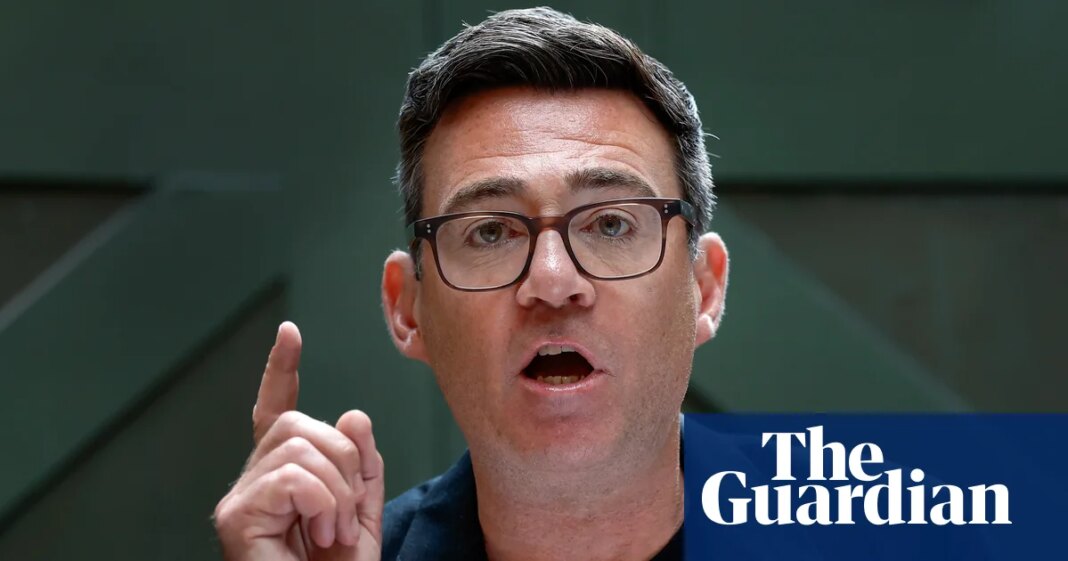
Andy Burnham has set out his blueprint to transform the UK with a promise to improve living standards and restore faith in politics through the “biggest rebalancing of power our country has ever seen”.
The person widely expected to be the next prime minister said the current system was “broken” and that “more of the same” would not be enough to tackle the significant challenges faced by the country.
In a wide-ranging speech anchored by an ambition to “lift the country back up” and to revive hope among fed-up voters, Burnham said there needed to be a dramatic “change in how Britain is governed, not just who governs it”.
With Burnham now all but certain to take over from Keir Starmer in less than three weeks’ time, his address was intended to show what direction he will take the country, and reassure both Labour MPs and voters who may feel he is untested, and even unprepared, for power.
Speaking at the People’s History Museum in Manchester, the new Makerfield MP, dressed in his now-familiar dark T-shirt and jacket, said a “new direction” was at the heart of his offer, which included:
-
A long-term ambition of greater public control of essential services such as water, housing, energy and transport to help curb the cost of living.
-
A No 10 North hub to oversee the distribution of power and resources from Whitehall across the country, which the Guardian revealed would be run by his former chief executive in Manchester.
-
The biggest council housing building programme since the postwar period, and a high street “renaissance” through reform of business rates.
-
Rebalancing an education system that he said had been too focused on the university route and putting academic and technical courses on an equal footing.
In his speech, Burnham once again sought to reassure that he would stick to Rachel Reeves’s fiscal rules, after he suggested last year the UK was “in hock” to bond markets, saying his programme was backed by the “discipline that comes from sound public finances”.
But he said he would not announce key cabinet positions until he was closer to power, urging people to ignore “wild speculation” over his pick as chancellor, which would give the clearest indication yet about his economic trajectory. Ed Miliband, the energy secretary, is thought to be favourite.
Hinting at an early package of cost of living support once he makes it to Downing Street, he acknowledged that “people can’t wait for ever for change” as many households struggle with bills and other everyday essentials.
“People need a bit extra now to help with rising costs,” Burnham said. “I will do my very best to deliver it and, whilst not taking risks with the public finances, will seek to give Britain some breathing space as soon as I can. People need to be able to look forward to a night out or a holiday with the kids. People need hope.”
Hope was a recurrent theme in the speech. “What hope can we have that it will be different this time? That is the question I would be asking if I was a voter right now,” he said.
“Westminster has not been working for people and it has not been working for a very long time. In fact, it is broken. And as a result, the country isn’t where it should be. It is stuck in a rut, and clearly we can’t go on like this.”
Burnham, who served in the last Labour government and sat on the opposition benches until he became mayor of Greater Manchester, said his generation of politicians had to take responsibility for not being good enough.
“Now that might matter less in a world where people’s lives are getting better but when they are not it is dangerous and destructive of what remains of cultural trust in politics,” he said. “We can’t go through another decade like the one we just had. We need a new determination to raise living standards … We need to change politics and we need to do it now.”
Burnham will set up No 10 North as the “nerve centre of a rewired Britain” to oversee a devolution of power and resources to mayors and local authorities across the UK. It would be run by Caroline Simpson, the chief executive of the Manchester combined authority, who has has been putting his vision of “Manchesterism” into practice and would become his deputy chief of staff under James Purnell.
after newsletter promotion
Burnham intends to remain living in his family home in Greater Manchester rather than in Downing Street, sources told the Guardian, suggesting he would only reside in the flat above No 10 during the week.
He also suggested Whitehall had long been “too adversarial” and different departments had wasted too much time fighting each other. “Let me say this very directly: the days of Whitehall fighting the devolution of power into the regions and nations are over for good.”
In a suggestion that he could legislate to force Whitehall to act more in the interest of the regions, the No 10 operation based in Manchester would be tasked with “striving for equivalent living conditions” in all parts of the country.
This could potentially mean following the German model, he hinted, where the federal government is legally required to share income tax and VAT revenues with the regions, and requires fiscal equalisation to reduce wealth disparities between areas.
Addressing concerns that Manchester did not necessarily reflect the entire north of England, Burnham said the hub would also allow power to flow to the Midlands, the south-west and London, as well as the north-east, Yorkshire and the Humber.
Burnham also indicated he wanted to take on the culture of Westminster and that, while “the political direction I set is not up for negotiation”, he wanted the whipping system to allow MPs to act as “authentic representatives” without fear of political retaliation.
He also suggested he would reach out to other political parties to find “as much common ground as we can” to help deliver his 10-year plan for change.
Meanwhile, Mark Rutte, Nato’s secretary general, has said he is confident Burnham will stick to the alliance’s long-term spending commitments and that he would recognise that rearmament can spur economic growth.
Burnham said UK public procurement policy – including in defence – would be focused on helping British-based companies, suggesting that would be the case even if it ended up costing taxpayers more.
Snap polling by JR Partners, commissioned by the campaign group 38 Degrees, found Burnham won agreement from Reform UK voters on regional devolution and utility control.
Ahead of the speech, Kemi Badenoch, the Tory leader, warned that the country was “headed for a summer of chaos”, with the economy “left in limbo” due to the lack of clarity over the policies of the “caretaker prime minister”.