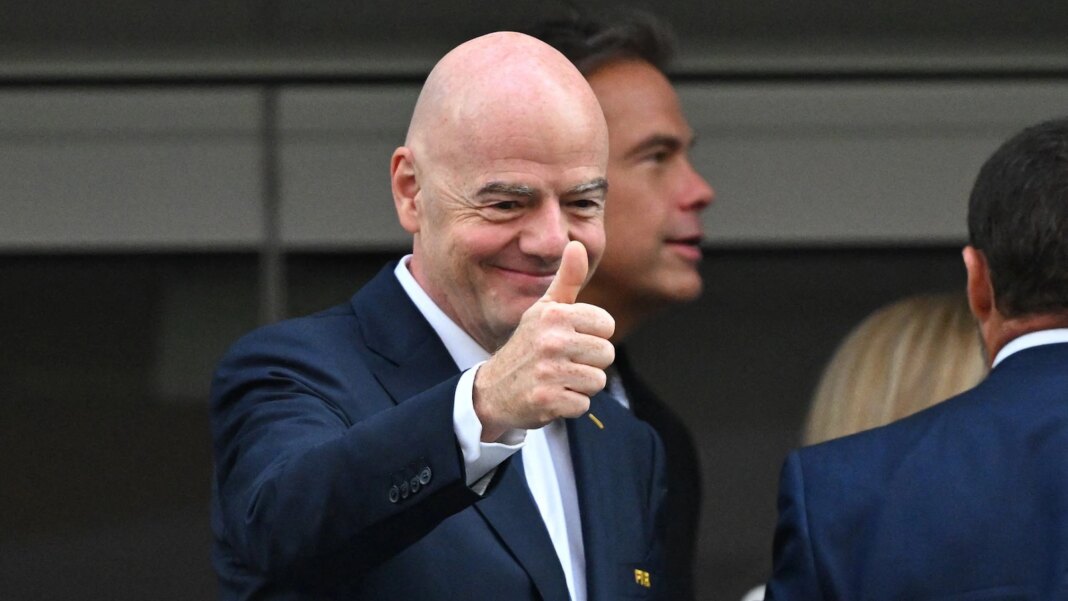
FIFA president Gianni Infantino has defended the controversial hydration breaks at the 2026 World Cup, insisting they are not driven by commercial interests and saying the governing body will review their future use after the tournament. The stoppages, which were introduced around the 22nd minute of each half in every match, have emerged as a significant topic of discussion during the expanded World Cup. Fans have booed the breaks, while coaches have questioned whether they disrupt the rhythm of games and turn football into something closer to a four-quarter sport.
Infantino rejected suggestions that FIFA had created extra windows for advertising revenue.
“I want to stress this because I hear as well it’s about money; it is not,” Infantino said. “We don’t make one dollar more in revenues in FIFA with these hydration breaks. Because all our contracts were signed well ahead of the decision to have these breaks. Broadcasters maybe, they make, they generate more. I don’t know, that’s great for them. But for us, we make zero additional revenues.”
Infantino said FIFA would analyse what it would do in future tournaments “based on this experience.”
The FIFA President said that the policy was introduced to maintain competitive balance across a tournament in which teams could play eight matches in 39 days.
“The most important element for us is to guarantee the sporting equity of the tournament,” he said. “If we were to use hydration breaks only in those matches where it was too hot and not in the other matches, we would give an advantage or a disadvantage to some of the coaches or some of the teams.”
That argument has done little to quiet criticism.
England coach Thomas Tuchel recently complained that mandatory breaks alter the game’s natural flow and effectively split matches into “four quarters.” While accepting the need for stoppages in extreme heat, Tuchel questioned making them universal, including in indoor venues.
Last night during the Portugal vs. Uzbekistan game, Azizjon Ganiev scored a goal right after the hydration break. Though it was disallowed by VAR review due to a foul in the run-up to the goal. Uzbekistan’s ball possession went up from 20 to 30% for the rest of the half.
This is somewhat like a strategic time-out in the IPL that gives time to regroup and often refresh. That has also resulted in the fall of wickets quite often.
Football supporters have voiced frustrations at these strategic hydration breaks. Loud jeers have accompanied several breaks, particularly in roofed stadiums such as Atlanta, where temperatures inside have been controlled.
Infantino, however, suggested the pauses may actually have improved the spectacle.
“Maybe the coach can reassess certain situations, correct certain mistakes. The players get a little rest and come back in full speed. Well, is that bad necessarily? Maybe it’s good,” he said.
“And we see as well the intensity of the games. We’ve never seen 90 minutes in a tournament like this played with such intensity. Until the last second of the match, players attack, and so on. And maybe, maybe not, but maybe it’s also a bit thanks to this little break.”
Infantino pointed to the Champions League final between Arsenal and Paris Saint-Germain in Budapest, where hydration breaks were also used despite mild evening temperatures.
He added that FIFA would assess the policy after the tournament.
“Based on this experience,” he said, the organization would decide how hydration breaks should be handled in future competitions.
But with criticism growing from coaches and fans alike, the hydration breaks have become an unexpected subplot of a tournament that FIFA insists has been played at full throttle.
Featured Video Of The Day
Tushar Deshpande’s Brilliant Final Act Ensures Thrilling Win For RR Over Gujarat Titans
Topics mentioned in this article