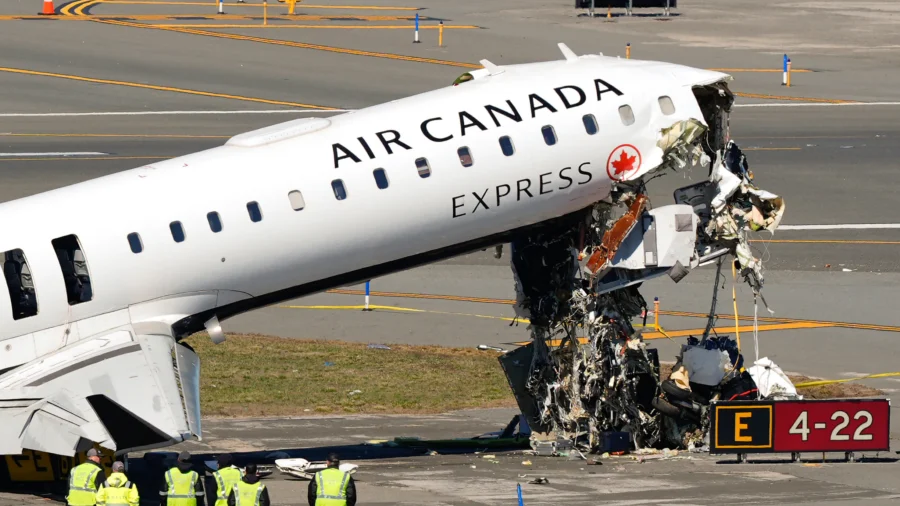
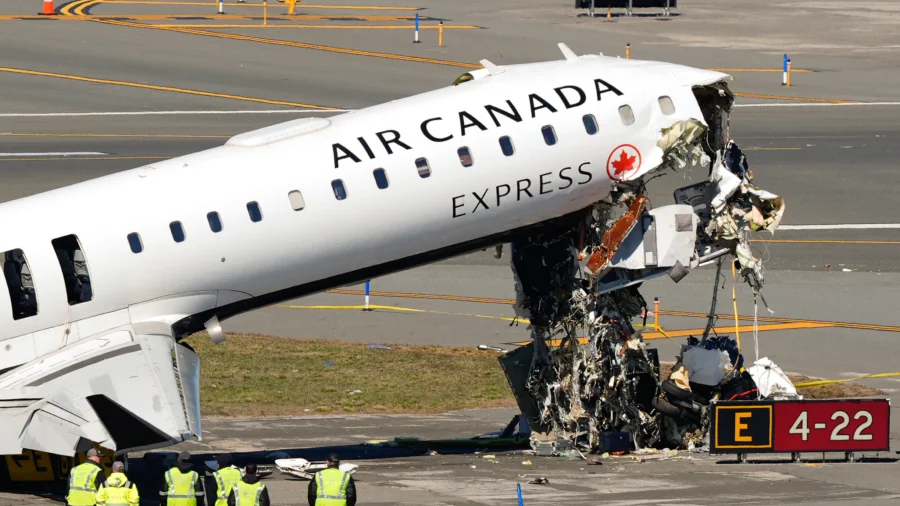
The National Transportation Safety Board (NTSB) released a preliminary report detailing the chain of failures that led to the March 22 nighttime collision. Jazz Aviation Flight 646—operating as Air Canada Flight 8646—struck an airport fire truck as the CRJ-900 jet touched down on Runway 4 just before midnight.
According to the NTSB report, 39 of the 76 passengers and crew members aboard were taken to local hospitals, six of them with serious injuries.
The airport’s ground surveillance system, known as ASDE-X, never generated a visual or audio alert warning controllers of the impending crash. The reason, investigators said, was that none of the seven emergency response vehicles on the taxiway—including the fire truck that crossed into the plane’s path—were equipped with transponders. Without them, the system couldn’t reliably track or distinguish the vehicles, leaving controllers blind to the danger. According to the agency, the FAA has long encouraged airports to outfit fire trucks with transponders to make their movements easier to monitor at busy airports.
Adding to the cascade of failures, red runway entrance lights—designed to warn vehicles when it’s unsafe to cross—went dark just three seconds before impact. The system is engineered to switch off those lights roughly two to three seconds before an approaching plane reaches each intersection.
The jet, traveling at 104 mph, touched down approximately two seconds before the crash.
The chaotic final moments unfolded quickly. The fire truck’s turret operator heard a voice on the radio shout “stop stop stop,” but was uncertain who the warning was meant for. Only after hearing “Truck 1 stop stop stop” did he realize the call was directed at his vehicle—and by then, the truck had already rolled onto the runway. He looked up and saw the approaching plane’s lights.
Controllers had been stretched thin. The ground controller—who also served as controller-in-charge—had been juggling a separate ground emergency near Terminal B, including two rejected takeoffs by another plane, leaving the local controller to manage transmissions on both radio frequencies simultaneously. The local controller had roughly 18 years of experience; the ground controller, about 19 years.
The fire trucks had been responding to that Terminal B emergency when Truck 1 requested and received clearance from the tower to cross Runway 4—at the very moment the Air Canada jet was less than a quarter mile out on final approach.
The captain and first officer were killed. The forward section of the plane was severely crushed, and both pilot seats were found separated from the plane in the debris field. Passengers self-evacuated through the jet’s four overwing exits in the dark.
The NTSB’s preliminary findings are subject to change as the investigation continues.