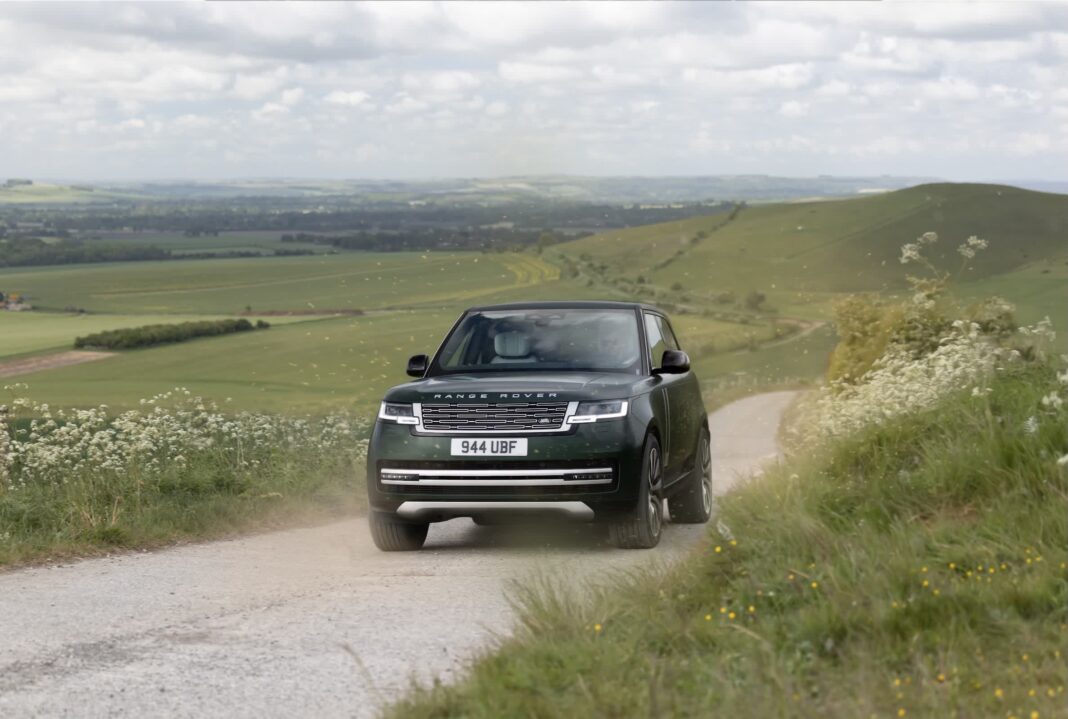
First look: Range Rover has introduced its first all-electric model, putting an 800-volt battery system and dual-motor drivetrain into its flagship SUV. It marks a major technical step for Jaguar Land Rover, combining fast-charging hardware, a large battery pack, and software-controlled off-road systems in a vehicle designed to preserve the Range Rover’s established identity.
The 2027 Range Rover Electric will be built at Jaguar Land Rover’s Solihull plant in England. It uses a 118.5-kWh battery pack, two electric motors, and a claimed EPA range of at least 333 miles. JLR says the SUV can charge at up to 350 kW, adding about 125 miles of range in 10 minutes. A 10% to 80% charge is expected to take 22 minutes.
The vehicle arrives about a year later than originally planned. It also comes as JLR works through supply-chain issues, lower profits, a restructuring program, and the aftermath of a cyberattack that halted production for more than a month last year.
JLR has upgraded its manufacturing operations in the West Midlands for EV production. The company said it has trained roughly 9,000 employees at Solihull for electrification work, along with another 1,500 workers elsewhere in the region. Its Electric Propulsion Manufacturing Centre in Wolverhampton is producing battery packs and electric drive units alongside internal-combustion engines.

The Range Rover Electric is based on JLR’s MLA platform, which was designed to support combustion, hybrid, and battery-electric powertrains. The electric version largely retains the shape of the current Range Rover. It has a revised grille, aero-focused wheels, and a flat underbody, but otherwise looks much like the gasoline and plug-in hybrid models.
Its front and rear motors are identical permanent-magnet synchronous units, each rated at 349 horsepower. Together, they produce 542 horsepower and 627 pound-feet of torque. JLR said the motors are 24% more efficient than those used in the Jaguar I-Pace.
The powertrain uses silicon-carbide inverters that can switch in less than a millisecond. Each motor contains 144 copper hairpin windings, with 0.2-millimeter laminations and a 0.7-millimeter gap between the rotor and stator. The power electronics are mounted in the space normally occupied by the transmission tunnel.

AESC supplies the battery cells, which use nickel-manganese-cobalt chemistry. The pack contains 10 modules arranged in a double-stack configuration. JLR said aerogel spacers help manage heat between the cells. Its ThermAssist system recovers waste heat from the powertrain. The company said the system can increase range by 7% and reduce cabin-heating energy use by 40%.
US-market vehicles will include a NACS charging port, Tesla Supercharger access, and ISO 15118 plug-and-charge capability. The SUV can also provide up to 3.6 kW of AC electricity through vehicle-to-load capability. JLR plans to add vehicle-to-grid support later.
The battery adds weight and also changes the SUV’s handling. The electric Range Rover is only 165 pounds heavier than the V8 version because it eliminates components including the front, center, and rear differentials and their driveshafts. The battery lowers the center of gravity by 3.4 inches, while its aluminum frame increases chassis stiffness by 56%, according to JLR.
Range Rover expects the electric SUV to reach 60 mph in 4.3 seconds. It has air suspension, twin-valve dampers, and rear-wheel steering that turns the rear wheels by up to 7.3 degrees. The vehicle weighs 6,195 pounds. One-pedal driving is optional, with regenerative braking of up to 0.2 G.
JLR says the electric model is 7 decibels quieter than the V8. Engineers added isolation around the front drive unit and addressed noise transmitted into the cabin through high-voltage cables. An active noise-cancellation system uses thin membrane speakers developed with Warwick Audio and installed in the headrests.

The electric Range Rover is designed to retain much of the off-road capability of its combustion-powered counterpart. Ground clearance is up to 10.3 inches, slightly less than the V8 model because of the rear drive unit. It can wade through up to 36 inches of water.
Instead of mechanical locking differentials, the electric model uses software-based torque management to control traction at the front and rear axles. JLR said the system can adjust power delivery based on available grip.
JLR said 80,000 people have registered their interest in the vehicle. About half are in North America, and 70% are new to the brand.