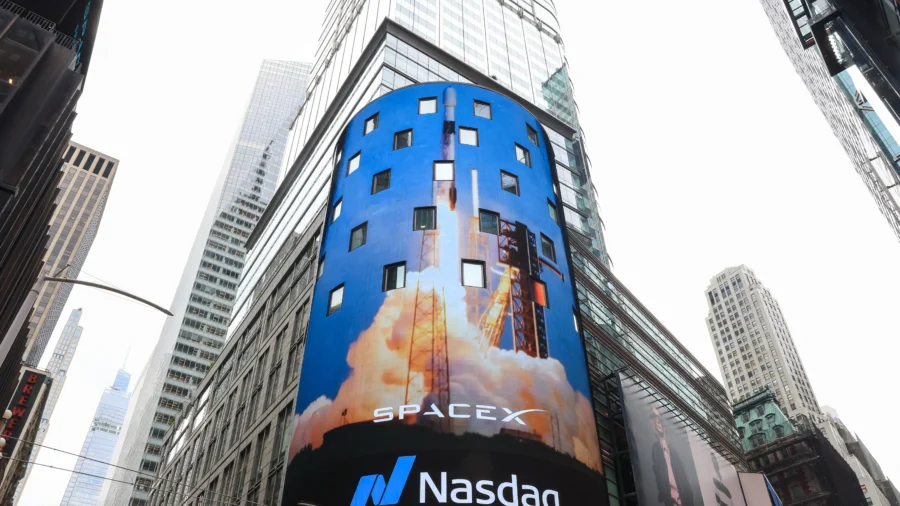
Elon Musk’s rocket, artificial intelligence (AI), and satellite company raised $75 billion during the largest IPO ever.
Underwriters—including Goldman Sachs, JPMorgan Chase, and Morgan Stanley—chose to purchase an additional 83.3 million shares under the overallotment. Referred to as the “greenshoe,” the overallotment is typically exercised when the stock rises.
This brought the total haul to $85.7 billion.
Shares of SpaceX climbed almost 20 percent on its first day of trading on Nasdaq, surging from $135 to around $161. To kick off the trading week, the $2.3 trillion company rose about 11 percent, reaching nearly $180.
Prominent investors were not taking early profits either.
Hold the Profit Taking
Billionaire investor Ron Baron confirmed to CNBC on June 15 that his investment management firm, Baron Capital, added to its stake in SpaceX. The company purchased an additional $1 billion in SpaceX shares at its debut, raising the firm’s position to about $25 billion.
“I think we’re going to make hundreds of billions of dollars,” Baron said in an interview with CNBC’s “Squawk Box.”
“What they’ve done isn’t possible for anyone else to accomplish. Not possible. And so he’s at least 10 years ahead of everyone else, as far as making satellites, as far as making rockets, as far as building networks.”
He anticipated that SpaceX would be valued at up to $40 trillion over the next 10 years.
“Normally, our economy doubles roughly every 10 years,” Baron added. “What he thinks is, by the innovations and the work that he’s doing, he’s going to make the economy grow 10 times in 10 years, not double.”
Gina Rinehart, the wealthiest person in Australia, purchased an undisclosed stake in SpaceX through her mining company, Hancock Prospecting.
“Elon has done what very few people in history have done—he has not just imagined the future, he has built companies capable of delivering it, and helped to keep American technology at the forefront,” Rinehart said in a statement on June 15.
“This is a significant investment for Hancock, and we are pleased to have received an allocation in what has been an extremely popular and oversubscribed IPO.”
Investors appear to agree, as the stock’s solid performance signals robust demand for companies at the forefront of innovation, said Evan Schlossman, principal at SuRo Capital.
“The fact that SpaceX was able to price such a large IPO—$75 billion in absolute value—and then see the stock move higher after the open speaks volumes,” Schlossman said in an emailed note to The Epoch Times.
“I think that a successful SpaceX IPO is generally a positive signal for broader investor interest in innovation and technology. It’s a reflection of the demand, interest, and desire to invest in these types of companies.”
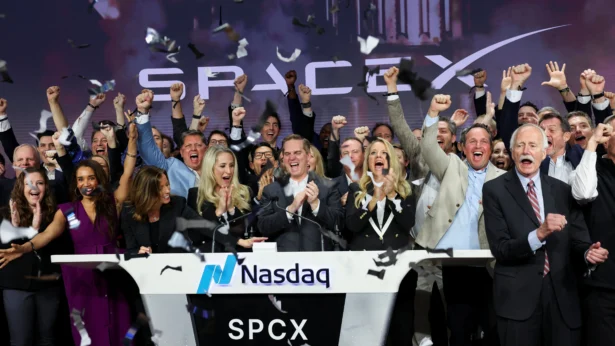
President and COO of SpaceX, Gwynne Shotwell, and CFO and President of Strategic Acquisitions, Bret Johnsen, ring the opening bell with company leaders during SpaceX’s IPO at the Nasdaq MarketSite in New York on June 12, 2026. Reuters/Brendan McDermid
Five Wall Street analysts initiated coverage of the stock last week, and four of them issued a “Buy” rating, according to MarketBeat.
‘Extreme Corporate Governance Policies’
Despite the ebullient atmosphere on Wall Street after SpaceX’s impressive debut, several groups are unhappy about its governance structure.
The prospectus submitted to the Securities and Exchange Commission (SEC) shows Musk with sweeping control over the company. Musk will have 85 percent of the voting power and own a little less than half of SpaceX’s shares.
Critics warn that this hamstrings shareholders and limits their power to hold SpaceX and its corporate leaders accountable.
“With extreme corporate governance policies to consolidate power with Elon Musk, the world’s first trillionaire, and provide itself with preemptive immunity from any meaningful legal accountability, SpaceX is availing itself of radical and dubious policy changes at the SEC and changes to Texas corporate law to wipe out protections for the very people whose investments are fueling its record-breaking IPO,” the Alliance to Protect Shareholder Value said in a statement to The Epoch Times.
The group—led by Americans for Financial Reform, the Consumer Federation of America, the Healthy Markets Association, and the American Association for Justice—is also concerned that retirement savers could be harmed now that SpaceX will be fast-tracked into indices and investment portfolios.
Weeks before the June 12 IPO, the Nasdaq updated its methodology to allow mega-IPOs—SpaceX, Anthropic, and OpenAI, for example—to be fast-tracked into its index. As a result, index funds would be required to purchase a stake in SpaceX.
Millions of passive investors will be forced to own a share of SpaceX, whether they want to or not.
Kevin Stocklin contributed to this report.