The US secretary of transportation, Sean Duffy, has announced a series of measures to help Spirit Airlines passengers following the low-cost airline’s collapse early on Saturday after running out of cash and the failure of rescue talks with the Trump administration.
Duffy said that larger US airlines, including United, Delta, JetBlue and Southwest, had agreed to cap ticket prices specifically for Spirit customers who need to rebook canceled flights, subject to a Spirit flight confirmation number and proof of payment.
American Airlines and Delta Air Lines would also offer reduced fares on high-volume Spirit routes, and ultra-low-cost carrier Allegiant has committed to freezing fares across routes that overlap with the failed carrier. A third airline, Frontier, would offer a 50% base-fare reduction to affected travelers, it was announced.
Duffy also said in a statement on X that most major US carriers will extend travel pass benefits and spare seats to Spirit pilots, flight attendants and other employees who need to return home after being stranded by the company’s collapse.
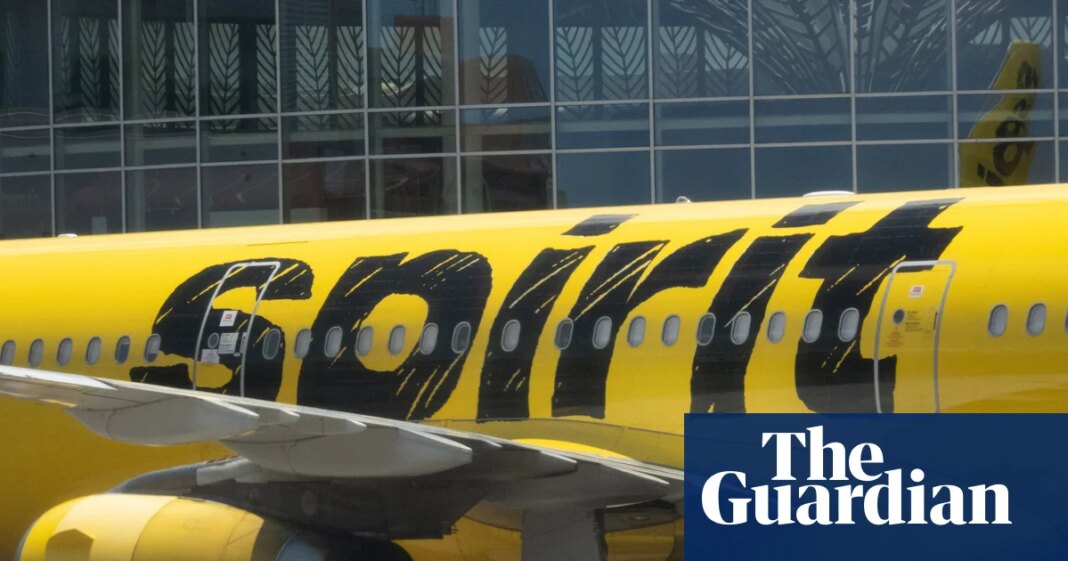
Spirit once operated hundreds of daily flights on its bright yellow planes and employed about 17,000 people, but early on Saturday it announced that after 34 years in business it had “with great disappointment … started an orderly wind-down of our operations, effective immediately”.
“To our guests: all flights have been canceled, and customer service is no longer available,” the airline said.
“We are proud of the impact of our ultra-low-cost model on the industry over the last 34 years and had hoped to serve our guests for many years to come,” the announcement continued.
The company had struggled to make a deal with its creditors and secure funding to maintain operations after shuttling in and out of bankruptcy twice in recent years. But the sharp rise in jet fuel prices since the start of the US-Israel war on Iran effectively sealed the fate of the airline.
The Trump administration floated taking a 90% stake to prevent Spirit’s collapse but the company’s bondholders rebelled.
Duffy said that Spirit employees would be offered preferential employment interviews, and that American and United would launch websites to ease that process. Spirit employed about 2,000 pilots and 5,000 cabin crew.
The International Association of Machinists and Aerospace Workers (IAM) said in a statement that Spirit’s collapse was “devastating for the thousands of airline workers” and blamed it on “corporate mismanagement and poor financial stewardship”.
“We call on Spirit’s leadership and the bankruptcy court to ensure that every worker receives the full severance, back pay, and benefits they are owed,” the major labor union said. “Workers should not be the last in line when a company fails.”
Duffy predicted Saturday that “after today we are going to see a stronger competitive market in our airline industry” and said he did not think the government needs to bail out other low-cost airlines that have in total sought $2.5bn in government relief because of high jet fuel prices.
“I would say that at this point, I don’t think it’s necessary. They do have access to cash. If they want to come to the US government, we would be a lender of last resort. If they can find dollars in the private markets – I think that’s better for them,” Duffy said at a press conference at Newark airport in New Jersey.
According to the Wall Street Journal, the decision to let Spirit collapse came during a 15-minute phone call between commerce secretary Howard Lutnick and Spirit CEO Dave Davis when they agreed that the ultra-low-cost carrier had run out of rescue alternatives.
Efforts to find a buyer included reaching out to rival JetBlue, which had a $3.8bn merger with Spirit blocked in 2022 on antitrust grounds, and American Airlines. Both failed. A plan to use the Defense Production Act to mobilize private industry to support Spirit under the guise of national defense also stumbled.
The failed airline will process refunds for any flight purchased through via credit or debit card, and existing ticket holders can also contact their credit card issuers for refunds under the Fair Credit Billing Act, or their flight insurance providers or the airline’s bankruptcy court.
After earlier reports that Spirit was close to liquidation, the Trump administration said it was working out a deal to keep the carrier afloat, including a potential $500m loan from the federal government. But the moves ultimately came to nought.
Donald Trump said last week he was aware the company had been struggling and the US president suggested the federal government could buy out the carrier.
On Friday, he told reporters an announcement could come later Friday or Saturday. “We gave them a final proposal,” the president said. “We’re looking at it, but if we can’t make a good deal – no institution’s been able to do it. I said I’d like to save the jobs.”
A creditor close to the deal said: “The Trump administration made an extraordinary effort to try and save Spirit, but you can’t breathe life into a corpse. Given that, the company should make its intentions clear for the sake of its customers and employees.”
Spirit’s woes predated the war in Iran, as the company has struggled to increase demand for its services since the Covid-19 pandemic.
A group of other budget carriers, including Frontier and Avelo, reportedly pitched a $2.5bn bailout to the Trump administration last week, arguing they had been disproportionately affected by higher fuel prices.
Budget airlines offer consumers low base-level fares but typically add on hefty fees for services such as carry-on bags and seat selection.
Founded in 1983 as Charter One Airlines, Florida-headquartered Spirit operated throughout the US, Latin America and the Caribbean.
Reuters contributed reporting