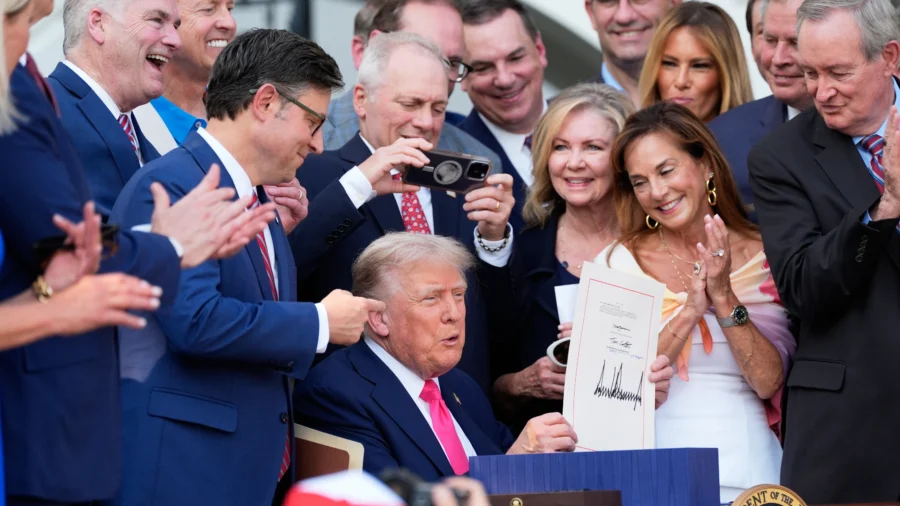
President Donald Trump’s signature tax legislation—the One Big Beautiful Bill Act—is expected to contribute to economic growth more than initially expected, the White House said.
The Council of Economic Advisers released the 2026 Economic Report of the President on April 13. The annual report offers a detailed assessment of the president’s policies over the past year and their effects on current and future economic conditions.
This year, officials concentrated on 14 topics, most notably the economic and fiscal effects of the president’s landmark bill, from gross domestic product (GDP) to inflation-adjusted wages.
Over the next four years, the White House now expects the bill to bolster real GDP by 4.9 percent, from the initial estimate of 4.6 percent.
Looking ahead to the 10-year budget window, GDP growth will be as much as 2.7 percent higher when combined with the administration’s other public policy endeavors.
Economic think tanks had presented various estimates during the fierce debate on the bill last year.
The Tax Foundation, for example, predicted that the tax provisions would increase GDP by 0.8 percent in 2026 and rise “to a peak of 1.2 percent in 2028,” before slowing to a long-run GDP boost of 0.7 percent.
“Temporary tax provisions, including tax deductions for overtime and tipped income along with temporary expensing for structures, will boost GDP from 2025 to 2028 before phasing out,” Tax Foundation economists said in their research.
A July 2025 analysis by the Penn Wharton Budget Model estimated that the GDP would decrease by 0.3 percent over 10 years.
“After 30 years, GDP falls by 4.6 percent and wages fall by 3.4 percent, due to capital shallowing relative to current law,” the group said.
Business Investment
One of the core components of the One Big Beautiful Bill Act was the reprivatization of the U.S. economy, allowing the private sector to drive economic growth rather than the government.
While individual taxpayers received lower tax rates, businesses were also given various advantages, including 100 percent bonus depreciation and full immediate expensing for research and development.
Real business investment is expected to increase by more than 10 percent, up from the initial forecast of 7.3 percent. The 10-year window projects as much as 8.5 percent growth.
“Permanently extending lower tax rates and full expensing of capital investment eases obstacles to business formation and expansion,” the 2026 economic report reads.
“This investment will drive more and better jobs for Americans, higher wages, and enhanced competitiveness in the global arena.”
According to the 450-page report, outcomes from the legislation have already been seen, with real nonresidential business fixed investment growing 5.5 percent, topping “the 3.7 percent pace recorded in the final two years” of the previous administration.

A technician works at an Amazon Web Services AI data center in New Carlisle, Ind., on Oct. 2, 2025. The United States has outpaced many advanced economies in growth and productivity over the past year, with some analysts describing the momentum as the start of a new industrial revolution. Noah Berger/Getty Images via Amazon Web Services
White House economists also attributed the increase to the president’s deregulatory agenda.
Artificial intelligence (AI), energy, and housing were cited as sectors that benefited the most from the removal of red tape and the reduction of permitting timelines.
A deeper dive into the data indicates that a majority of business investment growth was driven by the AI buildout. Investments in other industries, such as industrial and transportation, were anemic last year.
“Exactly how much of a boost [One Big Beautiful Bill Act] will provide, remains to be seen,” TD senior economist Thomas Feltmate said in a March 12 research note. “But past research on the impacts of the TCJA [Tax Cuts and Jobs Act] has suggested that the previous round of tax cuts did provide at least some boost to investment activity in the years following its enactment.”
Research suggests that TCJA-supported business investment growth was seen centered in specific industries or companies.
For example, corporate investment in equipment and structures increased by 8 percent to 14 percent, according to the Brookings Institution.
The 2017 law also lowered the average net cost of new investment, which dropped the “cost of new domestic capital goods,” according to a 2024 paper published by the National Bureau of Economic Research. As a result, the legislation bill bolstered “domestic investment spending by about 3 percent, and a 1 percent decline in the cost of foreign capital investment also has a positive effect of about 0.6 percent,” it said.
Still, according to the White House, productivity gains from these deregulatory efforts could translate into an additional 0.8 percentage point of GDP growth.
Wages
Workers’ earnings have taken a hit over the past month due to the spike in energy prices, but this could be temporary, based on the White House’s forecasts.
Inflation-adjusted wage growth is estimated to surge between $4,000 and $7,200 per worker over the next four years.
Additionally, the White House says, the typical annual family take-home pay (two children) will increase by $7,600 to $10,900.
“These gains will support American workers in recovering the roughly $3,000 in spending power they lost during the previous Administration,” the council stated.
Since the outbreak of war in Iran, inflation has chipped away at workers’ paychecks.
In March, real average hourly earnings declined by 0.6 percent, stemming from a 0.2 percent rise in earnings and a 0.9 percent increase in the Consumer Price Index. Real average weekly earnings also dropped 0.9 percent.