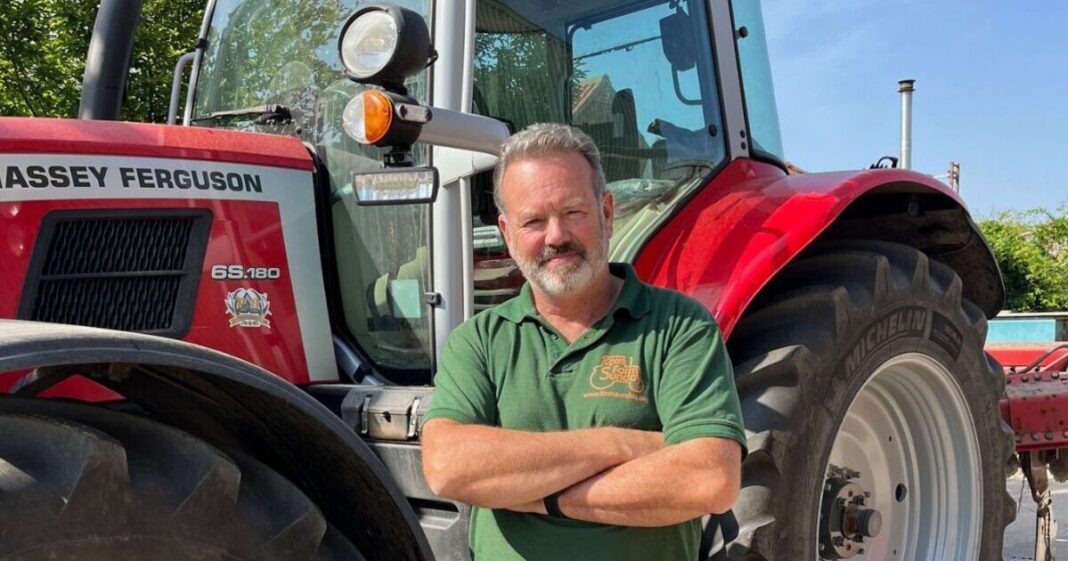

Richard Bramley says his harvest is down 25% on expectations this year (Image: Richard Bramley)
British farmers have criticised the Government for pausing a scheme that helped future-proof food production against extreme weather – after a raft of other “incompetent” policies. Richard Bramley, 57, was still reeling from Labour’s introduction of inheritance tax for farms worth over £1 million when he recorded a 25% drop in crop yields, following the driest six months in England in nearly 50 years. The third-generation arable farmer is one of many impacted by the extreme conditions across the country, with five areas – including his home county of Yorkshire – officially in drought, and six more experiencing prolonged dry weather.
Lower yields have also exacerbated the financial challenges faced by small farm owners, who are also contending with high running costs and the impact of tax rises on diversification projects including farm shops, event venues and accommodation. Mr Bramley said his efforts to invest in soil health at 550-acre Manor Farm, allowing it to retain moisture for endurance during hot and dry periods, could be impacted by Labour’s pause on the Sustainable Farming Incentive (SFI) scheme – which financially rewards farmers for adopting sustainable farming practices. The Government said it will provide more information about the scheme’s future later this year.
Read more: Farmers slam ‘growing absurdity’ of taxpayer-funded vegan councils
Read more: UK dairy farmers speak out over food security crisis threatening entire country

The soil at Manor Farm was particularly dry during a period of hot weather in May (Image: Richard Bramley)
An uncertain economic picture and shift towards food imports – including through new deals with the US and the EU – has also made the 57-year-old fear for the sector’s future, with “no one paying attention” to the pressing crisis posed by a hotter climate.
“We’re operating on extremely tight margins,” he told the Express. “We already have to think about how we’re growing to sow next year’s crop – that will be directly funded by what we manage to earn this year.
“A normal economic cycle would see low crop supplies pushing prices up, but in recent years, there’s been an influx of exports to plug that gap, so prices have been suppressed. We’re dealing with low yields and low prices.”
It’s a demoralising position to be in, Mr Bramley says, especially while navigating the extensive red tape that – rightfully – makes UK food production a leader in high safety, welfare and sustainability standards.
“The SFI was a mechanism the government introduced to help us keep that reputation,” he said. “But it’s been paused indefinitely. That shouldn’t be happening – there needs to be more long-term thinking and recognition of worthwhile investments.”
“One of the major frustrations is that we can all see what’s coming. We’re living and breathing the climate impact. We’re seeing the global instability and we know all too well the struggles of being a UK food producer.”

Mr Bramley is also Environment Forum Chair for the NFU (Image: Richard Bramley/NFU)
He described the Government’s wider approach to agriculture, including its inheritance tax reform, which the Express is fighting against as part of its Save Britain’s Family Farms campaign, as a “huge own goal” by Chancellor Rachel Reeves.
“It shows utter incompetence,” he said. “Just a lack of knowledge about the economics of food production. A lot of farmers will be borrowing on assets they’ve got to ensure they can sow next year’s crop.
“Farms are the backbone of rural economies, but there seems to be a belief that we’re a rich country and don’t need to be reliant on homegrown food. It’s very shortsighted. Farmers will be saying ‘I told you so’ in a decade if this isn’t addressed.”
James Robert Blyth, 42, who runs Lower Farm in Ardleigh, Colchester, has similarly struggled to equip the land to deal with the growing climate threat.
He says he invested in a reservoir for irrigation, water management and natural soil regeneration four years ago, but has struggled to obtain an abstraction licence from the Environment Agency – and has not yet been able to put it into action.
The 42-year-old’s family built the reservoir at their own expense, but believe their licence application has been repeatedly pushed to the “bottom of the queue”. They are now considering giving up the effort altogether.
“Four or five months ago, we were asked to resubmit under a new pricing structure – which involves the application fee rising from around £600 to around £8,000,” he said. “We’re not even guaranteed to get the licence if we do apply again.”
For Mr Blyth and his family, it is just the latest in series of struggles – as they consider their next steps after the inheritance tax changes come into force next spring.
“It feels like we’re being attacked on all sides,” he said. “The advice was always for my father to keep the land in his ownership until he dies – but now my sister and I, who run the business with him, have to work out which part of it to sell off so we can keep farming.”
“If we had permission to use the reservoir, we know our yield this harvest would be higher,” he added. “Some fields have produced around four tonnes a hectare where we would have expected nine tonnes. And, with grain prices dropping, it feels like a double blow, for us and farmers across the country.”

Mr Blyth runs Lower Farm alongside his father and sister (Image: James Robert Blyth)
Chad Staddon, professor of resource economics and policy at UWE Bristol, said the immediate impact of climate change on English agriculture is concentrated in eastern regions, where irrigation is more common.
“The dry spring and summer have led to tightening restrictions on water abstractions from the natural environment by all users including farmers,” he said. “These restrictions have bitten hardest in eastern parts of the country including Norfolk, Suffolk and Cambridgeshire.
“Over 200 farms in East Anglia faced total cessation in surface water access in July, through what are called Section 57 irrigation bans, but this was later relaxed after intervention by the National Farmers Union (NFU).
“Other areas where drought has been formally declared include Lancashire, Greater Manchester, Yorkshire and the East and West Midlands. As of mid-August, over 800 water abstraction licenses are subject to curtailment, limiting or stopping irrigation from these sources. As for the status of reservoirs, as of mid-August, most were reporting volumes between 47% and 53% of total capacity.”
Rachel Hallos, Vice-President of the NFU, said: “The increasing extreme weather we are experiencing is impacting our ability to produce food, which will have substantial financial consequences on farm businesses.
“Although parts of the country have seen some rainfall, and farmers are no strangers to unpredictable weather, the extremes this year have been unprecedented. Last year’s harvest was marked by heavy rain; this year, it’s the lack of it. These fluctuations of drought and flood are becoming more pronounced and more regular.”
“Food security must be a national priority and that means the government supporting farmers and growers to build resilience,” she added.
“Farmers and growers need investment in climate adaptation and resilient crop varieties to safeguard our ability to feed the nation, weather market volatility and adapt to a changing climate.
“We also need investment in water infrastructure across the wider farming sector and planning reforms that allow us to better capture and store in times of plenty for use when it’s needed.”
A spokesperson for the Department of Environment, Food and Rural Affairs said: “This government has allocated a record £11.8 billion towards sustainable farming and food production and we will outline updates to our reformed SFI offer later this year.
“We are working with farmers to build greater resilience to climate change including through the National Drought Group.”