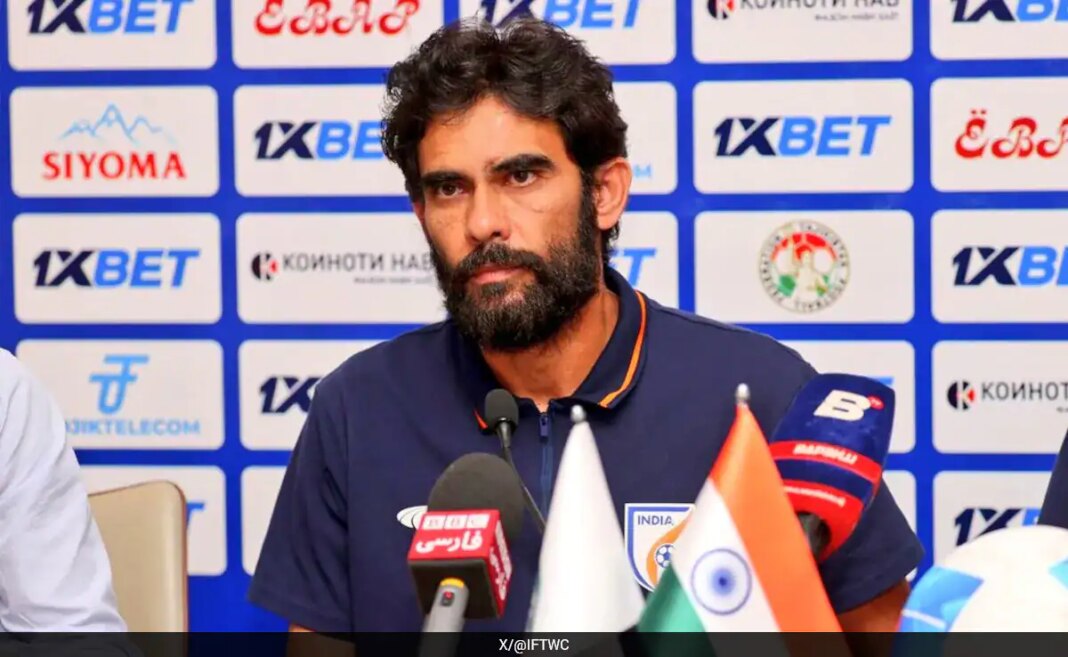
Indian football continues to find ways to trigger new controversies. Still recovering from last year’s Indian Super League drama, a fresh off-field row erupted ahead of the national team’s AFC Asian Cup qualifier against Hong Kong, after head coach Khalid Jamil and several players were denied entry into the Jawaharlal Nehru International Stadium in Kochi. The reason: a payment dispute. The unprecedented scenes in Kochi caused major disruption to pre-match media duties, raising serious questions about administrative coordination.
The team had arrived at the stadium in Kochi for a scheduled press conference ahead of their match against Hong Kong. It was the national team’s first game in Kochi in nearly a decade. But what transpired as the coach and players attempted to enter the stadium left everyone stunned.
Jamil, along with Ashique Kuruniyan, Sahal Abdul Samad and Bijoy Varghese, was prevented from entering the stadium by security staff of the Greater Cochin Development Authority (GCDA). Even journalists were denied access, triggering complete chaos.
READ | 1.4 Billion People Not Enough: Stuttgart Explains India’s Football Crisis
After non-payment was cited as the reason behind the incident, Kerala Football Association (KFA) president Navas Meeran attempted to downplay the situation, calling it a minor technical problem. He also assured that the match against Hong Kong, scheduled for 31 March, would go ahead as planned.
“The Asian Cup qualifier will go ahead as planned. What happened on Thursday was a minor technical problem, and it will be sorted out soon,” Meeran said.
According to reports, the GCDA demanded a security deposit of Rs 20-25 lakh and an additional Rs 3 lakh as rent to make the stadium accessible again. GCDA officials refused entry without full payment, while the KFA requested more time.
At the same venue in February, Indian Super League (ISL) club Kerala Blasters had also been denied entry ahead of a match due to a similar payment dispute. The venue is owned by the GCDA, but matches are organised through the KFA. From these recent incidents, it is clear that coordination between the two bodies needs significant improvement.
Topics mentioned in this article