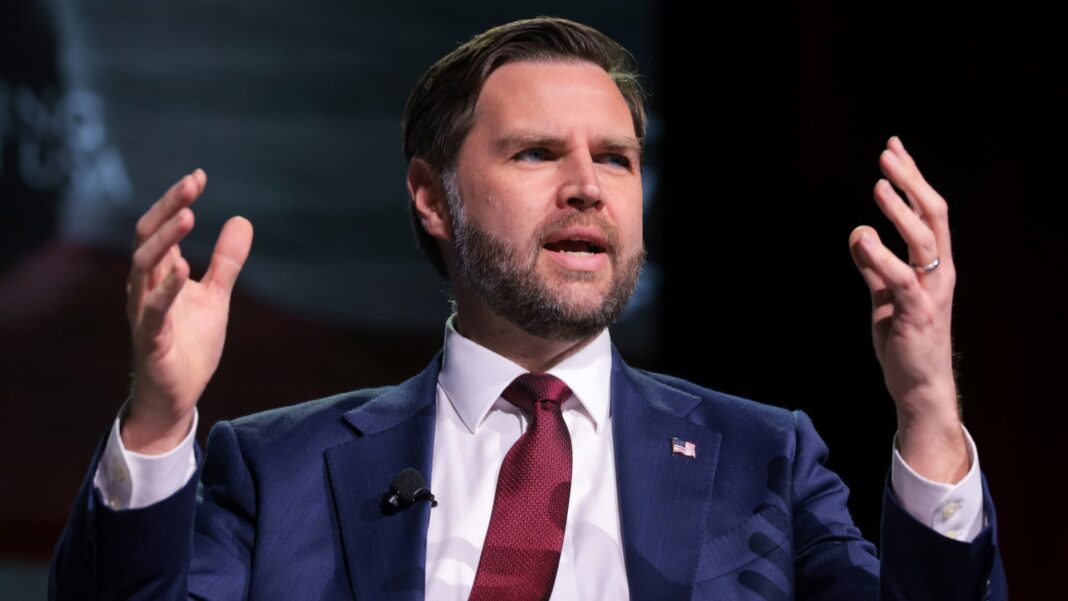
U.S. Vice President JD Vance speaks during a Turning Point USA event at Akins Ford Arena at the Classic Center on April 14, 2026 in Athens, Georgia.
Chip Somodevilla | Getty Images
President Donald Trump this month sent Vice President JD Vance to Hungary to boost its embattled prime minister and then to Pakistan for peace talks with Iran in hopes of ending the war the U.S. and Israel started.
Both trips ended with highly visible setbacks and some awkward moments, leading to questions about whether Vance’s political star is still rising or if he’s being saddled with some of the administration’s heaviest burdens.
Vance became the face of the U.S. delegation that last weekend failed to clinch a peace deal with Iran after a marathon 21-hour negotiating session in Islamabad. Tehran would not affirmatively commit to not seeking a nuclear weapon, Vance said.
The talks generated an unusual split-screen: As Vance delivered the news from the Pakistani capital that “we have not reached an agreement” with Iran, Trump and Secretary of State Marco Rubio were photographed together at a UFC fight in Miami.
U.S. President Donald Trump speaks with Secretary of State Marco Rubio and UFC CEO and President Dana White during UFC 327 at Kaseya Center on April 11, 2026 in Miami, Florida.
Julia Demaree Nikhinson | Getty Images
“I think Trump is likely to play the two of them, and other candidates including [Florida Gov. Ron] DeSantis, as kind of a real-life ‘Apprentice’ show,” Marc Short, former chief of staff to Trump’s first-term VP Mike Pence, said in a phone interview.
Vance on Monday defended the Iran trip as worthwhile, telling Fox News, “I wouldn’t just say that things went wrong. I also think things went right.”
“We made a lot of progress” and laid out Trump’s terms for a deal, Vance said, while noting the rarity of U.S. and Iranian leaders meeting at such a high level.
A source familiar with the negotiations in Pakistan told CNBC on condition of anonymity to discuss the private talks that the lengthy discussions exceeded the expectations of the U.S. team, who thought the trip would result in little more than brief table-setting talks.
The vice president’s office declined to comment for this story.
Days earlier, Vance had flown to Budapest to lend his support to Hungarian Prime Minister Viktor Orbán, who was facing a difficult reelection bid. Despite Vance’s two days on the ground, Orbán and his party lost.
Vance later said he knew there was a “good chance” that Orbán, who championed “illiberal democracy” as a right-wing populist, would lose. But he said the trip was worth it because the PM has been a good partner to him and Trump.
US Vice President JD Vance (R) and Hungarian Prime Minister Viktor Orban appear on stage together during a “Day of Friendship” event at MTK Sportpark in Budapest, Hungary on April 7, 2026.
Jonathan Ernst | Afp | Getty Images
Vance, who converted to Catholicism in 2019, has also been repeatedly pressed to comment on Trump’s heated criticisms of Pope Leo XIV over the pontiff’s opposition to the Iran war.
Vance in the Fox interview largely shrugged off the disagreements as no big deal, but also suggested that the Vatican, at least in some cases, should stay out of U.S. policy matters.
Asked again about the pope at a Turning Point USA event in Georgia on Tuesday, Vance said he takes care when discussing public policy and that Leo should likewise “be careful when he talks about matters of theology.”
The comments came two weeks after “Communion,” Vance’s forthcoming book about his journey to the Catholic faith, was announced. Writing a book is a well-trod path ahead of politicians running for higher office.
Stumping for Orbán was a ‘misstep’
Short called the Orbán sojourn a “misstep,” and said the tensions between Trump and the pope don’t help Vance. But he stressed that it was wrong to assume Vance has either been dismissed “to a dog house” or eclipsed by Rubio.
“By all standards I see, he’s still a frontrunner among Republican primary voters,” Short said of the vice president.
Indeed, Vance has long been seen as the clear choice to lead Trump’s MAGA political movement after the president leaves office. Rubio, a former Florida senator who ran for president in 2016, even told Vanity Fair last year, “If JD Vance runs for president, he’s going to be our nominee, and I’ll be one of the first people to support him.”
Recent staffing moves among the VP’s aides have bred speculation that the foundation is already being laid for a fundraising and policy network that could deliver Vance the presidency without relying solely on Trump’s political machine.
But the latest developments have some questioning whether he remains the heir apparent.
Vance is “no longer Trump’s obvious successor” after the failed Iran talks and Orbán’s loss, Financial Times U.S. national editor and columnist Edward Luce wrote Tuesday.
“Forget that America’s chief diplomat was absent from the most important bilateral talks of Trump’s presidency. The very moment Vance was announcing their collapse, Rubio was socialising with Trump at the ringside of an Ultimate Fighting Championship bout,” Luce wrote.
Vance’s political opponents, including anti-Trump commentators and Democrats such as California Gov. Gavin Newsom, took the opportunity to mock him.
Luce noted that Vance, a onetime Trump critic turned supporter, had praised the GOP leader largely on noninterventionist grounds. The New York Times reported last week that Vance was deeply skeptical of starting a war with Iran and had tried to stop it.
Asked in Monday’s Fox interview about that reporting, Vance did not deny it, saying instead that he advises the president on the assumption that his advice will stay private. He added that he agrees “100 percent” with Trump that Iran cannot obtain a nuclear weapon.
Meanwhile, Vance’s overall approval rating has been dragged down, alongside Trump’s, to the worst level of any modern vice president at this point in their term, CNN data analyst Harry Enten reported last week.
And while a recent straw poll of Conservative Political Action Conference attendees reportedly showed Vance remains the current favorite to win the 2028 Republican presidential nomination, his margin fell since last year — while Rubio’s grew.