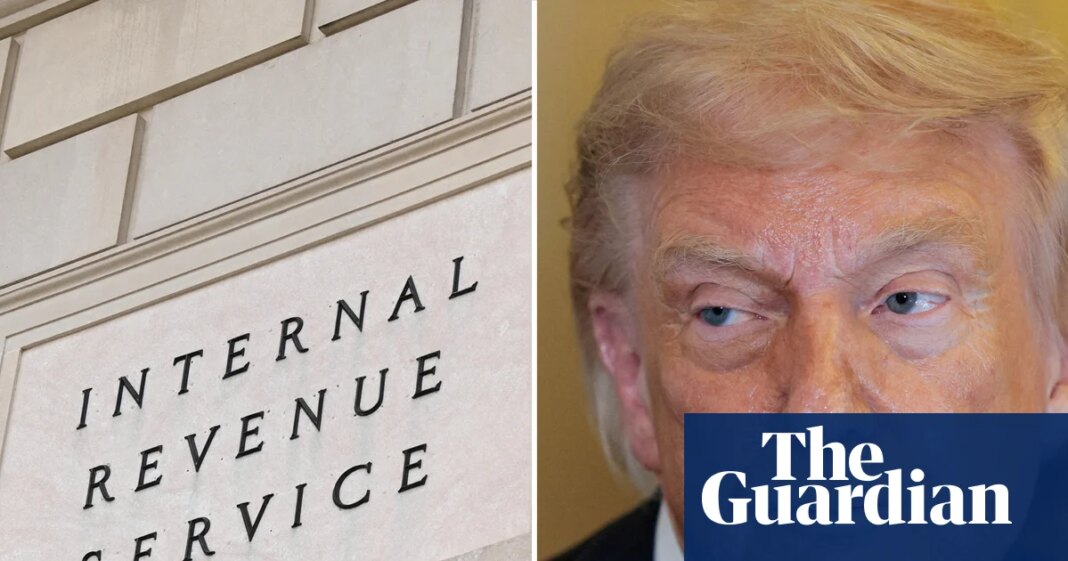
There is growing concern Donald Trump’s massive $10bn lawsuit against the Internal Revenue Service may soon be settled by his own administration – an unprecedented, self-dealing maneuver for a US president, in which billions of taxpayer dollars could be transferred to the president or his allies.
Trump may agree to drop his lawsuit in exchange for the launch of a $1.7bn fund to compensate people he says were wrongfully targeted by the Biden administration, according to reports by ABC News and the New York Times.
Among other people, more than 1,500 January 6 rioters would be eligible to receive compensation from the fund, ABC said. The treasury department’s Judgment Fund, a pool of taxpayer funds reserved to pay out court judgments and settlements, would allegedly become the vehicle for Trump’s self-styled victim compensation fund.
The cash grab for Trump allies, reportedly under discussion by justice department officials this week, would settle the president’s January lawsuit, in which he, along with two of his sons and the Trump family business, sued the government’s tax arm for $10bn dollars in damages for the leak of his personal tax returns to the New York Times and ProPublica during his first term.
The White House did not immediately respond to a request for comment.
Charles Littlejohn, a contractor working for the IRS, was sentenced in January 2024 to five years in prison for leaking to news outlets Trump’s tax returns, along with those of other wealthy individuals.
Under the terms of settlement deliberations first reported by the New York Times, Trump is also allegedly asking the IRS to issue a public apology for the disclosure of his personal financial records, and to waive an IRS audit of Trump, his family and his businesses. Trump could owe more than $100m in back payments on a single Chicago property if the IRS were to revise its contested tax bill, a New York Times investigation found.
“This president continues to demonstrate that he is the most stunningly corrupt chief executive this country has ever had,” said Donald Sherman, president and CEO of Citizens for Responsibility and Ethics in Washington (Crew). “When he’s not reaching into the pockets of the American people to enrich himself, he’s trying to create a slush fund for his political allies.”
The US district judge Kathleen Williams, the federal judge overseeing the case in Miami, has raised questions about whether there is a genuine controversy in the case – a legal requirement for any lawsuit. She has appointed a group of lawyers to advise the court on that question, and both sides have been asked to submit briefs by 20 May.
“Anyone who got through their first day of law school knows you can’t sue yourself,” said Andrew Warren, the deputy legal director at the Democracy Defenders Fund.
The group of court-appointed attorneys filed a brief on 14 May saying there was “reason to believe that the President is, in fact, exercising his control over the Defendants in this litigation”. There were numerous possible claims the Department of Justice could offer to defend itself in the case, but have not, they noted. They also suggested Williams could investigate whether Trump had meddled in the justice department’s decision-making and whether the agency’s lawyers had been able to exercise their independent judgment.
“Although Defendants’ failure to assert these defenses would be appropriate if, in the exercise of independent litigation judgment, Defendants and their attorneys determined that an early settlement was in the government’s best interest, and if they were engaging in arm’s-length negotiations to achieve that outcome, the circumstances raise the specter that Defendants and their attorneys may instead be operating at the President’s direction,” the court-appointed attorneys wrote.
The case is the latest example of how Trump has taken over the justice department – which typically operates at arm’s length from the White House – and deployed it for his own ends. He has used the agency to prosecute political rivals, and the acting attorney general, Todd Blanche, has shown a willingness to carry out Trump’s wishes.
If the case is settled for the full amount Trump is requesting, a $10bn payment would more than double his family’s net worth. The sum is equivalent to about two-thirds of the IRS’s total budget for the 2026 fiscal year, and would be five times greater than any other award paid by the treasury’s Judgment Fund from January 2020 to September 2025, federal data cited in a 5 February amicus brief filed by former federal officials and watchdog groups shows.
Given Trump’s sizable influence over the justice department, legal advocates say there’s a risk of a collusive settlement with the president, even though similar lawsuits have failed.
“There’s no difference between Trump directing the IRS to pay his family billions of dollars to settle the case, versus telling the treasury secretary that he deserves a $10bn bonus because he claims to be the smartest president ever,” Warren said.
There are other underlying issues with Trump’s lawsuit against the IRS, should his lawyers clear the legal hurdle posed by Trump’s role on both sides of the case.
Trump’s suit invokes protections afforded to American taxpayers under the Internal Revenue Code and the Privacy Act, which offer ordinary taxpayers an opportunity to seek redress for harm caused by undue government action.
Civil damage claims must be filed within two years of the discovery of any “unauthorized inspection or disclosure”, according to IRS tax code. Trump’s tax returns were first shared in 2019, and the leak became widely known by 2020. His civil damages lawsuit should be disqualified for delayed filing.
Trump’s personal attorney, Alina Habba, also attended a 2023 court hearing for Littlejohn, and identified herself on the record “on behalf of President Trump who was a victim”.
Lawyers and advocates have also flagged that Littlejohn was not a government employee. To sue the IRS for damages, Littlejohn would have had to be an “officer or employee of the United States”, US tax code says.
Trump’s patent refusal to release his personal tax returns has defied decades of legal precedent. Every other president and major party nominee has voluntarily disclosed personal tax information to the public for the past five years, according to a Crew report.
Trump’s lawsuit against the IRS is his third legal claim against his own administration. Trump asked the justice department to pay him about $230m for damages associated with its investigation into his handling of classified documents at Mar-a-Lago and its investigation into Russian ties to his 2016 campaign.
The administrative claims, filed under the Federal Tort Claims Act, seek compensation that far exceeds the sum typically paid out by the justice department in such cases.
Two legal experts said that the FTCA claims would likely be rejected if Trump were “any other American”.
Asked whether there was anything taxpayers could do to stop Trump from pillaging a taxpayer fund intended to pay out civilian claims, Warren said: “Having the DoJ pay out a massive settlement is no different than having the treasury give [Trump] a billion-dollar bonus or walking into Fort Knox and taking the gold, and there’s frankly little that can be done to stop it.”