
We independently evaluate all recommended products and services. Any products or services put forward appear in no particular order. if you click on links we provide, we may receive compensation.
Gym culture has plateaued. Lifting is baseline. Run clubs are on every corner. The question isn’t whether you train — everyone trains. The question is what your training has actually built. And for most men, the honest answer includes tight hips, a compressed posture, recurring niggles, and a body that looks capable but moves like it’s under protest.
Looking strong is easy. Moving well is rare.
The gym has become democratic. Resistance training, HIIT, run clubs, hybrid fitness — the barrier to entry is near zero. Every man in your office runs. Half of them lift. The baseline has risen dramatically.
What hasn’t risen is the quality of how most men move. Tight hip flexors from desk work. Rounded shoulders from phones and screens. Lower back strain from years of loading without stabilisation. These are the default outputs of modern training culture — which rewards volume and visible results but punishes the less glamorous work of mobility, control, and correction.
The new gap isn’t effort. It’s efficiency. The man who trains intelligently — who has built control through full ranges of motion, who doesn’t rely on momentum, who moves with intention — is increasingly rare. And increasingly noticeable.

Pilates exposes weakness fast
The humbling thing about Pilates — and the thing that makes it useful — is that it removes the shortcuts. No momentum. No compensating with a dominant side. No loaded bar to hide behind. Every weakness is immediately legible.
A man who can pull 180kg off the floor may find a slow, controlled single-leg lowering genuinely difficult. That’s not a contradiction — it’s information. The stabiliser muscles that Pilates targets are exactly the ones most lifting programmes neglect: the deep core, the hip rotators, the muscles responsible for spinal integrity and joint stability.
| WHAT PILATES TARGETS
• Deep stabiliser muscles — the ones that hold form under load • Full range of motion — not just the loaded portion • Left-right symmetry — imbalances become immediately visible • Controlled tempo — no momentum, no cheating reps |
WHAT MOST TRAINING MISSES
• Stabilisers are sacrificed for prime movers in heavy compound lifts • Range is often shortened to manage load or fatigue • Dominant side compensates quietly over years • Momentum substitutes for control in higher-rep work |
None of this makes lifting wrong. It makes Pilates the correction — the work that fills in the gaps that strength training consistently leaves open.

The aesthetic shift: from bulk to control
The cultural ideal of the male body has been quietly shifting. The oversized, compressed look — built for the stage, not the street — has given way to something leaner, more mobile, more athletic.
Pilates builds into that shift directly. It creates tension without size — the kind of physical presence that reads as capable rather than just big. It counteracts the ‘tight, shortened’ look that years of heavy lifting without mobility work produces: the rounded shoulders, the forward head, the hips that have lost their range.
The goal is starting to look like you can move — not just like you lift. That’s a different body, built by different training.
| THE NEW METRIC
Bulk is visible. Control is rare. A lean, mobile, well-postured body in 2026 signals more than a large one — it signals a longer, more disciplined relationship with how you train, not just how hard. |

Posture is the new advantage
Most men are subtly compromised in how they stand and move. Not dramatically — but visibly, once you know what to look for. Forward head. Elevated and rounded shoulders. Anterior pelvic tilt. These are the physical signatures of desk work, phones, and driving.
Pilates corrects them systematically. It strengthens the posterior chain, opens the chest, re-establishes spinal alignment, and retrains the movement patterns that poor posture has degraded.
The style payoff
- Jackets sit squarely on the shoulders.
- T-shirts drape cleanly across the chest.
- Trousers hang as they’re meant to.
- You look more composed without trying — good posture reads as confidence.
Tailoring assumes an upright spine and open chest — that’s what it’s cut for. Fix the posture, and clothes perform as designed.
Injury is the real limiter
Ask any man who’s been serious about training for ten or more years and he’ll give you a list: the hip flexor that flares after long runs, the lower back that tightens after deadlifts, the knee that required three months off. Injury is the tax on high training volume.
Pilates reduces that tax. It builds resilience in the joints and connective tissue that load-bearing training stresses. It corrects the movement asymmetries that accumulate quietly until they become injuries.
The best training programme is the one you can sustain. Consistency across years beats intensity across months. Pilates is, among other things, a long-term insurance policy for the rest of your training.
It makes everything else better
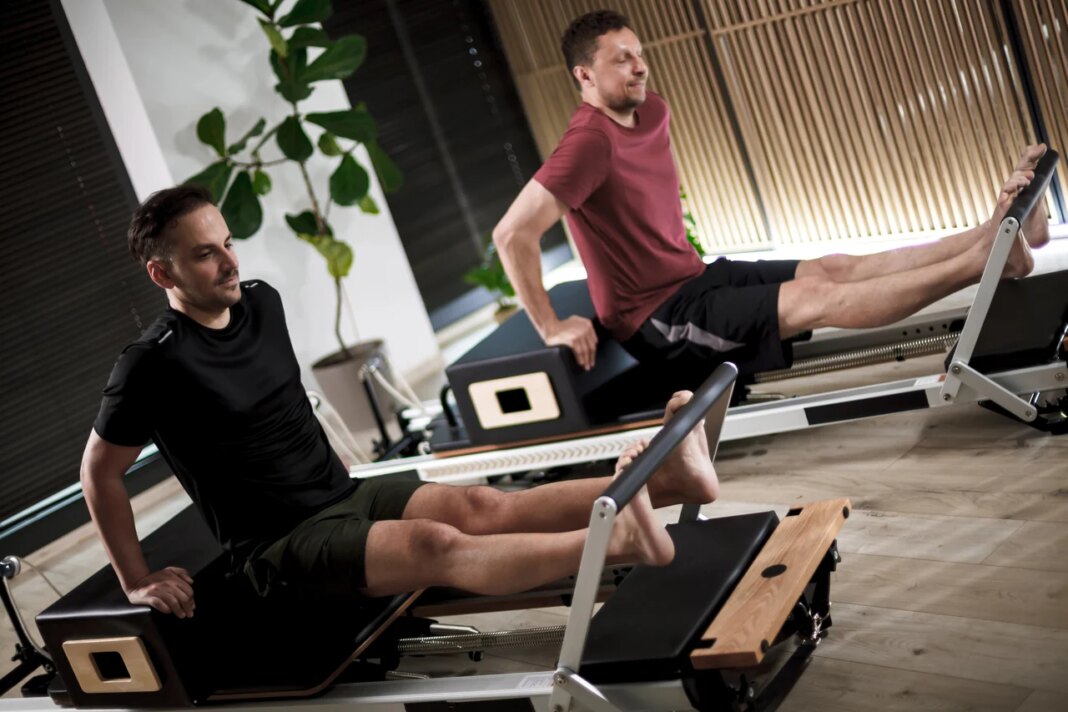
Pilates isn’t a replacement for other training. It’s the thing that makes other training work better — two sessions a week alongside whatever you’re already doing.
- Runners: improved stride efficiency and hip stability reduce impact stress. Fewer overuse injuries from better movement mechanics.
- Lifters: enhanced form through better proprioception. Stronger stabilisers mean safer, more controlled heavy compound work.
- Combat sports: balance, coordination, and rotational control are all direct Pilates outputs.
- Cycling: corrects anterior pelvic tilt and hip flexor shortening from sustained time in the saddle.
| THE ADD-ON
Adding 2 Pilates sessions per week can unlock better performance across all other training — without replacing any of it. |
The quiet confidence factor
Pilates demands a different quality of attention than most training. You’re not chasing a PR. You’re not pushing intensity. You’re learning to feel how your body is moving — which is harder than it sounds for men whose training has always been about output rather than awareness.
The result — after consistent months of Pilates — is a different physical presence. Less braced and stiff. More settled in the body. The kind of ease in movement that reads as grounded rather than nervous.
There’s a social dimension too. Stiffness in movement often maps to stiffness in presence. Men who move with ease tend to occupy space with ease. Pilates won’t fix social anxiety — but it consistently produces men who seem more physically at home in themselves.

Why it’s taking off now
Several things are converging: elite athletes and high-performance coaches openly crediting Pilates; the rise of boutique reformer studios; and a broader cultural shift toward mobility, longevity, and functional movement over sheer size.
The honest framing: Pilates isn’t new. It isn’t a trend. It’s late adoption — men catching up to something that’s been working for a long time.

How to start without looking like a beginner
You will feel like a beginner. The key is not compounding that by also coming in with the wrong expectations.
- Start with beginner reformer or mat classes — Don’t walk into an intermediate class on week one. The fundamentals exist for a reason — you need them even if your other fitness is solid.
- Expect it to feel harder than it looks — The men struggling most in beginner Pilates classes are often the ones who train hardest elsewhere. That’s the point.
- Prioritise form, not intensity — Losing control to add a rep is counterproductive by definition. The value is in doing it right, not doing it more.
- Commit to 6–8 sessions before judging results — The real shift — postural change, stability gains, body awareness — arrives around session six. Stay in.
| THE TONE
You don’t wing Pilates. You learn it. A training practice that requires patience and attention is a different kind of discipline — and in 2026, that discipline is exactly what separates the serious from the casual. |
The bottom line
Strength gets attention. Control earns respect. Longevity keeps you in the game.
In 2026, the edge isn’t who trains harder — it’s who trains smarter, moves better, and lasts longer. Pilates sits right at that intersection.
“Strength gets attention. Control earns respect. Longevity keeps you in the game.”

The editorial team at FashionBeans is your trusted partner in redefining modern men’s style. Established in 2007, FashionBeans has evolved into a leading authority in men’s fashion, with millions of readers seeking practical advice, expert insights, and real-world inspiration for curating their wardrobe and lifestyle.
Our editorial team combines over 50 years of collective experience in fashion journalism, styling, and retail. Each editor brings specialized expertise—from luxury fashion and sustainable style to the latest grooming technology and fragrance science. With backgrounds ranging from GQ and Esquire to personal styling for celebrities, our team ensures every recommendation comes from a place of deep industry knowledge.