IMF raises UK growth forecast for 2026
Newsflash: The International Monetary Fund has raised its forecast for UK growth this year.
IMF economists now expect UK GDP to rise by 1.0% in 2026, up from the 0.8% it forecast in April, due to the economy’s “strong pre-war momentum” and a “robust” performance in the first quarter of this year when the economy grew by 0.6%.
That upgrade should cheer ministers, even though it’s still below the 1.3% growth which the IMF predicted in January before the Iran war began, and would be a slowdown compared with 2025 when the UK grew by 1.4%.
The improved forecast comes after the IMF concluded its annual assessment of the UK economy (known as an Article IV Mission).
The IMF says:
While the UK economy has remained resilient in recent years, the war in the Middle East is dampening near-term prospects.
Growth is projected to slow to 1.0 percent this year, then gradually recover as the shock dissipates. Higher energy prices are expected to push inflation up temporarily and delay the return to the central bank’s target by about one year.
Key events
Petrol pump price closing in on April’s three-and-a-half-year high
Motorist groups are warning that UK fuel prices will soon rise over the highs set early in the Iran war.
The AA confirm that petrol pump prices are closing in on April’s three-and-a-half-year high, which they predict could be hit within days as the bank holiday weekend approaches.
The RAC has predicted that later this week the average price of a litre of petrol will eclipse the peak on 15 April, which was the last day prices peaked since the war in Iran began.
According to the RAC, the average price of a litre of petrol has risen to 158.24 today, only slightly below the 158.31p recorded on 15 April.
Luke Bosdet, the AA’s spokesman on pump prices, says:
“The need for ditching or delaying the fuel duty increase, due from September onwards, has been made more critical by average UK petrol pump prices climbing to within 1p of the three-and-a-half-year high, set in April.”
Yesterday, the Sun on Sunday reported that Rachel Reeves is expected this week to announced that the 5p increase in fuel duty that was due to take effect in the autumn will not now go ahead.
Downing Street have declined to comment on ‘tax speculation’, but didn’t deny the story, our Politics Live blog reports.
UK moves towards looser bank ringfence

Kalyeena Makortoff
The Treasury has fired the starting gun on loosening ringfencing rules for UK banks, but it’s still a relatively long road ahead, with consultations due to launch this summer and formal changes to legislation due…“as soon as parliamentary time allows.”
While the changes are due to be pretty technical, the Treasury said in its review released on Monday that proposed reforms would see banks “use a limited portion of their balance sheets more flexibly”, IE sharing resources across their ringfenced bank and the rest of their operations, and give the Bank of England more flexibility to update and tailor the rules over time.
The £35bn ceiling, at which banks have to ringfence their retail operations, will for example, be reviewed every three years, with a view to uprating it in line with the evolution of banking practices and growth in the deposit base.”
HMT says that the proposed reforms will help by “potentially unlocking up to £80bn of additional financing for UK businesses”.
Ringfencing was introduced after the 2008 financial crisis, in order to protect consumer cash from a bank’s riskier business activities in the coming months. Most of the big banks have lobbied relentlessly for rules to be rowed back, though Barclays has been the one stronghold for maintaining current rules, having invested heavily in their implementation.
Chancellor Rachel Reeves first confirmed that the government would be looking at ringfencing reforms nearly a year ago in July 2025, as part of her Mansion House speech in which she declared that rules and red tape were a”boot on the neck” of business and risked “choking off” innovation.
Things had gone quiet since, but banks were heartened last week to hear in the Kings Speech that the so-called Enhancing Financial Services Bill – which was expected to include the ringfencing changes – was due to be put through parliament.
The launch date of the consultation is currently TBC….
Full story: IMF urges UK to ‘stay the course’ on borrowing
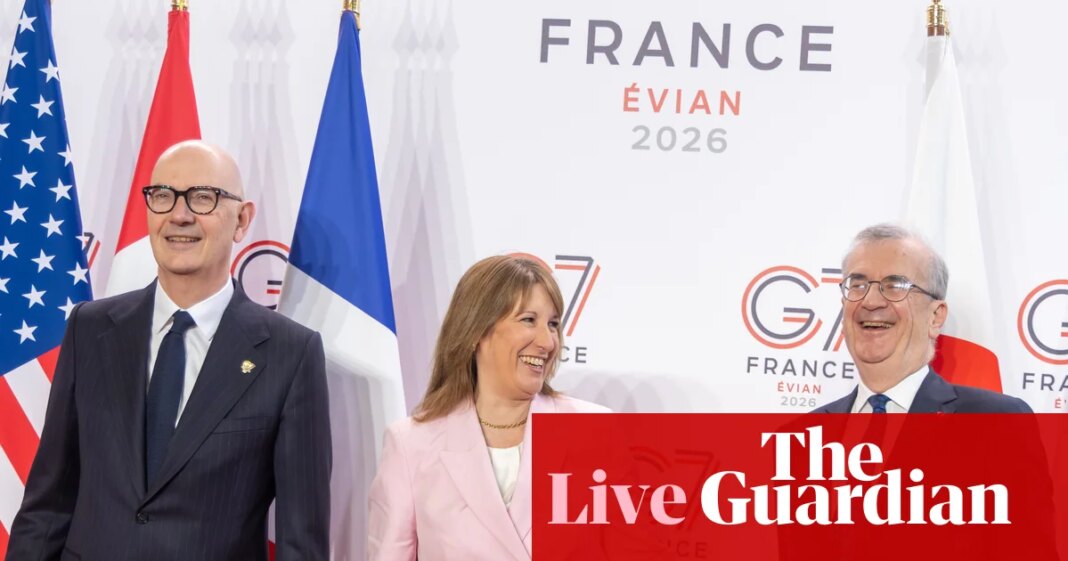
A ‘family picture’ of G7 finance ministers meeting in Paris has arrived:
The IMF is also recommending the Bank of England should leave interest rates on hold this year.
It says:
Monetary policy should remain restrictive to ensure that higher energy prices do not spill over to core inflation and wage growth. The rise in energy prices will lift headline inflation this year while also weighing on output, complicating policy calibration.
Staff assesses that holding the policy rate unchanged for the remainder of the year would maintain a sufficiently restrictive monetary stance to limit second-round effects and keep long-term inflation expectations anchored.
However, given the “exceptional uncertainty”, the BoE should retain the flexibility to either tighten or loosen monetary stance, and “be prepared to respond forcefully” if needed to cool inflationary pressures.
IMF: UK should ‘stay the course’ on deficit reduction
The International Monetary Fund is also urging the UK government to stick with its deficit reduction plans.
In the concluding statement following its Article IV healthcheck on the UK, the fund had warm words for the plans being executed by chancellor Rachel Reeves (and her fiscal rules), saying:
The authorities’ medium-term fiscal strategy continues to strike a good balance between deficit reduction and growth-friendly spending, and recent changes to the fiscal framework strengthen policy stability and credibility.
Staying the course on deficit reduction will be important given market pressures and elevated implementation risks.
This vote of confidence from the IMF comes as various groups within the Labour party draw up competing economic plans and ideas that might revive the party’s fortunes:
IMF raises UK growth forecast for 2026
Newsflash: The International Monetary Fund has raised its forecast for UK growth this year.
IMF economists now expect UK GDP to rise by 1.0% in 2026, up from the 0.8% it forecast in April, due to the economy’s “strong pre-war momentum” and a “robust” performance in the first quarter of this year when the economy grew by 0.6%.
That upgrade should cheer ministers, even though it’s still below the 1.3% growth which the IMF predicted in January before the Iran war began, and would be a slowdown compared with 2025 when the UK grew by 1.4%.
The improved forecast comes after the IMF concluded its annual assessment of the UK economy (known as an Article IV Mission).
The IMF says:
While the UK economy has remained resilient in recent years, the war in the Middle East is dampening near-term prospects.
Growth is projected to slow to 1.0 percent this year, then gradually recover as the shock dissipates. Higher energy prices are expected to push inflation up temporarily and delay the return to the central bank’s target by about one year.
Speaking of oil….Ryanair has said it is “confident” it will not face a jet fuel shortage this summer amid fears over widespread cancellations linked to the Iran war.
Neil Sorahan, the chief financial officer at the budget airline, said he was “increasingly confident that we will not see any supply shocks this summer”.
The airline said fares had fallen in recent weeks due to uncertainty around conflict in the Middle East, with prices expected to fall by a “mid-single digit percentage” in the three months ended in June.
IEA’s Birol warns commercial oil inventories are falling rapidly
International Energy Agency executive Director Fatih Birol has issued a new warning that oil inventories are shrinking fast.
Speaking to reporters on the sidelines of the G7 finance ministers’ meeting in Paris, Birol flagged that the tally of commercial oil inventories is shrinking at an accelerated pace.
Bloomberg has the details:
“I think it is depleting very fast,” he told reporters at the sidelines of a meeting of Group of Seven finance ministers in Paris, echoing comments from last week. It will be “several weeks, but we should be aware of the fact that it is declining rapidly,” he said.
He also highlighted that the spike in fertilizer and diesel prices comes at the start of the travel and planting season.
UK 10-year yields ease back
After hitting their hitting their highest levels since 2008 this morning, UK 10-year borrowing costs have eased back too.
The yield, or interest rate, on 10-year gilts is down 2.5 basis points (0.025 of a percentage point) to 5.14%.
That follows the easing in the oil price, after Tehran said it had responded to a new US proposal aimed at ending the Iran war (see earlier post).
It also follows early losses in global bonds, with Japan’s long-term borrowing costs hitting record highs (see opening post).
Dominic Caddick, economist at the New Economics Foundation (NEF), argues that borrowing costs will stay high regardless of who leads the Labour party.
“Borrowing costs will stay high regardless of who takes over the Labour Party – the real drivers are Trump’s Iran policy, UK inflation exposure, and pension market shifts that no austerity candidate can fix. Ending Britain’s bond market crisis requires direct intervention on inflation and better coordination between the Treasury and the Bank of England so that borrowing costs come down.
“Meanwhile, government must urgently address Britain’s weak demand to boost the economy. Through an essential energy guarantee government can help address inflation and deficient demand at once. A clear, credible economic strategy will bring borrowing costs down, and can be funded through progressive tax levers.”
[‘Pension market shifts’ refers to the shrinking market for defined benefit pensions, which had been a major purchases of long-term gilts such as 30-year bonds in the past]
In another example of the bond market sell-off, foreign investors sold China’s onshore yuan bonds for the 12th consecutive month in April, Reuters reports, citing official data.
Foreign institutions held 3.12trn yuan (£340bn) in bonds traded on China’s interbank market as of the end of April, the central bank’s Shanghai head office said, down from 3.19trn yuan a month earlier.