Secret listening devices inside people’s cars and homes. The commissioning of investigators to listen in on live phone calls. Corrupt payments to police officers. Illicit acquisition of personal medical and financial documents.
When the claims first appeared in 2022, they read more like the modus operandi of an organised crime gang than a newspaper publisher. Yet lawyers for a group of claimants taking the publisher of the Daily Mail to court alleged that they were just the “tip of the iceberg”.
They set the scene for a blockbuster case – effectively a final reckoning for British journalism’s phone hacking-era, the fallout from which had already led to the closure of Rupert Murdoch’s News of the World and an admission of “historical wrongdoing” by the Mirror group.
Associated Newspapers Ltd (ANL), publisher of the Daily Mail, the Mail on Sunday and MailOnline, had never made any admissions of unlawful activity, save for accepting that private investigators working on its behalf before 2007 may have breached the data protection act.
Now its editors and journalists were to take the stand as part of a £50m case.
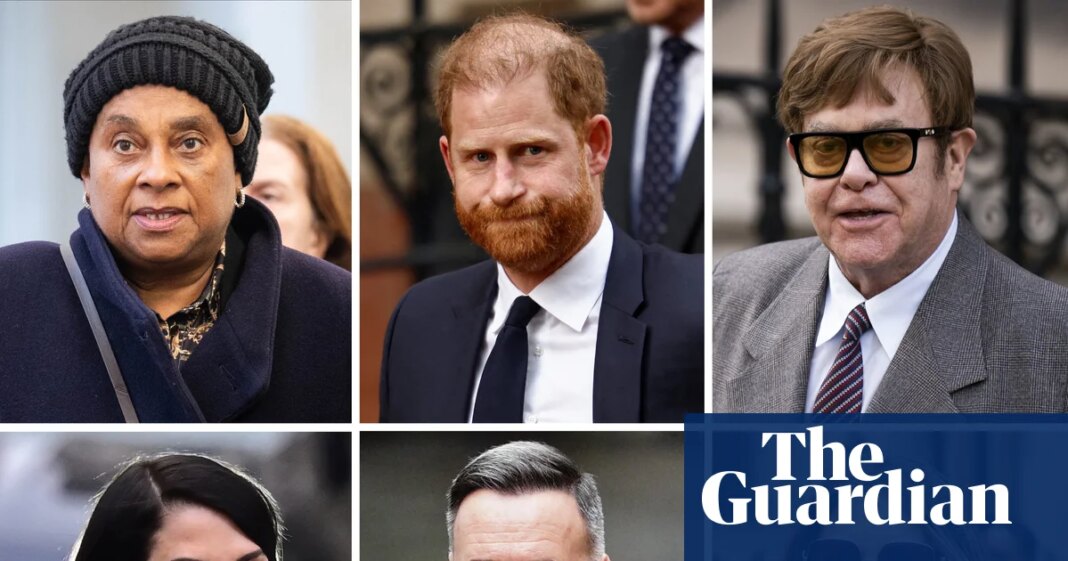
Prince Harry, Doreen Lawrence, Elton John and his partner David Furnish, the actors Liz Hurley and Sadie Frost, and the former minister Simon Hughes formed the group willing to head to court.
Yet by the time Mr Justice Nicklin delivered his devastating 436-page verdict, he not only dismissed the most lurid accusations, he concluded that the claimants had failed to prove the Mail had engaged in any unlawful activity at all.
The outcome flowed from an extraordinary 11 weeks in the Royal Courts of Justice, during which the claimants’ case slowly but surely shrank as a procession of celebrities, editors, journalists and private investigators filed in and out of court 76.
By the end of the proceedings, David Sherborne, the lead barrister for Harry and the claimants, was making an unusual plea to the judge.
He asked Nicklin to imagine that a rare watch had been stolen from a safe and re-emerged in the hands of a defendant. It should then be up to the defendant, he said, to prove that the watch had been sourced legitimately.
In this analogy, the private information of the claimants was the rare watch, which had ended up in the hands of the Mail.
Nicklin’s judgment comprehensively rejected this notion, repeatedly concluding that suspicion without conclusive proof was not enough.
The failure of the claimants’ case is inextricably linked to the saga over their key witness, an apparent whistleblower called Gavin Burrows, whose witness statement appeared to contain jaw-dropping admissions.
It included working with an “ex-army guy” to place devices in maintenance holes and junction boxes and bugging cars, as well as hacking celebrities and those close to them, including Elton John’s gardener.
There was a serious problem, however: Burrows had said before the trial that the statement was a forgery. The process by which Burrows’s statement was put together became a focus of the case.
The dispute also allowed the Mail’s lawyers to switch the spotlight on to the activities of the claimants’ legal team – a network of solicitors, barristers and press regulation campaigners.
They focused on one figure in particular: Graham Johnson, a former phone hacker who has since been paid by press regulation campaigners to interrogate claims of unlawful practices.
It emerged that the Burrows statement had been based on five meetings, apparently with no notes taken, and on memos by Johnson.
One such meeting, which included Sherborne himself, allegedly took place on a London roundabout. Meanwhile, the lawyer who signed off the disputed statement, the celebrity solicitor Anjlee Sangani, had not witnessed Burrows signing it, delegating that task to Johnson.
“This wasn’t her world, this was my world,” Johnson told the court, saying Sangani was “uncomfortable” in Burrows’s presence.
When Burrows eventually gave evidence – via video link from a secret location overseas – he maintained that the witness statement had been forged.
Nicklin’s judgment was damning about both Burrows as a witness and the process by which the disputed witness statement was taken.
The judge was “unable to accept” that the statement was made by Burrows, not just because he disputed signing it, but because of the way it seemed to have been compiled through notes and meetings.
For good measure, he said Burrows’s evidence was “argumentative, evasive, internally inconsistent and, at times, extraordinary”. Nicklin added that Sangani had shown a “serious error of professional judgment” in signing off the statement.
Without Burrows, the claimants were left with instances of “blagging” – securing information by deception. There were two cases that stood out, one relating to Frost’s ectopic pregnancy in 2003 and another in which a reporter had been given exact flight details for Chelsy Davy, Prince Harry’s then girlfriend, in 2007.
The judge said the draft article about Frost was “highly intrusive” and the flight details were “incriminating”, but in both cases concluded that unlawful tactics had not been proved.
At the conclusion of the case, Sherborne cited a raft of missing documents. Invoices related to stories were gone, as were emails. However, the judge concluded that the absence of documents “cannot substitute for proof that [unlawful information gathering] occurred in any given case”.
By the time Sherborne was making his analogy about the rare watch, time had run out to convince the judge of the claimants’ case.
There is already talk that Jonathan Harmsworth, the Mail’s proprietor, is holding a party to celebrate the verdict. Yet even with the emphatic victory, there has been collateral damage.
The case has ruptured the relationship between the Mail and Lawrence, the campaigning mother of Stephen Lawrence, who was killed in a racist murder more than 30 years ago. The Daily Mail became synonymous with the case in 1997, after running a front page labelling five men – Gary Dobson, Neil Acourt, Jamie Acourt, Luke Knight and David Norris – as Stephen’s “murderers”, and challenging them to sue for libel.
The Duke of Sussex had alerted Lawrence to the case against the Mail via a personal email. After meeting the prince’s legal team in London’s Corinthia hotel, she signed up as the case’s unlikely figurehead.
The verdict leaves the claimants with a huge legal bill, with ANL seeking to recoup its costs. The total cost for the case could reach £50m. It remains unclear who will foot the bill.