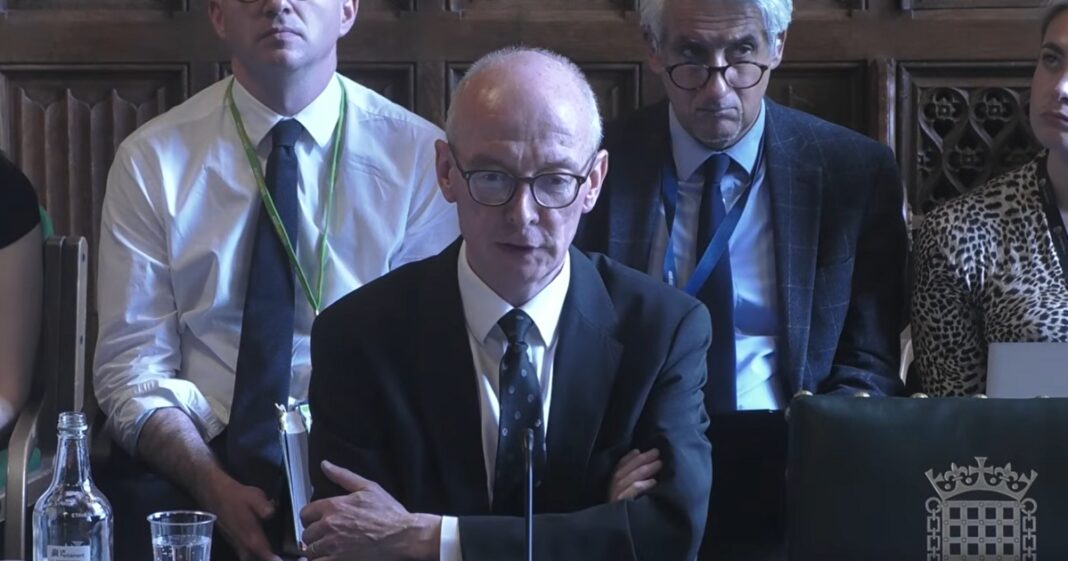

Work and Pensions Secretary Pat McFadden confirmed a key date for a review of pension ages (Image: Parliament TV)
The Department for Work and Pensions has issued a significant update on alterations to the state pension age which will affect millions. The process has already commenced this year – with a gradual transition from 66 to 67 underway.
The present state pension age stands at 66 but this will rise incrementally over the coming two years until reaching 67. Those first affected will be individuals born between 6 April and 5 May, 1960, who will be required to wait an additional month before receiving their pension payments.
At Work and Pensions questions this week it was confirmed that the next phase – examining a rise to 68 and beyond was under consideration – with a date now established. MP Damien Egan asked: ” I have some questions on the state pension and state pension age. First, we have this date of March ’29 for a review of the state pension. Are we still on track for that, and when do you expect to conduct that review?”.
Work and Pensions Secretary of State Pat McFadden confirmed this date: “There are periodic reviews of this built into the process. The state pension age has been rising in the last couple of decades. I do not want to pre-empt anything, but that review is built into the process. That is the timescale, and I have no changes to announce on that this morning.”
However, committee chair Debbie Abrahams argued that the change was being pursued on the grounds of increased life expectancy – yet fresh data suggested it was actually declining in certain areas. She said: “The Health Foundation has shown that healthy life expectancy has fallen by two years on average, and it will be worse in constituencies such as mine and yours, Secretary of State. The first Pensions Commission pegged the increase in state pension age to life expectancy.”
“Life expectancy has now increased overall, again, not in areas such as ours, but healthy life expectancy has declined. Are you considering using healthy life expectancy as well as life expectancy as a marker for what you should do about increasing the state pension age?”.
Mr McFadden said: “We should consider all these factors. I am conscious of, and stand by, what I just said to Mr Egan about how the same age can feel different and be experienced differently across different parts of the country. I am not trying to duck the question when I say this, but these are difficult decisions.
“You have to take into account affordability for the country, because even though it is a contributory system, it really works as a pay-as-you-go system. It has to be affordable and give people security in retirement, but it has to take into account the factors that you raise as well. We owe that to the public. It is a very delicate decision, which is why we do these careful reviews to take all these things into account.”
Mr Egan voiced concerns regarding older workers’ ability to remain in employment and revealed that during consultations with people in their 60s: “Half of 66-year-olds in the lowest income brackets are already frail, so there is perhaps a different conversation to be had there, but the bulk of the people we spoke to were anxious about being able to get back into the workplace once they had lost a job. It is quite right that to have the biggest impact, we focus on the young, but what would you say to people in the older groups?”.
Mr McFadden replied: “I am an optimist about growing older; I hope people see a productive working life when well up in years. One part of the story is that the increase in the state pension age has been accompanied by increasing rates of employment in people close to state retirement age, but you are right that another part of the story is that being 67 or 68 years old can feel very different in different parts of the country. I represent a working-class, Black Country constituency where there is a tradition of physical work, and I know that it can feel quite different to be 67 or 68 years old in my constituency compared with leafier parts of the country. We have to bear that in mind and consider all these aspects when thinking about the state pension age in the future so that we have a system that is fair to everyone, is financially sustainable and does the best job it can to give people security in retirement.”
The UK Government has also modified the schedule for the State Pension age rise, meaning that rather than reaching State Pension age on a specific date, individuals born between 6 March 1961 and 5 April 1977 will become entitled to claim their State Pension when they turn 67.
From April 2026, the Government began a phased increase in State Pension age from 66 to 67, to be completed within two years.
When the pension age previously rose from 65 to 66, it resulted in an extra 100,000 65-year-olds falling into absolute income poverty compared to the period before the adjustment.
Date of birth // Date State Pension age reached – current plans
6 April 1960 – 5 May 1960 66 years and 1 month.
6 May 1960 – 5 June 1960 66 years and 2 months.
6 June 1960 – 5 July 1960 66 years and 3 months.
6 July 1960 – 5 August 1960 66 years and 4 months.
6 August 1960 – 5 September 1960 66 years and 5 months.
6 September 1960 – 5 October 1960 66 years and 6 months.
6 October 1960 – 5 November 1960 66 years and 7 months.
6 November 1960 – 5 December 1960 66 years and 8 months.
6 December 1960 – 5 January 1961 66 years and 9 months.
6 January 1961 – 5 February 1961 66 years and 10 months.
6 February 1961 – 5 March 1961 66 years and 11 months.
6 March 1961 – 5 April 1977 67.