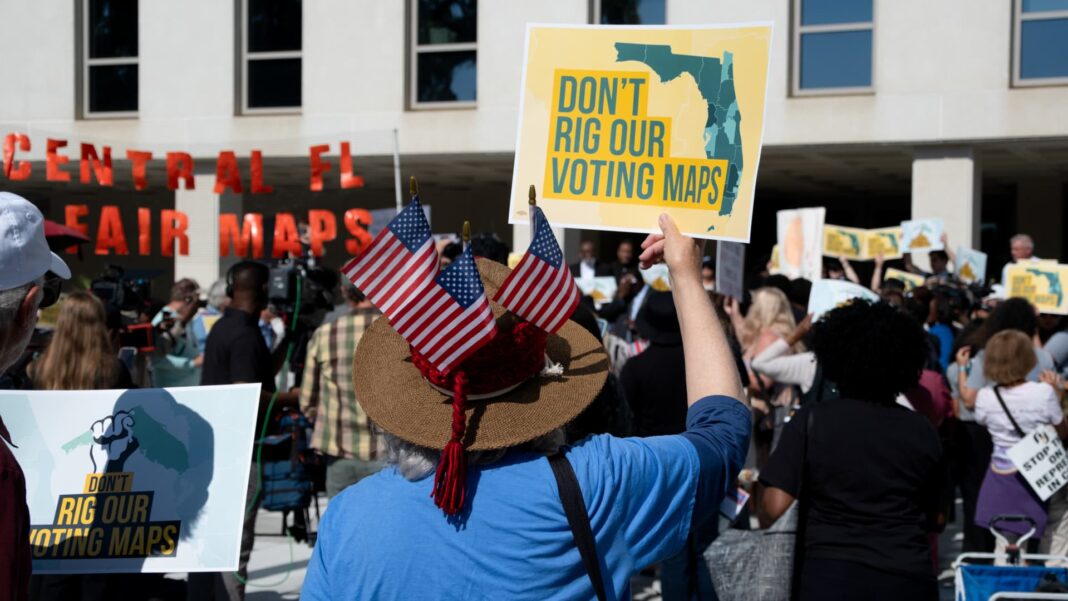
Demonstrators opposed to redrawing Florida’s Congressional map hold signs outside the Florida State Capitol in Tallahassee, Florida, US, on Tuesday, April 28, 2026.
Malcolm Jackson | Bloomberg | Getty Images
Tennessee’s Republican Gov. Bill Lee on Thursday signed into law a just-approved measure to eliminate the state’s lone Democrat-held congressional seat. It’s the latest move in a scramble to redraw U.S. House districts in the wake of a pivotal Supreme Court decision and ahead of the 2026 midterm election.
The maps are “insane,” according to Rep. Steve Cohen, the Memphis Democrat who holds the seat Republicans are targeting. In a post to X on Wednesday as a special session of the state legislature kicked off, Cohen said the proposal would jam people living more than 200 miles apart into the same district.
President Donald “Trump knows he HAS TO rig the game to keep his majority in November,” Cohen posted on X after the law was signed after earlier calling the effort a “power grab.” “And the TN GOP was willing to go along with it.” He also threatened to sue.
Power grab or not, redrawn maps like the one in Tennessee could be the key to keeping a majority in the House. And in the redistricting race to the bottom, neither party appears willing to take its foot off the gas.
The Supreme Court’s April 29 decision in Louisiana v. Callais to weaken part of the Voting Rights Act invalidated a majority-black, Democrat-held district in Louisiana and paved the way for states across the South to redraw their own congressional maps. In addition to Louisiana and Tennessee, Alabama and South Carolina have already taken steps to do so.
State Senator London Lamar, a Democrat from Tennessee, holds a copy of the proposed Congressional map for Tennessee during a special legislative session at the Tennessee State Capitol in Nashville, Tennessee, US, on Wednesday, May 6, 2026.
Madison Thorn | Bloomberg | Getty Images
Republicans face an uphill climb to hold their majority, as they struggle under the weight of President Donald Trump’s sinking approval ratings, the ongoing Iran war and rising gas prices. But they’re striking a more optimistic tone of late.
“You have one or two seats in each of those states — that’s huge,” one Republican operative, who spoke on condition of anonymity to speak candidly. “When you have a three-seat majority, every single seat matters.”
“There’s certainly a path. I think with [the Callais decision] happening, that path gets even brighter for us,” the operative said.
Could Democrats still take the House majority?
Even after the Supreme Court’s decision and other earlier redistricting efforts — like those in Texas and Florida, which could each net Republicans several seats — Democrats are widely viewed as the favorites to win the House majority later this year.
VoteHub, an independent political outlet that offers election analysis, gave Democrats an 85% chance of winning the House in a forecast published May 4, after the Callais ruling.
And Democrats, despite the Supreme Court setback, are projecting confidence.
“No matter how hard they try, Republicans will not be able to artificially gerrymander themselves into the majority in 2026. Voters will get the final say in November,” Viet Shelton, a spokesperson for the Democratic Congressional Campaign Committee, said in a statement.
But the math could get tricky.
Republicans already had a narrow edge on Democrats in the redistricting wars. According to an analysis by the nonprofit Issue One before the Callais decision, Republicans were projected to gain as many as 13 seats via partisan gerrymandering in Texas, North Carolina, Missouri, Ohio and Florida. Democrats could net 10, according to Issue One, though that relies on them maintaining new maps passed in Virginia that are the subject of a legal challenge in the state supreme court.
Post-Callais, Republicans could add at least five more, giving the GOP somewhere between an eight- to 12-seat edge, Issue One found. If successful, those redrawn maps have real potential to disenfranchise minority voters, said Michael McNulty, policy director at Issue One.
“We are very concerned that it essentially gives the green light to politicians to just weaken the voices of voters of color,” McNulty said. “And it just ignites what was already a gerrymandering war. It reignites it so that politicians can basically redraw maps to protect themselves, instead of doing the hard work to get voters to vote.”
More states are likely to follow in the 2028 election cycle by targeting seats formerly protected by the section of the Voting Rights Act that was struck down, including in places like Florida, Missouri, North Carolina and Texas, according to Issue One.
A staff members holds a chart showing the redistricting that has taken place in the state of North Carolina as members of Congress speak during a press conference outside the U.S. Capitol Sept. 18, 2025 in Washington, DC.
Win McNamee | Getty Images
And Republicans are urging states on.
“States should be proactive on redistricting and move quickly,” said David McIntosh, president of the Trump-aligned Club for Growth. That group’s campaign arm invested $2 million in state Senate races in Indiana to unseat a group of Republicans who quashed Trump’s redistricting push there.
“Indiana sent a signal that Republican primary voters want legislators to be aggressive and get the job done. Republicans must be willing to fight,” McIntosh said.
Trump has pushed redistricting
The Supreme Court decision does not instruct states to take any action on the districts in question, according to Omar Noureldin, senior vice president of policy and litigation at the nonprofit Common Cause.
But some Republicans, including Trump, have interpreted it as a mandate.
“We cannot allow there to be an Election that is conducted unconstitutionally simply for the ‘convenience’ of State Legislatures. If they have to vote twice, so be it,” Trump posted to TruthSocial on Sunday, alluding to House races in Louisiana where early voting had already begun, and was then halted, in the wake of the decision.
“We should demand that State Legislatures do what the Supreme Court says must be done. That is more important than administrative convenience. The byproduct is that the Republicans will receive more than 20 House Seats in the upcoming Midterms!” Trump said.
Outside of political circles, there’s little evidence these efforts are popular. Seventy-one percent of Americans in a recent YouGov poll said that partisan gerrymandering should not be allowed, while just seven percent said they supported the practice. Sixty-nine percent of Republicans said partisan gerrymandering should not be allowed, compared to 74% of Democrats.
But any wholesale changes to curb partisan gerrymandering are unlikely in the near term. Congress could pass legislation banning mid-decade redistricting or requiring independent independent redistricting committees. Democrats have, in recent years, made such proposals a priority. But both parties have little incentive to act in the current political climate.
Noureldin, meanwhile, called the current effort to redistrict across the South a “power grab.”
“They are drawing districts in a way that allows them to choose their voters, rather than the other way around,” he said.