Wall Street hits record high amid peace optimism

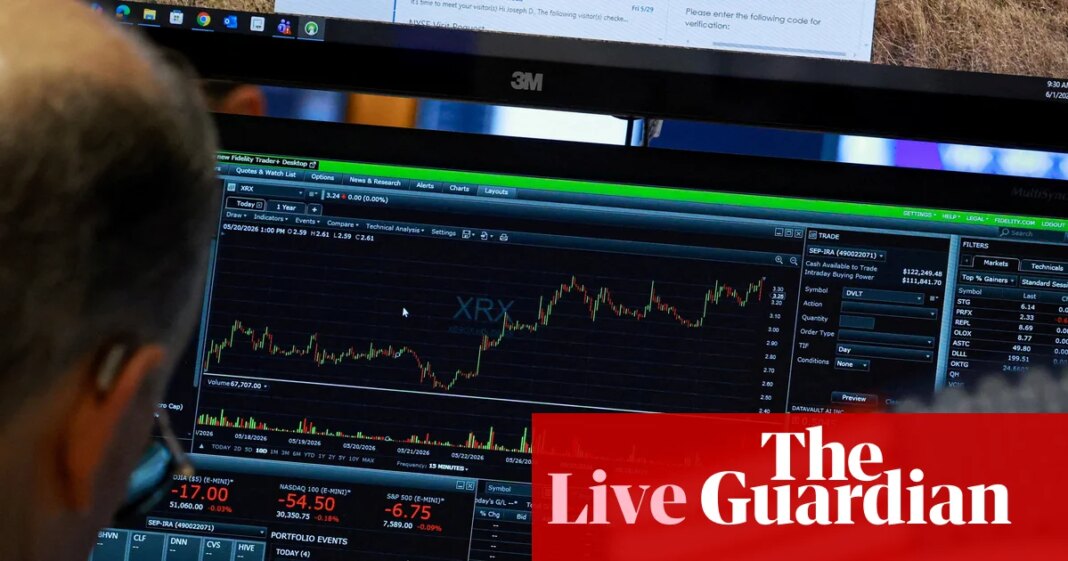
Boom! The US Dow Jones industrial average has hit a record high in early trading, as Wall Street jumps.
Relief over the US-Iran peace deal has pushed the index of 30 large US companies to a new peak of 51,857 points, over the previous record peak set in early June.
Aerospace manufacturer Boeing (+4%) is leading the risers, followed by construction equipment maker Caterpillar (+3.6%), and Amazon (+3.3%)
The Russell 2000 index of small US companies has also hit a record high, up 1.5%. This follows gains in European markets, which hit their own record high this morning.
“Peace optimism” is helping Wall Street to rally, says Neil Wilson, Saxo UK investor strategist, who explains:
Stocks soared and oil prices slid after the US and Iran agreed a peace deal to reopen the Strait of Hormuz.
“Ships of the World, start your engines. Let the oil flow!” President Trump posted. Iran confirmed the text of a memorandum of understanding had been finalised and said the war would end “permanently and immediately on all fronts”.
The two countries will sign the deal in a few days, in Switzerland, after the G7 leaders conference in France this week. The deal is seeing investors take some geopolitical risk premia off the table.
Key events
Rolls-Royce in nuclear reactor deals with Sweden, and partnership with Japan
Back in the UK, engineering firm Rolls-Royce has secured two important agreements involving its new small nuclear reactors.
Swedish nuclear development company Videberg Kraft has chosen Rolls-Royce to supply three Small Modular Reactors (SMRs) on the Värö peninsula, on Sweden’s west coast.
Videberg Kraft say:
The Videberg Project will build Sweden’s first new nuclear power plant in more than 40 years. It will significantly strengthen the Swedish energy system by adding 1,500 MWe of clean baseload capacity – around 6 percent of Sweden’s annual power consumption – for more than 60 years, supporting industries and households in southern Sweden while enhancing energy security.
This comes a day after the UK and Japan agreed to co-operate on advanced nuclear technologies, under which Rolls-Royce will work with the United Kingdom National Nuclear Laboratory (UKNNL) and Japan Atomic Energy Agency (JAEA), to “accelerate the introduction of advanced nuclear technologies in the UK.”
Wall Street hits record high amid peace optimism
Boom! The US Dow Jones industrial average has hit a record high in early trading, as Wall Street jumps.
Relief over the US-Iran peace deal has pushed the index of 30 large US companies to a new peak of 51,857 points, over the previous record peak set in early June.
Aerospace manufacturer Boeing (+4%) is leading the risers, followed by construction equipment maker Caterpillar (+3.6%), and Amazon (+3.3%)
The Russell 2000 index of small US companies has also hit a record high, up 1.5%. This follows gains in European markets, which hit their own record high this morning.
“Peace optimism” is helping Wall Street to rally, says Neil Wilson, Saxo UK investor strategist, who explains:
Stocks soared and oil prices slid after the US and Iran agreed a peace deal to reopen the Strait of Hormuz.
“Ships of the World, start your engines. Let the oil flow!” President Trump posted. Iran confirmed the text of a memorandum of understanding had been finalised and said the war would end “permanently and immediately on all fronts”.
The two countries will sign the deal in a few days, in Switzerland, after the G7 leaders conference in France this week. The deal is seeing investors take some geopolitical risk premia off the table.
SpaceX’s shares are rallying on its second day as a listed company.
After jumping 19% on Friday, SpaceX are up another 5.5% in early trading, as excitement over the company’s entry onto the stock market lingers.
This pushes its valuation further over $2trn, and confirms Elon Musk’s status as a trillionaire, even though SpaceX is loss-making, and floated at a hefty valuation of 92 times last year’s revenues.
US stock market joins the global rally
Wall Street’s main indexes have jumped at the start of trading, as New York traders welcome the news that Washington and Tehran reached a preliminary agreement to end the Middle East conflict and reopen the Strait of Hormuz.
The Dow Jones Industrial Average has climbed by 642 points, or 1.25%, to 51,844 points.
The broader S&P 500 is up 1.5%, while the Nasdaq Composite has climbed by 2.25%.
Deutsche Bank’s George Saravelos has identified four currencies that should benefit once super-tankers start moving through the Strait of Hormuz full of oil again.
-
Swedish krona: It is high beta to the euro, an energy importer, and pro-cyclical to global growth. The domestic economy has been outperforming most economies in Europe and yet the currency has been one of the weakest in developed markets since March.
-
South African rand: An unwind in oil risk premia, potential rebound in gold, high real-rate buffer and still-improving domestic backdrop should all help.
-
Chilean peso: The currency has been one of the biggest under-performers versus its aggregate terms of trade and positioning is short. With oil receding and copper remaining elevated, the balance of payments should materially improve.
-
Indian rupee: High sensitivity to oil prices and a market that is positioned short. RBI policy measures will support both near-term inflows and longer-term structural demand.
Fertilizer ships face backlog even if Hormuz reopens
The disruption to fertiliser supplies caused by the Iran war may not be reversed quickly, expert warn.
The Middle East is a key supplier of nitrogen-based fertilisers such as urea, and shortages since the conflict began have pushed up food prices.
But the bad news for farmers (and ultimately consumers) is that fertilizer cargoes are unlikely to be among the first shipments to move.
Alexis Ellender, senior dry bulk lead at Kpler, says (via Bloomberg):
“When it comes to moving ships through the Strait of Hormuz, it’s going to be oil tankers and LNG carriers that are top of the list once we get towards a more normal flow of traffic.
“Fertilizer is not as high a priority.”
Full story: Oil price lowest since March
Here’s our news story on the drop in the oil price today:
Gas prices fall on hopes of supply boost
European gas prices have dropped sharply today, on hopes that supplies from the Middle East will resume soon.
Despite warnings that it will take time for traffic through the strait of Hormuz to resume, wholesale gas prices have dropped to their lowest in over a month.
The month-ahead UK gas contract is down 7% at 103.9p per therm, its lowest level since 7 May, as traders react to the US-Iran peace deal.
The continental gas price has dropped by 6.4%, to €43.785 per megawatt hour.
That will make it cheaper for governments to rebuilt their liquified natural gas (LNG) reserves ahead of next winter.
Analysts at ING say:
Europe still needs to replenish its gas storage, which sits well below the seasonal average – at a time when Asia will increasingly compete with Europe for LNG supplies.
The UK stock market’s early rally has rather fizzled out.
The FTSE 100 is now up just 5 points, or 0.05%, having jumped almost 100 points at the start of trading at 8am.
The index is being dragged back by BP (-3.8%) and Shell (-5%), as well as weapons maker BAE Systems (-2.7%). Utilities, such as water and energy companies, are also out of favour as investors ditch ‘defensive’ stocks in favour of riskier alternatives.
Shares in US energy companies are dropping in premarket trading.
Exxon Mobil and Chevron are both on track to fall by around 2.9% once Wall Street opens in around 90 minutes.
French President Emmanuel Macron has declared that France and Britain are ready to lead a mission to reopen the strait of Hormuz, once the US-Iran peace deal is a reality.
Speaking at the G7 summit of world leaders, Macron also said the Netherlands and Italy would help in reopening the sea lane, Reuters reports.
The mission could be deployed within two or three days after the agreement is finalised, he added.
Aluminium prices drop after US-Iran breakthrough
Aluminium prices have fallen to their lowest level in two-and-a-half months today, on hopes that shipments from the Middle East will pick-up soon.
Producers in the region use the strait of Hormuz to bring in alumina and ship out refined aluminium.
The benchmark three-month aluminium on the London Metal Exchange fell by around 3.3% to $3,417 per tonne, its lowest since March 30.
Iraq, which relies on the strait of Hormuz to export most of its crude oil, has welcomed the deal announced by the United States and Iran to end the Middle East war.
Iraq’s foreign ministry expressed its “satisfaction with the announcement on the imminent reopening of the Strait of Hormuz to normal navigation, given its crucial importance in ensuring the flow of oil and gas to global markets”.
Fox to buy Roku in $22 billion deal
We have takeover drama in the media and technology world: Fox has reached a deal to aquire streaming service Roku in a $22bn deal.
Fox says the deal will create a “a scaled next-generation media and technology company”.
It brings together Fox’s live content – such as American football and baseball action, and Fox News – with the 100m households who use Roku’s streaming platform.
Lachlan K. Murdoch, executive chair and chief executive officer of Fox Corporation, has called the deal “a defining moment for Fox”, adding:
This combination will transform the scope of our company into high-growth verticals and yield a step change in our overall growth profile.
And we are executing this acquisition from a position of financial strength – maintaining our investment grade balance sheet while providing our shareholders with an uninterrupted return of capital program in the form of share buybacks and dividends. Roku pioneered streaming TV and scaled it into a leading CTV platform. Together, we intend to lead its next chapter.”
Motoring groups are hoping that the US-Iran peace deal will lead to cheaper fuel for drivers.
The average price of petrol has already dropped to its lowest level since early April, at 156.5p a litre last Friday.
RAC head of policy Simon Williams argues it should fall further, following today’s drop in oil prices:
“The oil price has already dropped as a result of the US Iran deal to open the Strait of Hormuz which is good news for drivers as this should quickly bring prices down at the pumps.
“We saw the cost of both petrol and diesel rocket at the start of the conflict, so we hope the fall will be just as quick. At its worst, the average price of petrol rose by 20% to 159.53p which was 27p more than it was on 28 February. Diesel peaked at 191.54p on 15 April which was a 49p increase, or 19%, since the start of the conflict.
“Prior to the deal being announced we were already expecting prices to come down significantly. If oil now begins to consistently trade around $85 – something we haven’t seen since early March – we should see the price of petrol reduce to 148p a litre from its current average of 156p in the next couple of weeks. Diesel, which currently costs an average of 177p, ought to fall to under 160p.
Reuters: Scouring the Strait of Hormuz for mines could take weeks
It could take weeks before the operation to ensure the strait of Hormuz is safe from mines has ended.
Reuters is reporting that this could delay a return to normal shipping traffic by weeks following a deal to reopen the waterway, according to shipping and maritime security sources say.
They add:
The operation by conventional minesweepers and state-of-the-art underwater drones could continue for 40 to 50 days before many insurance, shipping or oil companies are confident enough to sail through, according to assessments from five Western maritime security sources.
That could potentially hold up tens of millions of barrels of oil, in addition to the oil supply from the Gulf already blocked since the United States and Israel attacked Iran on February 28, according to estimates based on pre-war flows.
Earlier this month, US secretary of state Marco Rubio warned that Iran has mined “large segments” of the Strait of Hormuz.
The US-Iran deal removes the threat of a jump in oil prices this summer, says James Hosie, equity analyst at UK investment bank Shore Capital:
“The Brent spot price is now back to its lowest level since early March at c.$83 per barrel as markets digest the increasingly optimistic tone that the US and Iran are to sign a framework agreement to end the current conflict. Critically, the agreement includes the reopening of the Strait of Hormuz, with both sides ending their blockades.
A full recovery of Middle East oil, LNG and oil products supply will take time, but we see this news as removing the threat that a continuation of the existing stalemate driving a further spike in oil prices if inventory drawdowns had continued through the summer.”
The jump in energy prices this year has pulled the European Union into a goods trade deficit in April.
Statistics body Eurostat has reported that the EU recorded a trade in goods deficit of €7.1bn, compared with a surplus of €2.3bn in March and a surplus of €7.3bn in April 2025.
It adds:
This shift reflects a deterioration of €14.4 bn year-on-year, primarily driven by an increase in the energy deficit and a reduced surplus in the machinery and vehicles product group.