Published on
March 27, 2026

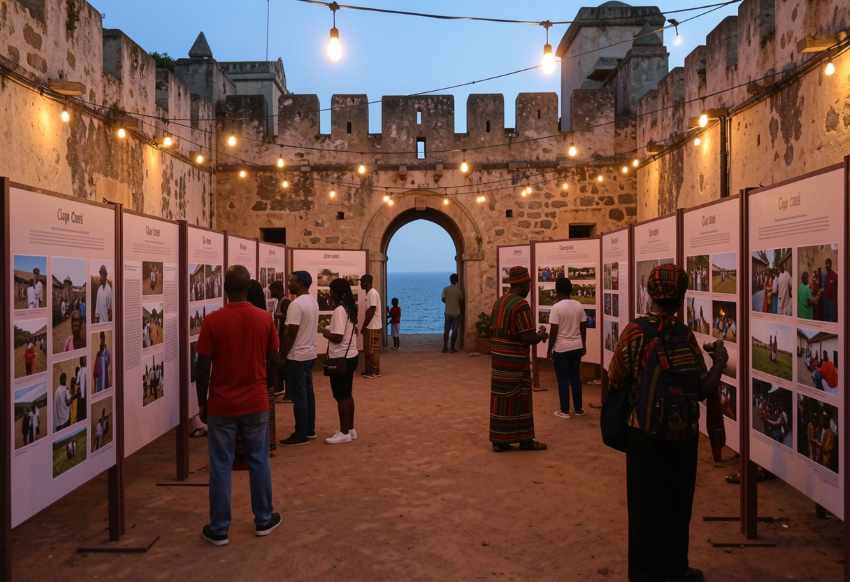
Image generated with Ai
In honour of Ghana Heritage Month 2026, the Centre for National Culture (CNC) and the Ghana Tourism Authority have formalised a significant cultural collaboration. This collaboration resulted in the “Black Star Experience Exhibition”, a large photographic showcase curated by Thomas Fynn, an internationally renowned photographer. This event was held at the historic Cape Coast Castle, which provided a poignant backdrop for a collection aimed at bridging the gap between Ghana’s storied past and its contemporary identity.
The exhibition was organised jointly by the Ministry of Tourism, Arts, and Culture and the National Commission on Culture. Regional directors noted that the CNC’s mandate is to promote the development and protection of the region’s cultural assets. As a result, the collaboration with Fynn was seen as a natural extension of this mission, given his lifelong commitment to documenting the Ghanaian experience through a professional lens.
Visual Chronicles of Leadership and Tradition
A vast array of photographic subjects was presented to the public, ranging from the foundational era of Ghana’s first president, Osagyefo Dr Kwame Nkrumah, to the administration of the current president, John Dramani Mahama. This political timeline was complemented by a deep dive into the sociological fabric of the nation. Images capturing intricate cultural beliefs, sacred rites of passage, and vibrant traditional festivals were displayed prominently.
Furthermore, the sensory heritage of the nation was represented through visual documentations of Ghanaian cuisine and funeral traditions, which remain integral to the country’s social structure. It was emphasized by colonial and regional heritage boards that the inclusion of archival imagery alongside modern captures allows for a comprehensive understanding of the nation’s evolution. The significance of using a medium such as photography was highlighted as a primary tool for cultural development, ensuring that historic events are not merely remembered but are visually preserved for future generations.
The Historic Significance of Cape Coast Castle
The choice of Cape Coast Castle as the exhibition’s site was lauded by various heritage and museum authorities. Although the structure was once utilized as a primary post for the trans-Atlantic slave trade, it has been repurposed as a centre for education and reflection. By hosting the “Black Star Experience” within these walls, a transformation of the space is achieved, where the site of past ordeals now serves as a vessel for the celebration of independence and resilience.
As a UNESCO World Heritage site, the castle attracts international scholars and tourists alike. It was suggested by local government representatives that the exhibition serves as a reminder of the journey undertaken since the independence of 1957. The castle stands as a silent witness to the shift from colonial struggle to the vibrant, sovereign nation celebrated during Ghana Month. This location reinforces the narrative of the “Black Star”, symbolizing the hope and honour of the African continent.
Advertisement
Advertisement
Five Decades Behind the Lens: Thomas Fynn’s Legacy
The 2026 exhibition was identified as a unique milestone, marking Thomas Fynn’s 50th year in the field of professional photography. The majority of the works displayed were captured by Fynn himself during his travels within Ghana and across international borders. His commitment to the craft was described as a national service, answering a call to project the nation’s diversity, sports, and political milestones to the world.
While official national honours have yet to be conferred upon him within his home country, Fynn’s global impact was acknowledged through his receipt of the “World Master of Art and Culture Award” in South Korea in 2010. It was suggested by attendees and organizers that the recognition of such pioneers is essential for the motivation of emerging photographers. The profession is encouraged to be viewed not merely as a hobby but as a vital educational medium that provides the visual evidence required for historical continuity.
Advertisement
Advertisement
Cape Coast: The Cradle of Ghanaian Politics and Tourism
During the keynote address, Cape Coast was described as both the citadel of tourism and the cradle of Ghanaian politics. The historical importance of the Aborigines Rights Protection Society, formed in 1897, was cited to remind visitors of the intellectual resistance against colonial land policies led by figures such as John Mensah Sarbah and J.E. Casely Hayford.
To further enhance the appeal of the region, several key tourist landmarks were highlighted, including the Fosu Lagoon, the London Bridge, and the John Evans Atta Mills Library. Pledges were made by local authorities to ensure that Cape Coast remains attractive to foreign investment through the rigorous maintenance of these sites and the promotion of enhanced sanitation policies. The goal of restoring the city to its position as a leading destination for international travellers remains a priority for the Central Region Development Commission.
Expanding the Horizons of Ghana Month
Beyond the photographic exhibition, a diverse schedule of programmes has been lined up for the remainder of Ghana Month. These include institutional dialogues centred on the promotion of indigenous culture and the exhibition of traditional Ghanaian cuisine. Musical performances and traditional dance displays are also scheduled to take place, providing a multi-sensory experience for visitors.
The resilience and natural beauty of the country are intended to be highlighted through these various events. It was noted by the presidency that the work of artists like Thomas Fynn is crucial in showcasing the cultural diversity that defines the nation. By integrating historical education with modern tourism, Ghana continues to position itself as a primary hub for heritage travel in West Africa.
Practical Information for Visitors
Visitors to Cape Coast during the 2026 season are encouraged to explore the heritage trails that connect the castle to other historic sites nearby, including Queen Victoria Park and the Nana Mbrah IV monument. The influx of visitors to the exhibition is expected to boost the local economy, and efforts are being made to ensure that international tourists have a seamless experience.
For those interested in the technical and artistic aspects of the exhibition, guided tours are available to explain the context of the archival pieces. The preservation of these images is seen as an important step towards educating the youth and providing a visual anchor for the national identity.
Advertisement
Advertisement