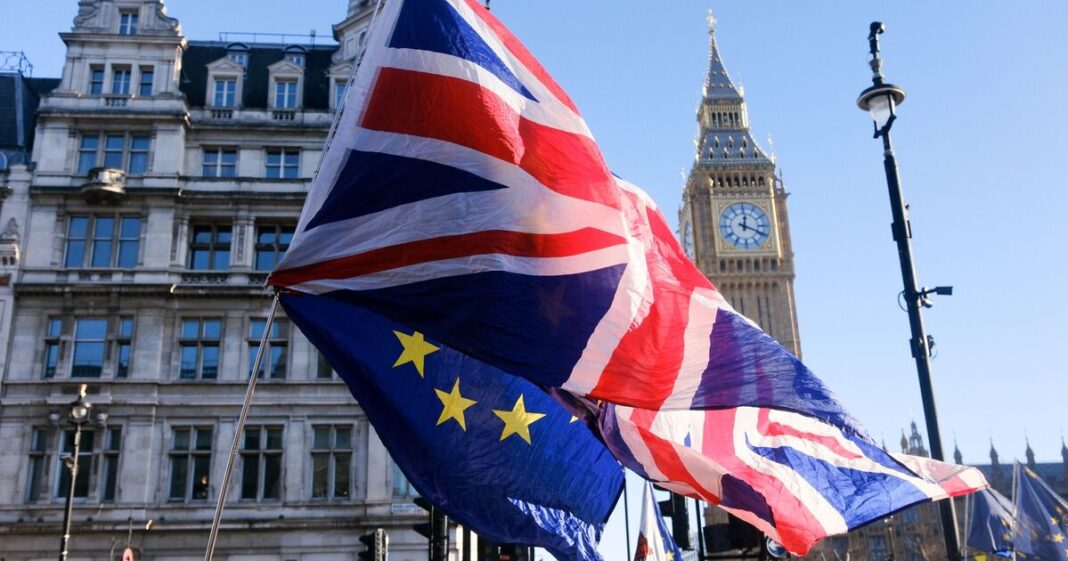

It is 10 years since the Brexit referendum (Image: Getty)
Brexit has had little overall impact on the UK economy and claims that leaving the EU caused a major hit to growth are not supported by the evidence, according to a bombshell new report. The study also challenges the widely held view that austerity after 2010 inflicted lasting damage on Britain’s economic performance, arguing that spending restraint was necessary to maintain confidence in the nation’s finances.
Economist Julian Jessop, an Economics Fellow at the Institute of Economic Affairs (IEA), examined the two events which are frequently blamed for Britain’s weak economic performance over the past 15 years. His research concludes that the evidence for either being a major drag on growth or productivity is much weaker than commonly assumed.
On Brexit, Mr Jessop argues that its economic impact has been exaggerated, pointing to what he describes as a “bewildering range” of estimates of the damage caused by leaving the EU.
The Office for Budget Responsibility’s assumption that Brexit would ultimately reduce productivity by 4% was based on an average of 13 external studies, the report says.
Nine of those studies suggested a smaller impact.
The OBR also assumed that Brexit would lead to a 15% reduction in Britain’s total trade in goods and services – something which the report says has simply not happened.
The study also takes aim at more recent research attempting to measure the economic consequences of Brexit.
A 2025 paper published by the National Bureau of Economic Research estimated that Brexit had reduced UK GDP per head by 8% when using economic “doppelgänger” comparisons, and by 6% using firm-level survey data.
Jacob Rees-Mogg Answers YOUR Brexit Questions | 10th Anniversary
But Mr Jessop argues these approaches cannot adequately separate Brexit from other factors affecting economic growth since the 2016 referendum.
The Covid pandemic and energy crisis, for example, affected countries in very different ways, while the US, Italy and Spain have benefited from domestic factors which have nothing to do with Brexit.
Instead, the report argues that the UK’s performance should be compared with individual countries with similar characteristics and at similar points in the economic cycle.
On that basis, the UK has continued to perform similarly to countries including France, Germany and Canada.
The report therefore concludes that Brexit has “largely been a non-event in macroeconomic terms”.
Mr Jessop argues this is unsurprising because “relatively little has actually changed”.
Our community members are treated to special offers, promotions, and adverts from us and our partners. You can check out at any time. Read our Privacy Policy
The research acknowledges that leaving the EU did bring some initial economic costs, including disruption to labour markets and weaker business investment.
However, it says those pressures are already fading as uncertainty has eased and companies adapt to the new arrangements.
The report also challenges descriptions of the post-2010 period as one of “savage cuts”.
Public spending was broadly held steady in real terms between 2010-11 and 2019-20, according to the research.
The fall in spending as a proportion of GDP largely returned it to levels that had been normal before the global financial crisis.
The period was also marked by relatively rapid growth in public services productivity.
Meanwhile, fiscal consolidation helped bring the annual budget deficit down from 8.7% to 2.6% of GDP, while the cyclically-adjusted current budget deficit was nearly eliminated.
Mr Jessop does acknowledge that capital budgets suffered larger reductions, arguing that cuts to environmental protection, defence and justice now appear short-sighted.
But he rejects the idea that simply spending more would necessarily have delivered stronger growth, warning that a major public works programme could have been as wasteful as HS2.
Mr Jessop said: “Austerity and Brexit have become convenient scapegoats for problems that have much deeper roots.”
He added that it was time to stop blaming the two events and instead have a “more honest conversation” about what is really holding the UK economy back.
The briefing forms part of the IEA’s wider series examining Britain’s “Great Stagnation”, with further papers due in the coming weeks before the research is compiled into a book scheduled for publication in September.