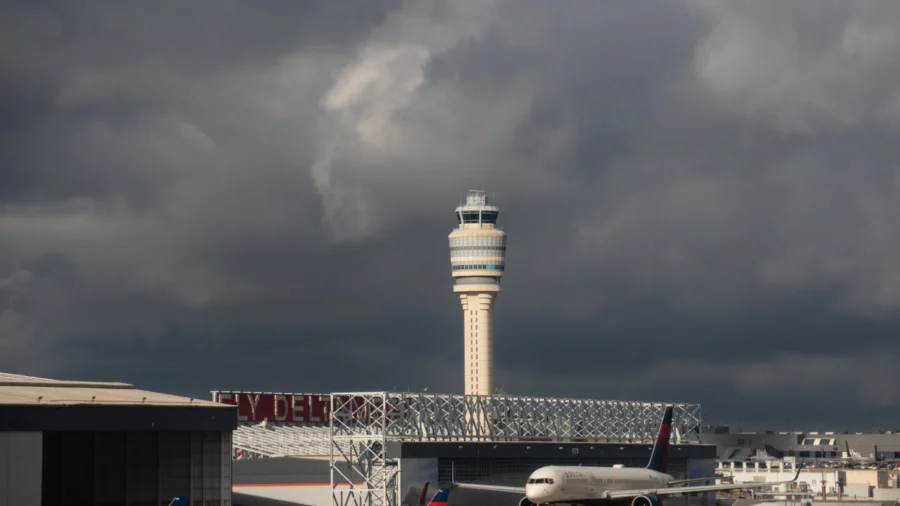
The Department of Transportation (DOT) announced on May 15 that it is investing more than $750 million in installing new, state-of-the-art air traffic control facilities across eight airport locations in the United States.
The funds will be used to replace air traffic control towers and Terminal Radar Approach Controls in Charleston and Greer sites in South Carolina, Sacramento and San Jose in California, Grand Forks in North Dakota, Lawton in Oklahoma, Pocatello in Idaho, and Tamiami in Florida, the DOT said in a statement.
The Federal Aviation Administration (FAA) “chose the replacement locations based on the safety and efficiency needs of the nation’s airspace system. Many air traffic facilities are decades old. Failing infrastructure such as HVAC systems, pest issues, and leaking roofs have led to interruptions in providing air traffic services.”
Moreover, the FAA will invest $85.8 million to upgrade Federal Contract Towers (FCT) at 41 airports in 24 states. The FCT grant program provides $20 million per year over a five-year period to improve infrastructure, modernize towers, and install crucial air traffic control and communications equipment at federal contract towers.
Some of the airports set for these upgrades include Wiley Post Airport in Oklahoma, Acadiana Regional Airport in Louisiana, Marana Regional Airport in Arizona, and Missoula County Airport in Montana.
“This administration is laser focused on ushering in the Golden Age of Transportation and investing in our aging air traffic control towers is critical to that mission,” Transportation Secretary Sean P. Duffy said.
“We need a system and supporting infrastructure that is built for the future to attract top talent for our air traffic control workforce.”
Specifically, the bill allocated $4.75 billion for modernizing telecom infrastructure and upgrading relevant systems, $3 billion for replacing radar systems, and $1 billion for terminal radar approach control facilities.
At the time, Nicholas E. Calio, the president of Airlines for America, praised Trump for following through on his promise to address America’s aging air traffic control systems.
Earlier in March 2025, Heather Krause, managing director of physical infrastructure at the Government Accountability Office (GAO), had testified before a House subcommittee that the FAA needed to act “urgently” to modernize aviation systems.
An evaluation of air traffic control systems conducted by the FAA following a shutdown of the national airspace in 2023 due to an outage of these systems found major issues, Krause said.
Accidents and Operational Issues
In March this year, a fatal collision occurred between an Air Canada regional jet and a fire truck at the LaGuardia Airport in New York after a critical runway warning system failed to trigger an alarm prior to the accident.
Shawn Pruchnicki, a safety expert, former pilot, and aviation professor at The Ohio State University, said that some of the radios have caused headaches for pilots who fly their planes into busy airspaces.
The number one problem, according to Pruchnicki, is that there is only a single channel for communications for air traffic controllers and pilots, wherein only one person can talk at a time. It can “become problematic” when many pilots want to speak on congested radio channels.
Following the $12.5 billion funding allocation under the One Big Beautiful Bill, the FAA announced on Dec. 4, 2025, its plan to replace the current air traffic control system and to implement a brand new one by the end of 2028.
The new system will replace outdated infrastructure and will include 5,170 high-speed fiber, satellite, and wireless network connections, 27,625 radios, 612 radars, 462 digital voice switches, new Enterprise Information Display Systems at 435 airports, and Surface Awareness Initiative surveillance technologies across 200 airports.
Most of the work will take place simultaneously across the country. According to the FAA, additional funding of $20 billion will be required to complete the program.
In a May 12 post on X, Duffy also announced upgrading the Notice to Airmen (NOTAM) system, which alerts pilots about airspace, weather, and runway closures.
Jacob Burg contributed to this report.