Gangster movies are never really about crime. Scarface was about ambition eating itself alive. The Godfather was about family, loyalty, and the slow poison of power. It was a Shakespearean tragedy dressed in pinstripes and cigars. Those two movies painted a template for the genre, and for decades, everything that followed either nodded at them or tried to escape their shadow. Some did both at the same time.
Then the 21st century rolled in, and the gangster genre stopped being purely American. It went to Mumbai, to Rio’s favelas, to the streets of Naples, and to Copenhagen’s gritty underbelly. While directors like Martin Scorsese kept refining the form, a new wave of filmmakers, like Anurag Kashyap, Fernando Meirelles, and Matteo Garrone, blew the doors off what the genre was even allowed to look like. This list covers the 10 movies that stuck with me. They are the ones I’ve rewatched at odd hours, recommended to people who didn’t ask, and thought about long after the credits rolled. Narrowing it down to 10 wasn’t easy, which tells you something about how this era has been so far.
10
‘Sexy Beast’ (2000)
Directed by Jonathan Glazer

Retired safecracker Gal Dove has made a quiet life for himself in the Spanish sun – pool, tan, wife who loves him, the whole fantasy. Then Don Logan shows up. Sexy Beast isn’t really a heist movie, and it’s barely a crime movie in the traditional sense. It’s a movie about a man who is psychologically dismantled by another man’s sheer force of will. The confrontations between Gal and Don Logan are truly charged.
Ben Kingsley’s performance as Don Logan made people forget they had only ever seen him as Gandhi. He plays Logan as a bundle of naked, incandescent aggression. He’s restless, petty, and inexplicably terrifying in every mundane moment. There’s a dinner scene where Logan refuses to say yes, just repeating “no, no, no” while everyone around him shrinks, and it’s more uncomfortable than most horror movies. Jonathan Glazer’s direction is dense with dream sequences and Spanish heat rendered sinister, and it absolutely works.
9
‘Gomorrah’ (2008)
Directed by Matteo Garrone

Forget everything the word “mafia” conjures. Gomorrah isn’t about dons in dark rooms or codes of honor or men who kiss each other on the cheek before ordering hits. Based on Robert Saviano’s investigative book about the Neapolitan Camorra, it follows five interlocking stories, such as a teenager running errands, or two kids playing at being Tony Montana. It also depicts organized crime as something grotesque, unglamorous, provincial, and irredeemably stupid.
Gomorrah won the Grand Prix at Cannes and was selected as Italy’s submission for the Academy Awards. It’s actually a gut punch. Garrone shot the film on location in the Scampia housing projects, with much of the cast made up of locals, and the effect is neorealist in the best sense. The two teenage boys who spend the movie’s runtime larking about with stolen guns, imitating Scarface, are the most devastating thread, and the end of their story is shocking because of how unsentimental it is.
8
‘Gangs of New York’ (2002)
Directed by Martin Scorsese

Scorsese spent almost three decades trying to make Gangs of New York, and the weight of that ambition is visible in every frame. Set in the Five Points neighborhood of 1860s Manhattan (arguably the most lawless stretch of American urban history), it follows Amsterdam Vallon’s return to the neighborhood where his father was murdered. It’s both a revenge story and an origin story of New York itself as a place born in violence.
At the center is Daniel Day-Lewis as Bill “The Butcher” Cutting. The character has become one of cinema’s greatest villains because he’s evil in a conventional sense and has a warped, coherent worldview that the movie treats seriously. He loves his neighborhood, he hates what he perceives as the dilution of it, and he’s a nativist monster. Day-Lewis found something almost Shakespearean in him. While Leonardo DiCaprio holds his own here, Cameron Diaz is the weakest link in an otherwise impressive cast.
7
‘Pusher II’ (2004)
Directed by Nicolas Winding Refn
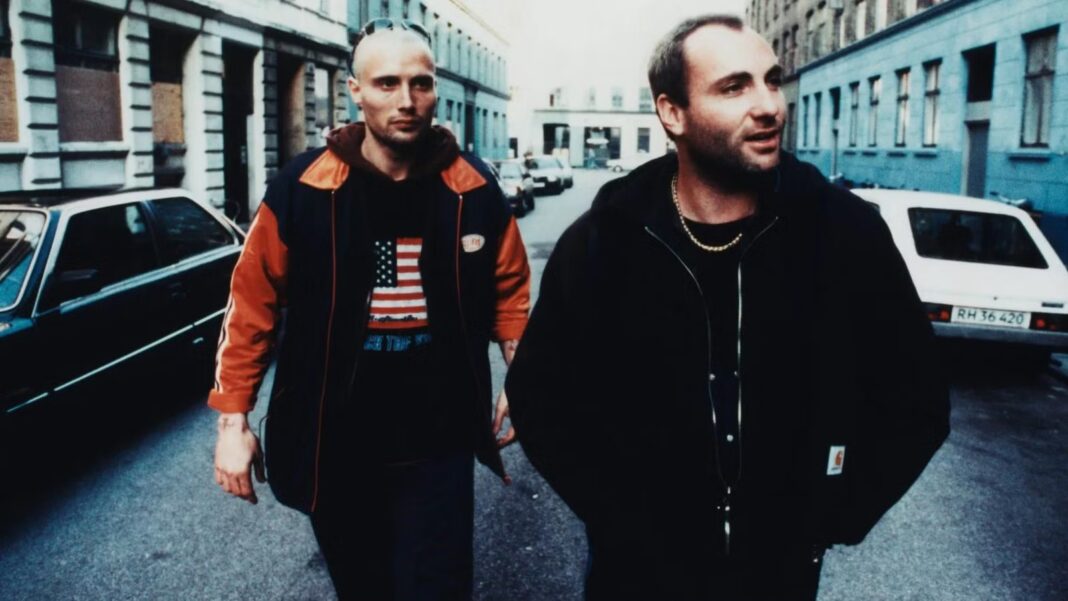
Nicolas Winding Refn made three Pusher movies, and the collective opinion (which I think is correct) is that the second one is a masterpiece. Pusher II: With Blood on My Hands follows Tonny, a small-time criminal and colossal screw-up who has just been released from prison. When he returns to Copenhagen, hoping to earn respect from his crime-lord father, his father thinks he’s an idiot. Then he finds out he has a son he didn’t know about, and the narrative becomes much more interesting than simply a crime story.
Mads Mikkelsen played Tonny before Casino Royale, before Hannibal, and before the world caught up to him. Watching it now, you have this eerie sensation of seeing a great actor operating without a safety net. Tonny has Mikkelsen’s cheekbones and none of his elegance. He’s dim-eyed and tattooed with “RESPECT” across the back of his skull (the irony is not subtle), and he shambles through the movie in a permanent state of bewildered resentment. Refn makes you feel the weight of a man’s need to be loved by someone who finds him worthless, and that’s a sentiment a lot of us can relate to.
6
‘City of God’ (2002)
Directed by Fernando Meirelles & Kátia Lund
I remember watching City of God for the first time, and feeling shattered because it was so violent and so alive. The movie is based on Paulo Lins’ novel about the Cidade de Deus housing project in Rio de Janeiro. It follows two decades of drug war in one of the world’s most dangerous neighborhoods, as seen through the eyes of Rocket, a kid who wants to be a photographer. The contrast between Rocket’s arc and that of his childhood friend, Lil Zé, who becomes a feared drug lord, is the spine of the story.
“The Apartment That Bleeds” sequence established Meirelles as one of the decade’s best directors. Meirelles and Kátia Lund shot with a non-professional cast of local kids, and it gives the movie a unique texture. While Alexandre Rodrigues as Rocket is wonderful, Leandro Firmino as Lil Zé is terrifying. City of God won four BAFTA awards and earned four Academy Award nominations, and it basically reconfigured what international crime cinema could achieve.
5
‘Eastern Promises’ (2007)
Directed by David Cronenberg

A teenage girl dies in a London hospital after giving birth, leaving behind a diary in Russian. Anna (Naomi Watts), the midwife who delivered her baby, starts pulling a thread which leads to the Vory v Zakone, the Russian mob operating out of a family restaurant in North London. Eastern Promises is David Cronenberg doing what he does best: making a film that is propulsive and conventional on the surface, but much colder and stranger underneath.
Viggo Mortensen won an Oscar nomination for his turn as Nikolai, a driver and fixer for the mob who may or may not be something more. He barely raises his voice in the entire movie. There’s a startling bathhouse fight scene in which two men attack a naked Nikolai with knives. It’s brutal, unglamorous, staged with zero heroics, and just ugly and desperate. Overall, Eastern Promises is a movie where nothing is as it seems, and Cronenberg trusts you to sit with that misdirection.
4
‘American Gangster’ (2007)
Directed by Ridley Scott
Directed by Ridley Scott, American Gangster tells the true story of Frank Lucas, a Harlem drug lord who fabricated a heroin empire in the late 1960s. He cut out the middlemen and sourced products directly from Southeast Asia, smuggled in the coffins of dead American soldiers. The story is too cinematic to be real, and Scott doesn’t waste that irony. The movie tells parallel stories of Lucas (Denzel Washington) and the detective hunting him (Russell Crowe) with a lot of confidence.
Washington is intense here. He played Lucas as disciplined and domestic, a man who demands invisibility. Early on in the movie, he reprimands his brother for wearing a flashy fur coat at a boxing match, explaining that the loudest person in the room is always the weakest. Later, Lucas himself shows up in a chinchilla coat, and you realize the movie is charting the exact arc of his unraveling. Russell Crowe brought style and grit to a role that could easily have felt functional. Most importantly, Scott shot Harlem in the early 1970s with nostalgic warmth, so the violence lands even harder.
3
‘The Irishman’ (2019)
Directed by Martin Scorsese

While Martin Scorsese has been making crime movies for 50 years, The Irishman feels like the one movie he made for himself. It’s a three-and-a-half-hour reckoning with everything the genre has celebrated and everything it has conveniently left out. Based on Charles Brandt’s book, I Heard You Paint Houses, it follows Frank Sheeran (Robert De Niro), a truck driver turned mob hitman and Teamsters official. He narrates his life from old age, including his alleged role in the 1975 disappearance of Jimmy Hoffa.
The Irishman is a movie about time, loyalty, and the hollowness of a life lived in service to men who never valued you. In the final act, Frank is in a nursing home, estranged from his daughter and visited by a priest who can’t quite understand what he’s trying to confess. It’s easily among the most traumatic things Scorsese has ever put on screen. This is not the director of Goodfellas. He’s more interested in silences than set pieces. While digital de-aging technology drew most of the pre-release conversation, the emotional weight swallowed that discourse.
2
‘Gangs of Wasseypur’ (2012)
Directed by Anurag Kashyap

Five and a half hours across two parts, spanning five decades, three generations of warring families, and a coal mining town in Jharkhand that functions as its own closed world with its own laws. And that’s just the gist. Gangs of Wasseypur is the most ambitious Indian movie of the century so far. Anurag Kashyap made it after years of battling the industry, and the resulting product is chaotic and overflowing and sometimes recklessly alive. However, it refuses to slow down.
The saga begins with Shahid Khan, a petty thief who gets on the wrong side of a powerful coal baron named Ramadhir Singh. The conflict escalates through his son Sardar (Manoj Bajpayee, who has never been better), and then his grandson Faizal (Nawazuddin Siddiqui, who broke out here). The political tension is dense; there’s mention of the caste system, colonial-era land structures, Emergency-era corruption, and the local economy of violence. While Gangs of Wasseypur earns a spot on this list partly from my personal bias, if you’re among the very few people still sleeping on these two movies, I suggest you change that soon.
1
‘The Departed’ (2006)
Directed by Martin Scorsese
Yes, Scorsese is on this list three times. No, I’m not sorry. The Departed is his remake of the 2002 Hong Kong thriller Infernal Affairs. The movie is about an undercover cop in the mob and a mob mole in the police, each hunting the other without knowing who they’re hunting. Scorsese executed this perfect premise with the kind of filmmaking confidence that makes you feel embarrassed to be watching anything else. Set in Boston, it follows Billy Costigan (Leonardo DiCaprio) deep into the Irish mob run by Frank Costello (Jack Nicholson), and Colin Sullivan (Matt Damon) deep into the state police.
The Departed won Best Picture, Best Director, Best Adapted Screenplay, and Best Film Editing at the 79th Academy Awards. The awards validated a career’s worth of nominations that came to nothing, and the reaction at the time was something similar to a collective exhale from people who had been waiting 20 years for the Academy to catch up to Scorsese. What I keep coming back to, though, are the performances. Mark Wahlberg’s Dignam is incredible, and Alec Baldwin’s Captain Ellerby is impeccable. Jack Nicholson is, divisively, huge. Some find Costello cartoonish, but I think the point is that psychopathy, after a certain point, starts to look exactly like this.
10 spots were never going to be enough. Movies like Snatch, A Prophet, Animal Kingdom, Killing Them Softly, No Country for Old Men, and Sicario could have been here. Also, the century is still young, and Anurag Kashyap has more films in him. So does Scorsese, presumably. What’s your favorite gangster movie of the last 26 years? Comment below.