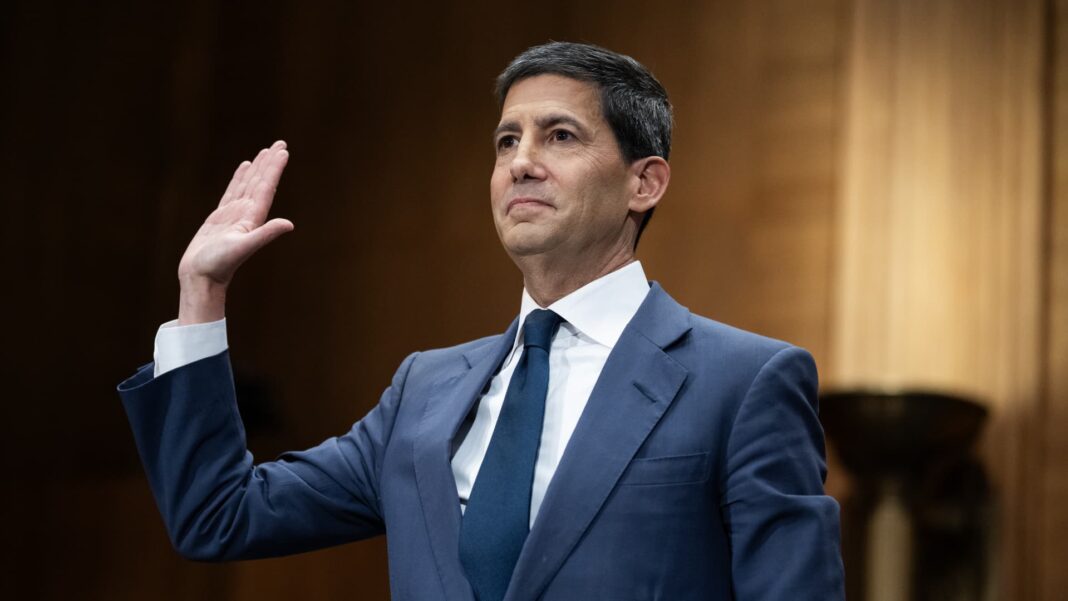
Kevin Warsh, nominee for chairman of the Federal Reserve, is sworn in to his Senate Banking, Housing and Urban Affairs Committee confirmation hearing in Dirksen building on Tuesday, April 21, 2026.
Tom Williams | Cq-roll Call, Inc. | Getty Images
It has taken eight and a half years, but on Wednesday President Donald Trump finally succeeded in reversing one of the few mistakes he has admitted to making as president. In November 2017, Trump chose Jerome Powell to chair the Federal Reserve, opting for someone he saw as malleable over a charismatic but youthful former Fed governor, Kevin Warsh. Trump has regretted it ever since.
The question that has consumed the markets as the Senate moved toward Wednesday’s confirmation is whether Trump will come to regret this decision, too. Fed chairs “change once they get the job,” Trump said in January. If Warsh loses Trump’s backing, the new Fed chair may not have the bulwark of congressional support that helped Powell resist Trump.
Whether Warsh can succeed in the mission of “regime change” he has pledged for the Fed will hinge on his ability to navigate this exceptionally challenging political landscape. But while he starts his tenure at a significant political disadvantage compared to Powell, Warsh’s history and his relationship with Trump suggest the new chair is more likely to blaze an independent trail than his detractors believe. And he may do so in a collaborative way that would surprise those who are bracing for immediate friction.
Warsh, 56, was confirmed Wednesday with just 54 votes, with Sen. John Fetterman of Pennsylvania as the only Democratic “yes” vote. That’s the weakest support a Fed chair has received since the position became Senate-confirmed in 1977. The previous record low was held by Democrat-nominated Janet Yellen, who received 56 votes in 2014, including 11 from Republicans.
Among those who voted against Warsh this time was Minority Leader Sen. Chuck Schumer, D-N.Y. That is a reversal from 2006, when Schumer backed Warsh for a Fed governorship because Warsh “knows unequivocally that the Fed must be independent, nonideological, and nonpartisan.” Warsh was confirmed unanimously that year.
Powell found a vital ally in the Senate in the face of Trump’s attacks. Sen. Thom Tillis, R-N.C., threatened to delay Warsh’s confirmation until the Department of Justice dropped a criminal investigation into the Fed. U.S. Attorney for the District of Columbia Jeanine Pirro did so in April, clearing the way for Warsh.
“Powell met more than twice as often with U.S. senators than his predecessors,” University of Maryland researchers who studied Fed chairs’ calendars found in a study published in April.
Many longtime Fed watchers have already written off Warsh as a lost cause, because they seem him as either deluded in thinking he can sway the Fed’s hardened bureaucracy or because he is a mere “sock puppet” for Trump, as Sen. Elizabeth Warren, D-Mass., Warsh’s most prominent progressive critic, calls him.
But Warsh isn’t a bystander who lucked his way into arguably the economy’s most influential role. Trump wrestled publicly with whether to give him the job. He offered the Fed position to Scott Bessent, now treasury secretary, before he had even won the 2024 election.
Last year, Warsh advised Trump not to fire Powell, a decision that would likely have benefitted Warsh personally at the expense of the Fed’s credibility. He went on to win Trump’s nomination in January amid a whisper campaign that his record of concern about inflation and worries about tariffs made him a poor match for this president.
To be sure, Warsh is no one’s idea of a liberal. He has been publicly conservative since he ran successfully for president of Stanford University’s student Senate. He went on to work as a research assistant for his intellectual idol, the archconservative economist Milton Friedman. But more than his ideology, it is Warsh’s ability to connect his set of beliefs to others’ ideas and ambitions that makes him politically potent, said John Cogan, a Stanford economist who taught Warsh as an undergraduate and now counts him as a friend.
“I’ve known him as a person who is able to understand other points of view and one who is willing to find common ground,” Cogan said.
Warsh will need to immediately put his skills as a political operator to work, both within and outside the Fed’s walls.
Inside the Fed, Warsh will need to bring around a committee of interest-rate voters who are alarmed by the risk of resurgent inflation. The consumer price index jumped to 3.8% in April, federal-government data released this week showed, driven by the Iran war’s energy shock. Even stripping away volatile energy prices, so-called core inflation has now risen for three straight months, leading some Fed members to worry they haven’t set interest rates high enough to restrain price increases regardless of what is happening in the Middle East.
Cutting interest rates may be a tall order
There will be little appetite on the Fed to deliver the quick rate cut that Trump has demanded. The president said recently he would be disappointed if Warsh can’t deliver it.
Warsh told senators during his confirmation hearing that he never promised Trump he could. And he has framed his mission as Fed chair around the idea that the central bank has been overly obsessed with the minutiae of short-term economic data at the expense of resetting its credibility with the markets.
The evidence for that lost credibility shows up in inflation expectations, in Warsh’s view: Neither market participants nor consumers surveyed by the Fed expect inflation to return to the Fed’s 2% goal within five years.
Warsh will try to reset those expectations by getting the Fed out of the business of committing to where interest rates will go in the form of forward guidance, revamping communications so that the institution speaks more with one voice, updating the data sources the Fed relies on, and striking a new bargain with the Treasury Department about how the two share responsibility for managing the economy.
Can Warsh put that all through and deliver the rate cut Trump expects? The market doesn’t think so, assigning him a 1% chance of getting rates down this year, according to CME FedWatch.
There is a distinct possibility that Trump will explode if Warsh fails in June to put through cuts. But that idea assumes passivity from Warsh. The other option is that the Fed chair who has spent nearly a decade preparing for this moment will continue to persuade the president that he can deliver the golden era Trump so desperately wants. It would hardly be the first time Trump pivoted suddenly toward a politically convenient idea when it comes from someone he trusts.
Warsh’s divided support may say more about how the nation has changed than his politics. His pitch has been that he understands better than anyone how to ensure the Fed’s lasting influence as a stabilizing force for Americans’ livelihoods despite the broader political deterioration.
He now has the chance to prove himself. If he fails, a bulwark of U.S. economic strength will decline with him.