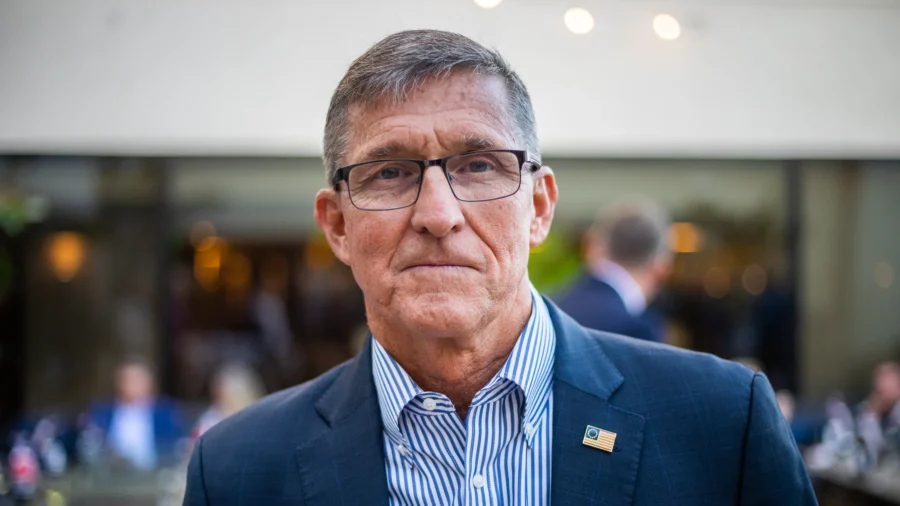
The Department of Justice (DOJ) and retired Lt. Gen. Michael Flynn, a former national security adviser in President Donald Trump’s first term, reached an undisclosed financial settlement Wednesday, according to court documents.
Once Flynn has confirmed receipt of the settlement funds, he and the DOJ will file a joint dismissal of the case with prejudice, with each party bearing its own costs and fees, the agreement shows.
The former Trump adviser’s lawyers did not immediately respond to a request for comment.
A DOJ spokesperson provided an emailed statement to The Epoch Times, stating that Wednesday’s settlement is an important step in redressing a “historic injustice,” referring to the allegations of Russia collusion in 2016 and the prosecution of Flynn that resulted.
“Those who instigated the Russia Collusion Hoax and Crossfire Hurricane abused their power to mislead the American people and tarnish the reputations of President Trump and his supporters,” the DOJ’s statement said.
Crossfire Hurricane was the codename of the FBI investigation into the later-discredited claims of ties between Trump and Russia to influence the 2016 election.
Flynn, a former head of the Defense Intelligence Agency (DIA) under the Obama administration, was investigated by the FBI beginning in August 2016 over alleged ties to Russia. In January 2017, he was interviewed by two FBI agents and asked about a conversation with a Russian official. At first, he denied the conversation, which was not the truth, then said he didn’t remember. Intelligence officials and others later concluded that the conversation did not involve collusion or illegality.
Flynn initially pleaded guilty but then withdrew that plea, claiming he did not intentionally lie and was misled by his attorneys to enter the guilty plea because prosecutors threatened legal action against his son.
Internal emails from Flynn’s first legal team showed this was true—prosecutors informed his legal team that Flynn’s son would be left alone if he signed the guilty plea.
In 2020, then-head of the District of Columbia U.S. Attorney’s Office Timothy Shea concluded that it seemed the FBI’s purpose for interviewing Flynn was to “elicit … false statements and thereby criminalize Mr. Flynn.”
The DOJ eventually dropped the charge, but the judge overseeing Flynn’s case refused to dismiss it. Trump ultimately pardoned him in 2020.
In 2023, Flynn filed a lawsuit against the DOJ and FBI, accusing prosecutors from Mueller’s office of investigating and prosecuting him for political reasons.
“General Flynn—who already had a reputation as a hands-on disruptor at DIA, who had publicly excoriated the politicization of the intelligence community, and who had made clear his desire to overhaul the national security structure and the ‘interagency process’—was a direct threat, not only to the self-interest of entrenched intelligence bureaucracies and the federal officials involved, but to exposing their prior and ongoing efforts to derail and discredit President Trump,” the suit stated.
Aside from accusations of a malicious, politically motivated prosecution, Flynn’s suit also accused the government of abusing the legal process by coercing him into the guilty plea with threats of prosecution against his son.
“He was falsely branded as a traitor to his country,” according to the lawsuit.
The suit against the government, which included as defendants the FBI, DOJ, Executive Office of the President, Office of Special Counsel, former FBI Director James Comey, Mueller, and others, further claimed Flynn lost tens of millions of dollars as a result of the prosecution.
“[Trump’s] Department of Justice will continue to pursue accountability at all levels for this wrongdoing,” the DOJ’s emailed statement said. “Such weaponization of the federal government must never be allowed to happen again.”