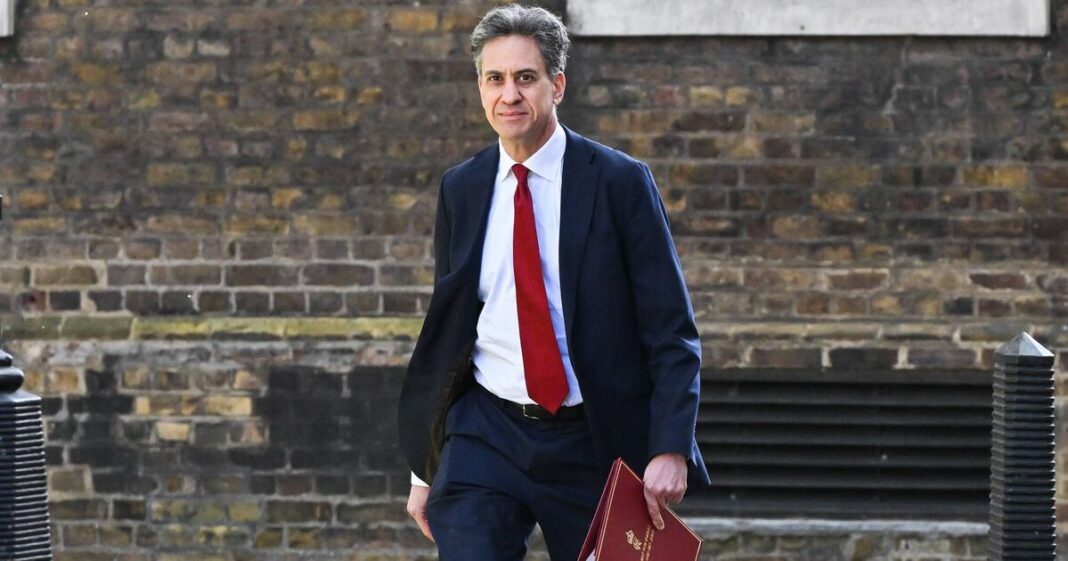

Secretary of State for Energy Security and Net Zero Ed Miliband (Image: Wiktor Szymanowicz, Wiktor Szymanowicz/Future Publishing via Getty Images)
Britain has itself to blame for suffering the sharpest G7 downgrade by the International Monetary Fund (IMF) with Ed Miliband and Labour’s net-zero agenda leaving the UK exposed, an expert has warned. The IMF cut the UK’s growth forecast from 1.3% to just 0.8%, sending a clear warning signal as global tensions rise and energy markets remain volatile amid the ongoing Middle East conflict.
While many advanced economies are facing pressure, one expert suggests the UK is particularly exposed due to its reliance on international energy markets at a time of heightened geopolitical risk. That exposure has left policymakers facing an increasingly difficult balancing act, with the Bank of England caught between tackling inflation driven by rising energy costs and supporting an already fragile economy.
Secretary of State for Energy Security and Net Zero, Ed Miliband, is driving an agenda to achieve clean power by 2030, aiming for net-zero emissions by 2050.
Speaking this week as the Government-owned firm Great British Energy – Nuclear (GBE-N) announced a deal with a firm owned by engineering giant Rolls-Royce, allowing work to start immediately on creating three small modular reactors (SMRs), he said that reducing the UK’s exposure to volatile fossil fuel markets was the “unavoidable lesson of this war”.
“That is why this Government is doubling down, not backing down, on our clean power mission, drive for renewables and nuclear,” he said.
“We’re ending years of delay with the biggest nuclear building programme in half a century from Sizewell C to this first fleet of SMRs.”

Tony Redondo (Image: Tony Redondo/Newspage)
Read more: UK drivers given dates for ‘petrol and diesel shortages and price rises’
Read more: RAC says petrol and diesel ‘should fall by several pence a litre’
But one expert argued that the government has doubled down on long-term ambitions for energy security without securing short-term stability, leaving the UK uniquely vulnerable when global shocks hit.
Tony Redondo, founder at Newquay-based Cosmos Currency Exchange, said the downgrade should be seen as a wake-up call, but Britain has itself to blame.
He added: “The IMF’s April 2026 World Economic Outlook has sent a tremor through the UK’s financial landscape. Britain suffered the sharpest G7 downgrade, from 1.3% to 0.8%, a vulnerability of its own making, with Miliband’s Net Zero agenda leaving it uniquely exposed to global energy volatility and escalating Middle East hostilities.
“Britain has itself to blame. The Bank of England is caught in a stagflationary bind, forced to fight war-driven inflation without crushing an already fragile economy.”
Mr Redondo warned that without a shift in strategy, the outlook could worsen further – particularly if energy prices continue to climb. In effect, he said, Britain was being squeezed from both sides, rising costs on one hand and stagnating growth on the other.
This is not simply bad luck – it is the consequence of years of policy missteps and a failure to prioritise energy resilience, Mr Redondo said.
He continued: “To reverse course, the government must confront cold reality: radical energy decoupling is now a national security imperative. North Sea oil and gas fields must be reopened and nuclear projects accelerated to sever dependence on overseas energy markets.
“Without decisive action, 0.8% looks optimistic. Should conflict drive oil above $100 and remain there, the UK’s middling growth could slide into a painful and prolonged contraction.”